
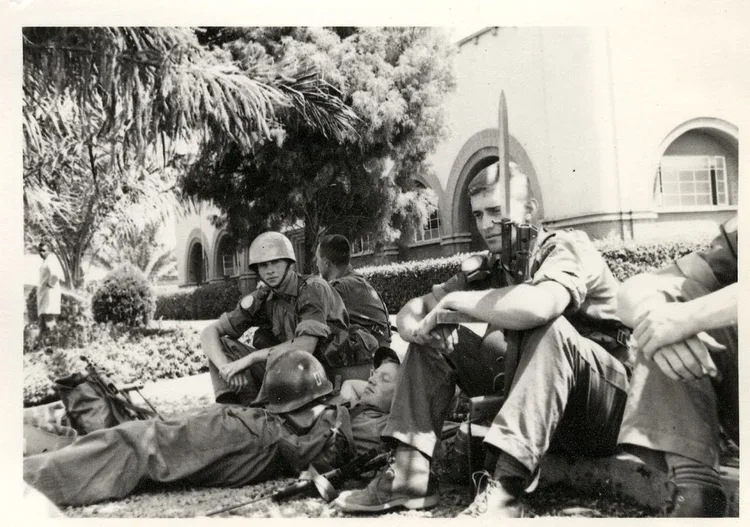
AFTER THE BATTLE
Photo: Lars Frost
The reactions of individual soldiers after taking part in combat are probably as varied as the soldiers themselves. When, in addition, the person who was your enemy yesterday becomes your friend today, only to become your enemy once again, it is understandably extremely difficult for an individual soldier to come to terms with.
Under these circumstances, the expectations placed upon UN soldiers regarding their attitudes towards former adversaries and the people around them are exceptionally high.
It was against this background that Battalion Commander Colonel Jonas Waern wrote the following words (see accompanying images) in the battalion magazine Djungeltelegrafen (“The Jungle Telegraph”) in October 1961, just over a month after the fierce fighting in Elisabethville in the Congo that September.
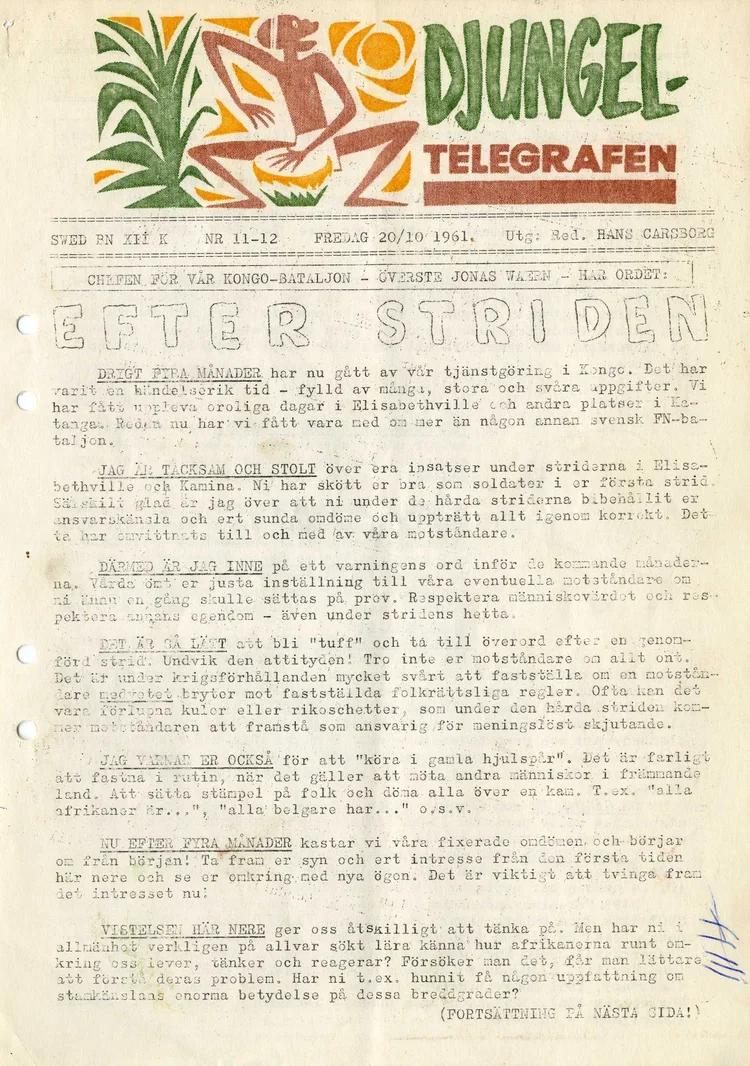
THE JUNGLE TELEGRAPH
SWEDISH BATTALION XII K — NO. 11–12 — FRIDAY, 20 OCTOBER 1961
Editor: Hans Carsborg
THE COMMANDER OF OUR CONGO BATTALION — COLONEL JONAS WAERN — HAS THE FLOOR:
AFTER THE BATTLE
JUST OVER FOUR MONTHS have now passed since we began our service in the Congo. It has been an eventful period, filled with many important and difficult tasks. We have experienced troubled days in Elisabethville and elsewhere in Katanga. Already, we have been through more than any other Swedish UN battalion.
I AM GRATEFUL AND PROUD of your efforts during the fighting in Elisabethville and Kamina. You have acquitted yourselves well as soldiers in your first experience of combat. I am particularly pleased that, even during the fiercest fighting, you maintained your sense of responsibility and sound judgement, and conducted yourselves correctly throughout. This has earned us respect even from our fiercest adversaries.
THIS BRINGS ME to a word of warning concerning the months ahead. Cherish and preserve your fair-minded attitude towards those who may become our adversaries, should you once again be put to the test. Respect human dignity and the property of others — even in the heat of battle.
IT IS ALL TOO EASY to become “tough” and resort to boastful talk after having been through combat. Avoid that attitude! Do not assume the worst of your adversaries. In wartime conditions, it is often extremely difficult to establish whether an opponent has actually violated the established rules of international law. Stray bullets or ricochets can often make an adversary appear responsible for indiscriminate shooting during fierce fighting.
I ALSO WARN YOU against falling into old habits. It is dangerous to become set in your ways when dealing with people in a foreign country — to label people and judge everyone alike. For example, “All Africans are...” or “All Belgians have...” and so forth.
NOW, AFTER FOUR MONTHS, let us cast aside our preconceived opinions and make a fresh start! Rediscover the curiosity and interest you felt when you first arrived here, and look around you with fresh eyes. It is important to make a conscious effort to rekindle that interest now!
OUR TIME HERE offers us a special opportunity for reflection. But have you really made a serious effort to understand how the Africans around us live, think and react? If you make that effort, you will find it easier to understand their problems. Have you, for example, begun to appreciate the enormous importance of tribal identity in this part of the world?
(CONTINUED ON THE NEXT PAGE!)
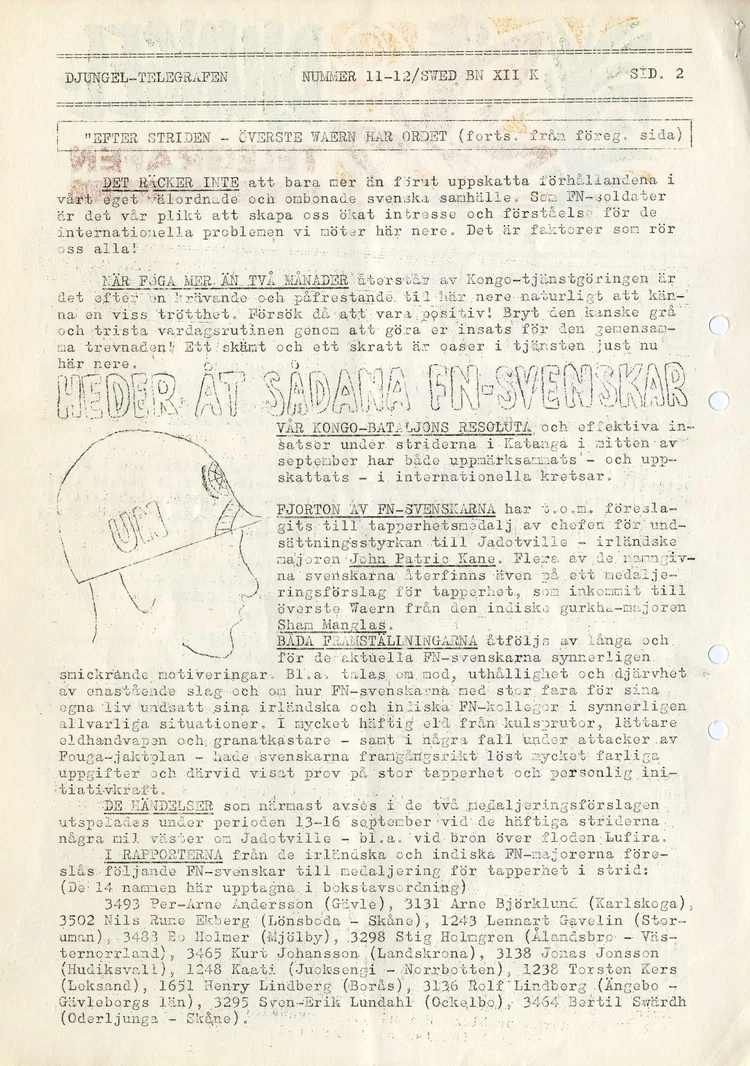
THE JUNGLE TELEGRAPH
ISSUE 11–12 / SWEDISH BATTALION XII K — PAGE 2
“AFTER THE BATTLE – COLONEL WAERN HAS THE FLOOR” (continued from previous page)
IT IS NOT ENOUGH merely to appreciate, more than we did before, the conditions in our own well-ordered and comfortable Swedish society. As UN soldiers, it is our duty to develop a greater interest in and understanding of the international problems we encounter here in the Congo. These are matters that concern us all!
WITH LITTLE MORE THAN TWO MONTHS of our service in the Congo remaining, it is only natural to feel a certain weariness after such a demanding and exhausting period here. But try to remain positive! Break the perhaps dull and monotonous daily routine by doing your part to maintain good spirits among us all. Humour and laughter are particularly welcome oases in our duties here at present.
HONOUR TO THESE SWEDISH UN SOLDIERS
THE DETERMINED AND EFFECTIVE ACTIONS OF OUR CONGO BATTALION during the fighting in Katanga in mid-September have both attracted attention and earned appreciation in international circles.
FOURTEEN SWEDISH UN SOLDIERS have even been recommended for medals for bravery by the commander of the relief force sent to Jadotville, the Irish Major John Patrick Kane. Several of the Swedes named in his recommendation also appear in a separate recommendation for gallantry submitted to Colonel Waern by the Indian Gurkha Major Sham Manglas.
BOTH RECOMMENDATIONS are accompanied by lengthy and exceptionally complimentary citations concerning the Swedish UN soldiers involved. Among other things, they speak of extraordinary courage, endurance and daring, and describe how the Swedish soldiers, at great risk to their own lives, came to the assistance of their Irish and Indian UN comrades in extremely dangerous situations. Under intense fire from machine guns, small arms and mortars — and, in some cases, during attacks by Fouga jet fighters — the Swedes successfully carried out extremely hazardous missions, demonstrating great bravery and personal initiative.
THE INCIDENTS referred to in the two recommendations took place between 13 and 16 September, during the fierce fighting several dozen kilometres west of Jadotville, including at the bridge over the Lufira River.
IN THE REPORTS submitted by the Irish and Indian UN majors, the following Swedish UN soldiers are recommended for decorations for gallantry in combat: (The 14 names are listed here in alphabetical order.)
3493 Per-Arne Andersson (Gävle), 3131 Arne Björklund (Karlskoga), 3502 Nils Rune Ekberg (Lönsboda, Skåne), 1243 Lennart Gavelin (Storuman), 3483 Bo Holmer (Mjölby), 3298 Stig Holmgren (Alenäsbro, Västernorrland), 3465 Kurt Johansson (Landskrona), 3138 Jonas Jonsson (Hudiksvall), 1248 Kaati (Juoksengi, Norrbotten), 1238 Torsten Kers (Leksand), 1651 Henry Lindberg (Borås), 3136 Rolf Lindberg (Ängebo, Gävleborg County), 3295 Sven-Erik Lundahl (Ockelbo), 3464 Bertil Swärdh (Oderljunga, Skåne).
Quisque iaculis facilisis lacinia. Mauris euismod pellentesque tellus sit amet mollis.