
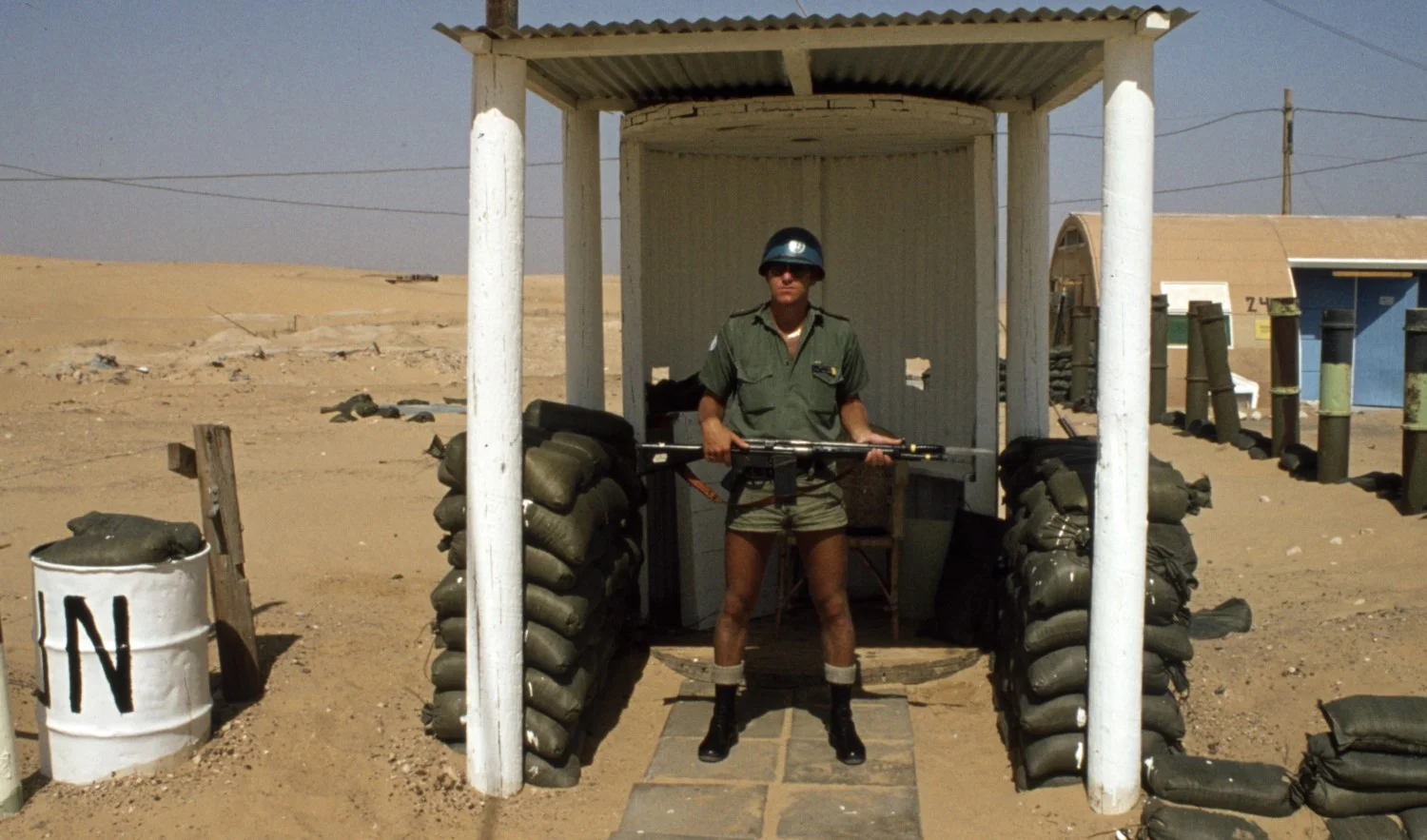
ALL THOSE POSITIONS

Guard at UNEF II / Photo:Lars-Åke Jansson
When Lars-Åke Jansson travelled to the Middle East around Midsummer 1975 to serve with the 1st Company of Battalion 58M as part of UNEF II, the Swedish contingent had already been established in the area for approximately two years. The battalion was stationed at two main camps and a number of smaller outposts known as “positions.”
During his service with Battalion 52M, Lars-Åke brought his camera and carefully documented life at the various positions along the confrontation line and within the buffer zone. Lars-Åke would later also serve with Battalions 64M and 66M. Below is a selection of photographs from some of these positions.
Camp Tre Kronor
The main camp, Tre Kronor (Three Crowns), was located in Al Nagila. The camp was established on the site of an old railway station, where some of the existing buildings could be repurposed, including for the battalion's administrative office.
The old water tank that had once supplied steam locomotives was converted into a reservoir for shower water.

Camel riding at Camp Tre Kronor / Photo: Lars-Åke Jansson

UN-soldiers marching / Photo: Lars-Åke Jansson
Camp Sinai
Camp Sinai was a smaller Force Headquarters (FHQ) located in the northern sector. The camp was built next to a bomb-damaged railway station.

Entrance to Camp Sinai / Photo: Lars-Åke Jansson

Stand easy! / Photo: Lars-Åke Jansson
Position 501.
At Position 501, there were numerous tank wrecks along what had been nicknamed “Shoot-rep Road” (a “shoot-rep” was the type of report UN peacekeepers submitted whenever they heard gunfire).

Observation post at Position 501 / Photo: Lars-Åke Jansson

Tank wreck / Photo: Lars-Åke Jansson
Position 507.
Life at the position, located right on the Mediterranean coast, could at times be quite demanding despite its beautiful setting. The outpost was extremely isolated, and travelling to and from it was difficult.

Position 507 with the Mediterranean Sea in the background / Photo: Lars-Åke Jansson

Swedish UN vehicle at Position 507 / Photo: Lars-Åke Jansson
Position 510.
Located in close proximity to the buffer zone and Israeli forces. On occasion, a football match was played against the Israelis.

Tents and vehicles at Position 510 / Photo: Lars-Åke Jansson

Football match against the Israelis / Photo: Lars-Åke Jansson
Position 512.
One of the battalion's duties was to monitor the transit of refugees fleeing from both sides of the confrontation line. Prisoner exchanges between the warring parties also took place on occasion.

Tents and a civilian bus at Position 512 / Photo: Lars-Åke Jansson

Shaded waiting area for people in transit / Photo: Lars-Åke Jansson
Position 514.
The Israelis had positioned a mobile aerial work platform in the middle of the desert. They used it to raise personnel equipped with binoculars, allowing them to observe far into Egyptian territory.

Constructed walkway leading to Position 514 / Photo: Lars-Åke Jansson

Polishing boots while on duty as a radio operator / Photo: Lars-Åke Jansson
Leaveresor
During their deployment, the UN peacekeepers were also given the opportunity to take a well-deserved break from their demanding work in the desert. Leave trips, as they were called, were organised to destinations including Tel Aviv and Jerusalem.

Outside the hotel in Tel Aviv / Photo: Lars-Åke Jansson

With Jerusalem in the background / Photo: Lars-Åke Jansson
UNEF II was established following the war between Israel and a coalition of Arab forces led by Egypt and Syria in October 1973. The conflict is known by several names, including the October War, the Yom Kippur War and the Ramadan War, as it coincided with both the Jewish holy day of Yom Kippur and the Muslim holy month of Ramadan.
The Swedish contingent was formed from personnel serving with Sweden's UN Standby Battalion, following the deployment of an advance party from the Swedish UN battalion in Cyprus.
In total, Sweden filled 7,642 positions within UNEF II.
Quisque iaculis facilisis lacinia. Mauris euismod pellentesque tellus sit amet mollis.