

THE ATTACK ON KAMINAVILLE
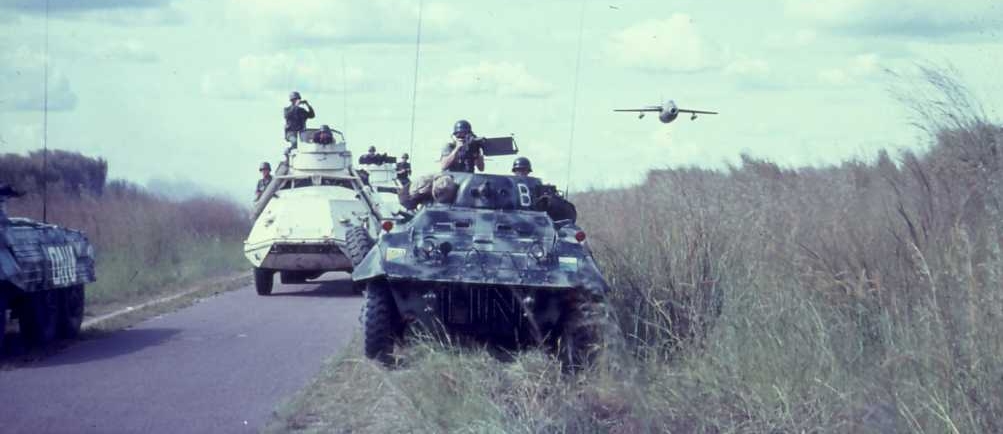
On the afternoon of 30 December, the commander of the Swedish battalion, Lieutenant Colonel Fredman, received orders to capture Kaminaville early on 31 December. (…) It later emerged that the gendarmes had expected an attack on the town as early as the 30th. When nothing happened that day, they began drinking beer and firing signal flares, perhaps in an attempt to boost their fighting morale. However, the effect was quite the opposite. Scattered groups of gendarmes went on looting sprees throughout the town. The bank was emptied of cash. — O. Hederén, African Interlude.
More than 6,000 Swedes took part in the UN mission in the Congo during the so-called Congo Crisis. The mission lasted from 1960 to 1964, and UN troops came under intense pressure on several occasions. On 30 December 1962, Swedish and Ghanaian UN troops, as part of Operation Grandslam, received orders to capture Kaminaville the following day and disarm the Katangese gendarmerie, which controlled the town. The following is an account of the events of New Year's Eve 1962, based on the veterans' archives held by Fredsarkivet. Wherever possible, we have used the veterans' own words in describing the events.
Immediately after the Swedish battalion commander, Lieutenant Colonel Fredman, received orders to launch the attack on Kaminaville the following morning, Kurt Hultgren, Åke Sandberg, Freddy Heinefors, Björn Mattsson, Tommy Nilsson and the other Swedish soldiers began their preparations.
Corporal Björn Mattsson writes: If anyone was afraid, the rest of us did not notice it. Afterwards, most claimed that what they had felt that evening was mainly curiosity, as though thinking that they were finally going to experience something exciting. Equipment was carefully prepared, and weapons were checked one last time. Nobody went to bed before midnight, and few slept soundly that night. Reveille was at 3:30 a.m. An extra-hearty breakfast in the mess hall. And then we set off before dawn.


5:20 a.m. Order to move out. Dawn is beginning to break, and the light makes our faces look paler than they actually are. — F. Heinefors.
At 6:00 a.m. on New Year's Eve 1962, the advance began, with the main body of the battalion moving along the main road from the base towards Kaminaville, while the bulk of the 3rd Company advanced from Kiavie towards the town along minor roads. A small guard detachment was left behind at the bridges in Kiavie. During the night of 30–31 December, a large number of red signal flares had been observed over Kaminaville.
During the advance towards Kaminaville, the 2nd Company, commanded by Major Fagerström, formed the leading unit. Approximately three kilometres northeast of the town, the company came under heavy fire, including machine-gun and mortar fire, forcing the company commander to withdraw about 600 metres.
The battalion commander then assembled the armoured cars and armoured personnel carriers into an armoured group which, supported by heavy mortars, broke through the gendarmerie lines. — O. Hederén.
Freddy Heinefors describes the same incident: 6:20 a.m. Two kilometres from Kaminaville. A deafening explosion — we have made contact with the enemy. The mortar rounds are landing very close to us. We halt, dismount and take up positions. We were pinned down by mortar fire for approximately an hour. We took cover and returned fire.
7:05 a.m. The battalion commander arrives from the rear lines. He now assumes command of the combined assault force and orders a combat patrol from the 2nd Company to advance. Our mortar returns fire. Enemy fire against the combat patrol intensifies. Meanwhile, our own mortar unit moves into firing position. — F. Heinefors.


As a curious detail, it may be mentioned that only two of the Swedish mortar rounds, two so-called ranging shots, accidentally struck unintended targets. One shell exploded close to a villa on the outskirts of the town, while the other partially demolished one of Kaminaville's brothels. Fortunately, nobody was injured in either incident. — O. Hederén.
At 7:55 a.m., the final assault began, and just under an hour later, the troops started advancing into the town itself. The soldiers mounted their armoured personnel carriers, and the Swedes saw signs that the gendarmes were fleeing in panic. Wounded gendarmes had been left behind and were given medical attention by Swedish medics.


Fleeing gendarmes then ran aimlessly through the side streets, and a few minutes after 9:00 a.m., the Swedish UN troops reached the centre of Kaminaville. Combat patrols moved out from the town square along the streets, clearing one block after another. Members of the gendarmerie were taken prisoner.
The gendarmes' fire during the battle was extremely heavy, but they were poor marksmen, and their shots went too high. The Swedish battalion was also fortunate: an 8 cm mortar shell landed eight metres from a squad but fell into a small depression in the ground, preventing anyone in the squad from being hit by shrapnel. A captain had his binoculars shot out of his hands without being injured himself. The gendarmes left one man dead, and a number of gendarmes were taken prisoner. The Swedish battalion suffered no casualties.
(…) During the operation, Swedish fighter aircraft patrolled the area, ready to intervene if necessary. Occasionally, the aircraft descended to very low altitude to frighten the gendarmes. They were met with intense small-arms fire, and when they returned to base, most of the pilots discovered bullet damage to their aircraft. — O. Hederén.
Corporal Matsson describes the same incident: Our forwardmost machine guns began rattling away. Slowly, we crept forward, keeping the vehicles alongside us at all times. By now, the exchange of fire was intense.
A bullet knocked the binoculars out of our captain's hand, and the same projectile damaged my radio antenna. Still no one wounded. Well, there was a gendarme lying on the road. "Nothing we can do for him," said our medic.


Freddy Heinefors writes: 9:45 a.m. Meanwhile, the gendarmes have assembled to reorganise at the large gendarmerie camp on the southeastern outskirts of the town. Another gendarmerie camp is located further south.
9:55 a.m. Reconnaissance towards the nearest gendarmerie camp is ordered. Our mortar unit takes up positions southwest of the town square. Plans are drawn up to attack both camps. Sporadic gunfire can still be heard here and there.
1:00 p.m. Orders are issued to capture the second gendarmerie camp. The 2nd Company forms the leading assault force. The base is captured without an exchange of fire. The gendarmes have fled.


O. Hederén writes:
The disorder in the military camps was appalling, and everywhere there were clear signs of the haste with which the gendarmes had fled. In one of the mess halls, for example, the table was laid for breakfast, and food had been left on the stove, which was still switched on. The "spoils of war" included nearly 40 vehicles, two of them armoured cars, several dozen tonnes of ammunition, a 40 mm Bofors anti-aircraft gun mounted on a vehicle, a recoilless rifle, 12.5 mm machine guns, a large number of small arms of various types, food supplies, clothing and equipment, and spare parts of various kinds.
Once the gendarmes realised that the Swedes had broken through their defences, all organised resistance ceased. Kaminaville was quickly occupied. By the afternoon, both military camps in the town had been cleared.
The sector commander and the civilian base administrator met with the town's authorities just a few hours after its capture. The aim was to restore normal life in Kaminaville as quickly as possible.
The Swedish battalion commander initially served as the town's military commandant, followed in turn by the battalion's company commanders. Life soon returned to normal. However, there were severe shortages of essential supplies, creating new problems for the base's civilian administration. To keep everyone informed about ongoing activities, weekly military-civilian meetings were arranged in Kaminaville, attended by representatives from both the town and the base.
Operation Kaminaville had been successfully completed without any Swedish casualties or unnecessary destruction. The Swedish battalion celebrated the beginning of the new year in Kaminaville's largest military camp, where they enjoyed Swedish pickled herring and fresh pineapple. The camp was named Camp Fred.

Quisque iaculis facilisis lacinia. Mauris euismod pellentesque tellus sit amet mollis.