
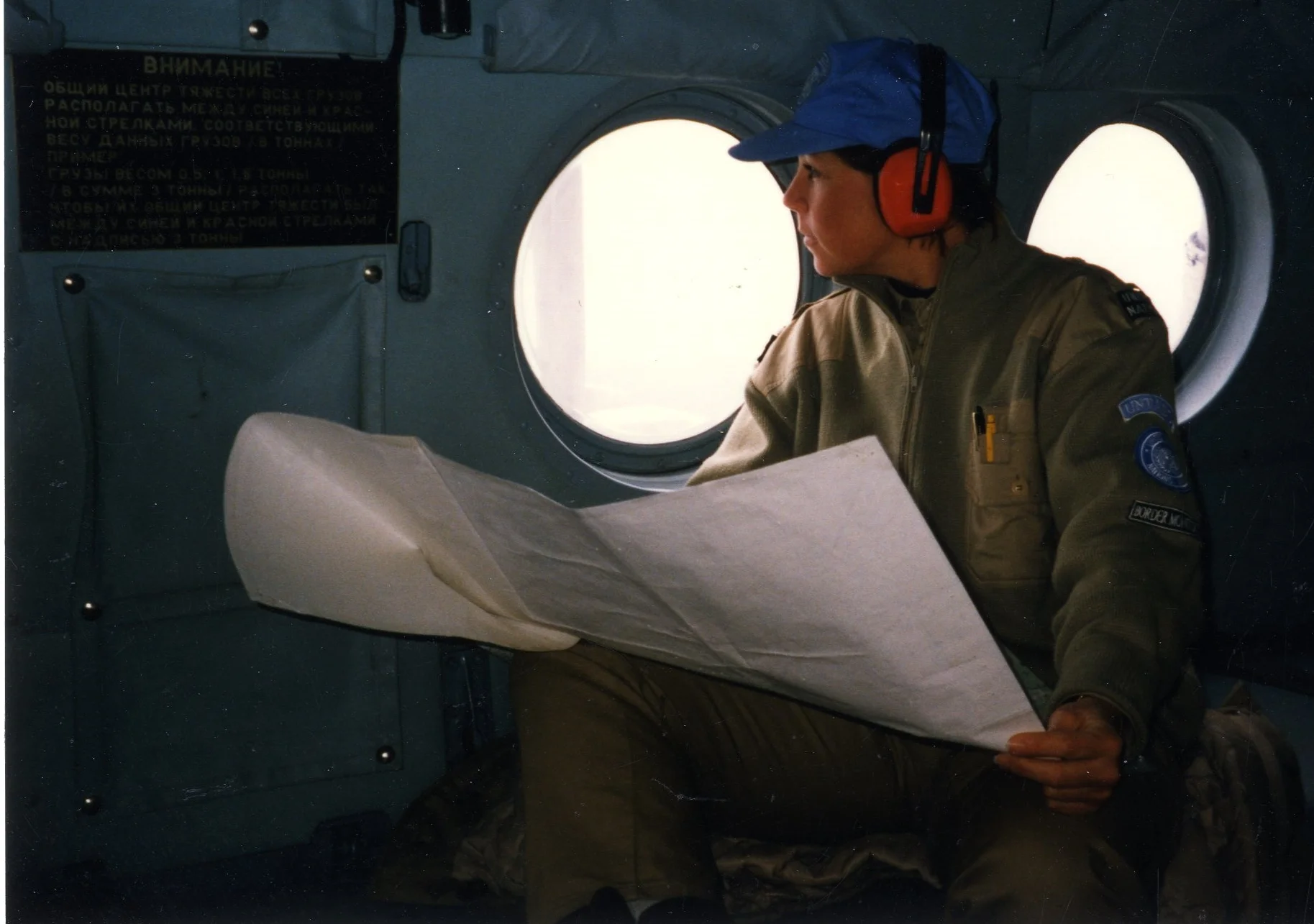
BORDER MONITOR IN CROATIA
In 1995, Croatian government forces succeeded in regaining control of large parts of the territory that had been held by Serbian rebel forces between 1991 and 1995. The exception was a small area in eastern Croatia, which remained under the control of Arkan's Tigers, a notorious Serbian paramilitary group.
In November 1995, a peace agreement, known as the Erdut Agreement, was finally reached, bringing an end to Arkan's control over eastern Croatia. Following a transitional period of United Nations administration, the region was reintegrated into the rest of Croatia. The UN mission was established in January 1996, in accordance with UN Security Council Resolution 1023 (UNSCR 1023). It was a so-called Chapter VII operation, with an executive mandate to administer the region for at least one year.
With both military and civilian components, the United Nations Transitional Authority in Eastern Slavonia, Baranja and Western Sirmium (UNTAES) was tasked with, among other things, supervising and facilitating demilitarisation; monitoring the return of refugees; helping to maintain peace and security; establishing a temporary police force; carrying out duties relating to civil administration and public services; organising elections; and undertaking other activities in accordance with the agreement.
The mission consisted of just under 3,000 uniformed personnel from approximately 30 countries, including around 2,300 troops, 100 military observers and 400 police officers.
One of the somewhat unique features of the mission was that, for the first and only time, the United Nations deployed civilian border monitors. Their task was to facilitate the free movement of people across the eight international road and railway border crossings between the region and what was then Yugoslavia.

I was one of approximately 50–60 observers, stationed in Ilok in the south, on the border with present-day Serbia. The majority of the personnel had military or police backgrounds, and most were retired. Only a handful were civilians, and apart from me, there was just one other woman. A former colleague of mine from my time with Swedish Customs and I arrived in the autumn of 1996, following a recruitment process that had taken eight months.
In addition to our task of facilitating freedom of movement, we were gradually assigned a variety of other duties, including registering Serbs who were leaving the region, attempting to prevent the illegal export of timber, and mapping the actual border. Many of these issues required knowledge of borders, customs, migration and human rights, so the composition of the personnel was far from ideal. We needed more civilians, customs officers, police officers and other personnel with expertise in migration and border matters, and fewer military personnel from special forces units. The spirit of the saying "Peacekeeping is not a job for soldiers, but only soldiers can do it", once attributed to Dag Hammarskjöld, was clearly evident. In my opinion, it was being interpreted rather too broadly.
We wore what were known as civilian uniforms: sand-coloured trousers and shirts, blue UN caps and the familiar UN insignia on our sleeves. I remember being immensely proud of my first proper UN assignment. I felt reasonably comfortable dealing with questions concerning the borders and our specific responsibilities, but I understood very little about the other aspects of the UN mission. There was no preparatory training whatsoever.
We worked practically every day, maintaining a presence at the border crossings around the clock, often in twelve-hour shifts. At the border, we worked alongside Serbian and Croatian police and customs officers, with UN troops from Jordan also present. Some of the border crossings were close to Ilok, making it possible to drive home for lunch. At other locations, we had to bring our own food. Shipping containers and, in some cases, large American motorhomes (!) served as combined offices and resting places for the night shift. These facilities were often shared by the two observers on duty.
One of the American motorhomes that served as an office and resting area.
Our military colleagues from Jordan suffered in the cold wartime winter, having no winter equipment and wearing only their desert uniforms. They had an especially difficult time when the snow and freezing temperatures arrived, as they were forced to stand outside for hours.
Our time at the border was filled with registering refugees, inspecting lorries and drinking plenty of coffee and tea!
The UN's civilian administration, military observers and civilian police were also present within our area of responsibility. We worked closely together in what today would be called civil-military cooperation, a comprehensive approach, and all the other associated terms. At the time, we had no particular name for it and no established rules. We simply did it because it was necessary, and it felt quite natural. During this period, we experienced a number of incidents in Ilok, but overall security was good. There were electricity shortages during the winter and water shortages in the summer, but we did not suffer any serious hardship.
With the help of a Ukrainian UN helicopter, and in cooperation with the UN civilian police, we mapped the borders through countless helicopter flights. Seeing the region from above was a deeply shocking experience, as the scale of the destruction became apparent in an entirely different way. Vukovar was the most heavily devastated city in the whole of the former Yugoslavia, and it certainly showed (see slideshow below).


One night in November 1997, the Croatian authorities were due to take over responsibility for border control from the United Nations, in accordance with the Erdut Agreement. Croatian customs officers and police were to replace the temporary personnel, many of whom were of Serbian origin. Preparations had included giving those Serbs who wished to remain the opportunity to join the new Croatian police or customs authorities, subject to a selection process, as well as joint training in Hungary.
The period leading up to the handover had seen a number of Serbian personnel resign, and tensions were running high when the time finally came. The first night passed peacefully, although the new mixed teams did not speak much to one another. When a Serbian officer went inside, a Croatian officer would go outside. But traffic was slow, and November nights were cold. Gradually, they began sharing the limited space available, and eventually they were playing cards and drinking coffee together, just as they might at any small border crossing anywhere in the world.
In addition to our primary assignment, we served as UN observers during the 1997 regional elections, assisted the civilian administration with transporting civilians, and organised our own local initiatives, such as providing weekly bags of basic food supplies to the poorest families in the area, among other activities.
Overall, we border monitors were considered a successful concept, and I find it incomprehensible that the approach has never been used again. The concept originated from an idea by Gerard Fischer, who had worked for the United Nations for more than 30 years. I met Gerard only a handful of times during my service with UNTAES, but we subsequently worked together in Kosovo and back home in Sweden. Gerard passed away in the summer of 2015 after a long illness.
UNTAES came to an end in January 1998, when Eastern Slavonia, Baranja and Western Sirmium had been peacefully reintegrated into Croatia, fulfilling the principal objective of the mission's mandate. The UN flag was lowered and the Croatian flag was raised at the border — a historic day.
This was my third assignment in the Balkans, and there would be more to come.
This is how I remember it.
— Lena Larsson
Quisque iaculis facilisis lacinia. Mauris euismod pellentesque tellus sit amet mollis.