
THE DECEMBER BATTLES IN THE CONGO 1961
More than 6,000 Swedes took part in the United Nations operation in the Congo during the so-called Congo Crisis. The operation lasted from 1960 to 1964, and UN troops came under severe pressure on several occasions.
In December 1961, Swedish troops, alongside UN forces from Ireland, India and Ethiopia, were involved in fierce fighting for Elisabethville, the capital of Katanga. The UN forces eventually succeeded in defeating the Katangese gendarmes in the city and capturing Elisabethville.
Below, you can read Bo L. Andersson’s account of his experiences during the days of fighting.
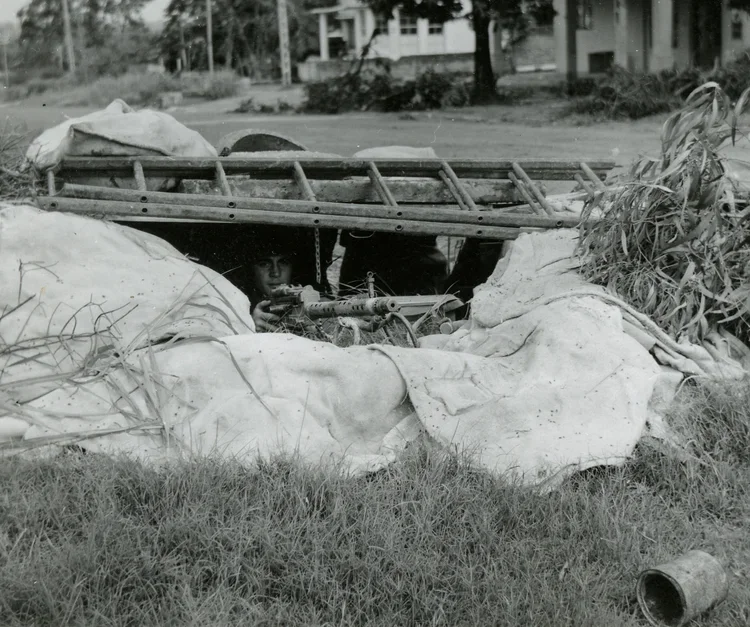
“We placed sheets of metal, doors and other debris over the defensive position for protection.” Photographer: B. Andersson.
By Bo L. Andersson
14 December 1961
Second day after arriving in Elisabethville. Reveille at 06:00, breakfast at 07:00. Rucksack packed with raincoat, mess tin and mosquito repellent.
Fall in at 09:00. At 09:15, we set off in two KP armoured personnel carriers along Chaussée de Kasenga towards the FINA petrol station. Corporal 4341 is not the only one feeling tense. We leave the vehicles at 09:45. As we make our way through wooded terrain towards our position at the petrol station, we come under fire, but fortunately the shots are too high. Bullets whistle over our heads through the treetops.
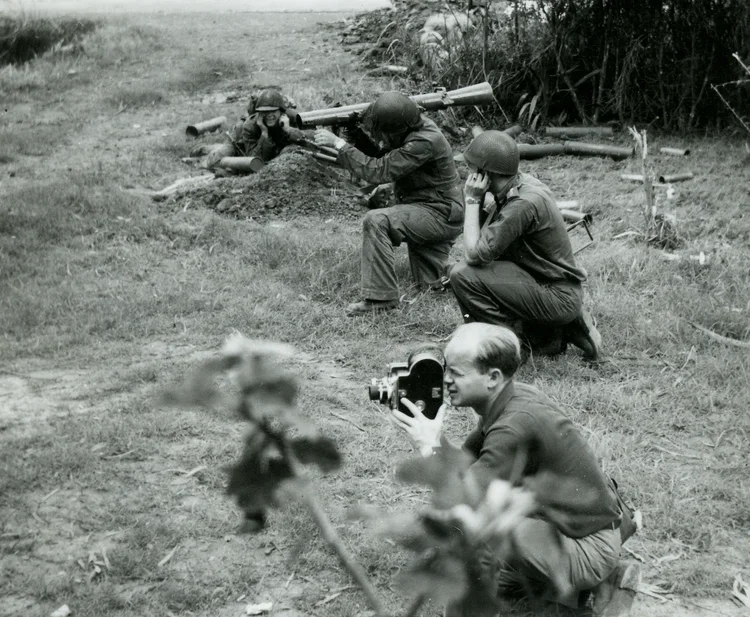
We have two American newsreel cameramen with us, and one of them puts down his camera and makes the sign of the cross. He then picks up his camera and continues with us.
When we reach our position, we have a marksman, 4361, lying under cover beside the road near the house where we are stationed. 4347 and I are lying in a pit beside the house with a recoilless rifle. We take a breather after digging ourselves a little deeper into the pit. We go to collect lunch and dinner. It's porridge and milk, followed by more digging. We are filmed while we work. All the time, bullets are whistling through the air. 4347 strikes a hand grenade with his pickaxe. For some reason, it has ended up in our defensive pit. The Irish arrive in the afternoon and carry out reconnaissance in an armoured car. They then reverse about 50 metres and open fire over the heads of the two sections positioned on the other side of the road. All hell breaks loose!
After 15:00, it starts raining, making our pit even muddier. I'm on guard duty with 4350 during the 21:00–23:00, 01:00–03:00 and 05:00–07:00 shifts. Heavy rain throughout the night, while the gendarmes fire on the Irish positions. The sound of gunfire mingles with the croaking of frogs.
“Recoilless rifle in action at the position we occupied on 14–15 December. The American newsreel cameraman was filming a report for American television.” Photographer: Unknown.
15 December 1961
Reveille at 07:00. Sporadic gunfire continues all the time. We are relieved between 08:15 and 08:45. Back at camp, we clean and maintain our weapons and equipment. Occasionally, bullets strike the roof of our accommodation. It's unsettling, and I hope everything will turn out all right.
Our section is on guard duty from 12:00 to 18:00 and from midnight to 06:00. My shift is from 15:00 to 16:00. A Canberra bomber is flying over Elisabethville, firing heavy-calibre ammunition. The “Barrels” have been here as well.
Tomorrow, we will probably be taking part in a larger UN operation. If it goes well, things may become calmer, or so those in the know say.
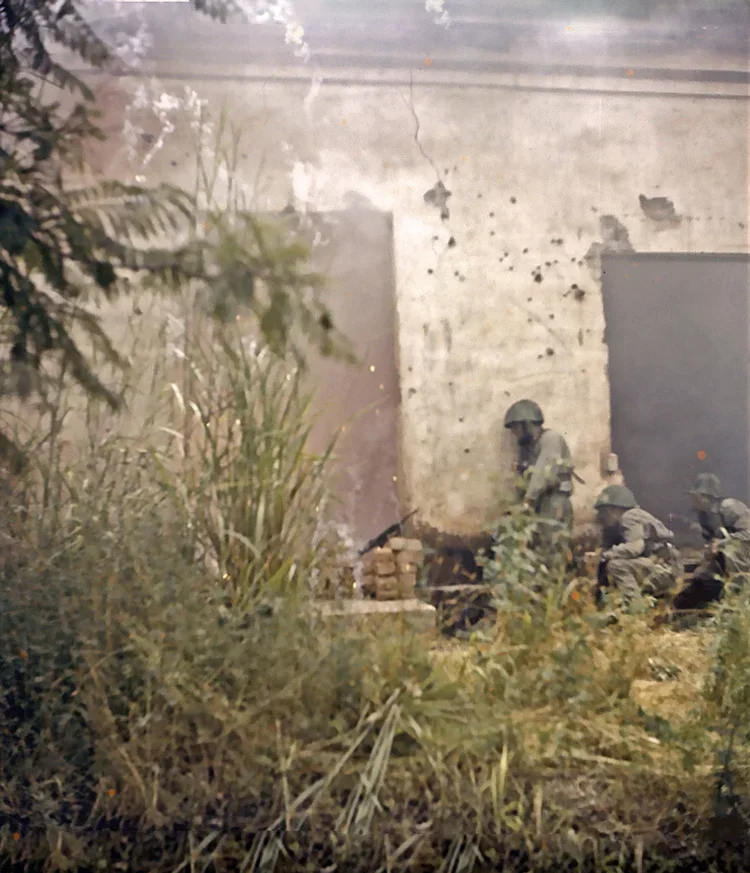
“The enemy was flushed out with a phosphorus smoke grenade.” Photographer: T. Dahlén.
16 December 1961
Reveille at 01:30. Collected the equipment we had prepared the previous evening. Fall in at 02:00.
At 02:15, we set off on foot along Chaussée de Kasenga, carrying all our equipment. All the streetlights had been switched off. We marched for ten minutes, then rested for two. It was hard going with the recoilless rifle and all its ammunition. Many of the men were tense. It was raining continuously, and with all the lights out it was pitch-black, so we had to hold on to the webbing of the man in front of us. As we passed villas and other buildings, we came under fire.
At around 03:00, we reached a stream which, after all the rain, was now three to four metres wide and about two metres deep. With the recoilless rifle on my shoulder and the water up to my neck, I managed to get across. 4364 went completely underwater but somehow managed to make it across as well. We took cover behind a hedge and emptied the water from our boots. I think we were all a little on edge, because we found ourselves laughing at the whole situation as we lay there with our legs in the air. We then continued our advance across a meadow, but were forced to remain there as the enemy fire intensified. I placed the recoilless rifle in front of me to provide a little protection against any bullets that might come our way. One Swedish soldier was wounded by fire from our own mortars.
Between 05:00 and 06:00, it began to get light, and we made our way to a house where we dug ourselves in as best we could to obtain cover from enemy fire. Before reaching the house, we had to drag along several men from the platoon who had been left lying on the ground in a state of shock. At around 07:30, we advanced behind the 3rd Company, which had lost one man. Recoilless rifles and machine guns were positioned on termite mounds to provide covering fire for the advance.
I was ordered by Quartermaster Sergeant Dahlén to run out alone into a meadow and silence some snipers by firing two high-explosive rounds into the houses from which they were shooting. I loaded the recoilless rifle with one round and took two more with me. After taking cover behind a tree and firing the first round, I ejected the empty cartridge case, reloaded and fired again. Both rounds hit their targets. We then continued our advance.
A little later, I was positioned on top of a termite mound about three metres high, with 4354 acting as my loader. Below me, on the side of the mound, 4356 was holding on to my legs to prevent me from sliding down. At the foot of the mound lay another comrade, trembling all over.
I fired two high-explosive rounds. The first struck a house, which collapsed. I fired the second into the crown of a tree so that the explosion would send fragments down towards the ground. I don't remember it myself, but 4356 says that the entire tree erupted in a sheet of flame. Those who had been firing at us fell silent. Throughout the time we were positioned on the termite mound, we were under enemy fire.
Eventually, we reached a bakery. There we dried our clothes beside the warm ovens and ate some of the bread we found. It was delicious. There were still snipers operating in the area. Corporal 4349 and his section captured one who was hiding in a tree (see photograph). While 4360 and I were lying in a defensive pit on a termite mound near the bakery, we came under mortar attack. The shells landed all around us. Very frightening! During the afternoon, Camp Massart was captured.
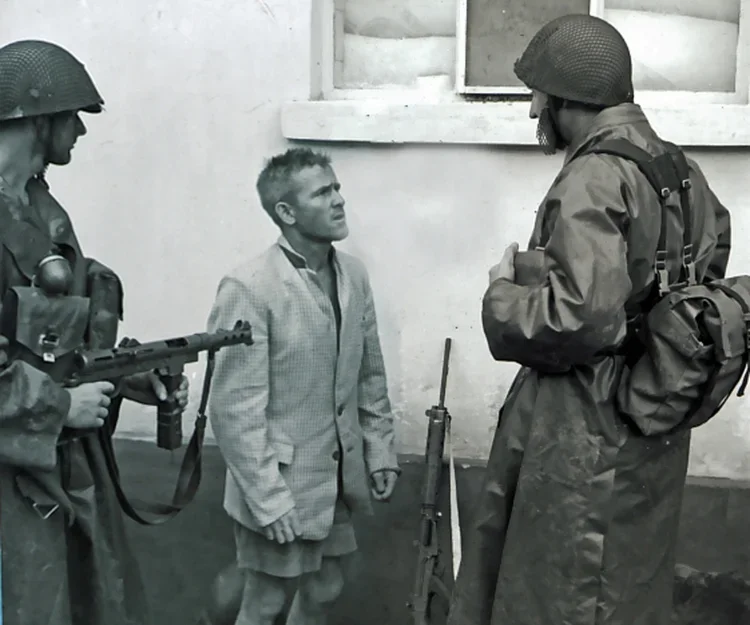
“The sniper positioned up in the tree.” Photographer: Unknown.
17 December 1961
Guard duty during the night. 4360 and I were on duty together. Snipers were active even then. During the day, the 3rd and 4th Sections moved forward to the junction of Avenue du Luxembourg and Avenue des Plaines, where the gendarmes had previously registered their fire. As we advanced, we took cover in the houses we passed. At one point, near the crossroads, we came under mortar attack. Some of us lay by the window openings to see where the shells were landing. In the middle of the room stood a table, and underneath it one of our officers was lying, taking cover.
When we reached the crossroads, 4362 and 4364 prepared a defensive position inside a drainage culvert. 4360 and I dug ourselves in beside a hedge (see the photograph at the top). We placed sheets of metal, doors and other debris over our position for protection.
At around 17:00, we heard the sound of incoming mortar rounds. I ran towards 4360 in the drainage culvert. Just then, a shell exploded. The blast and the smell of explosives hit me simultaneously. I threw myself into the defensive position. My submachine gun caught on the opening to the drain, preventing me from getting my legs inside. At that moment, the second shell exploded. Once under cover, we noticed that I was bleeding from my left arm. I made my way to the medic, where we also discovered that my right trouser leg was covered in blood. Shrapnel in my calf. The wounds were dressed using a field dressing. A little later, I was transported back to camp together with 4347, who was suffering from a stomach upset. The vehicle travelled through the BCK area. It was very frightening, with all the gunfire in the darkness. We arrived at the medical station at around 19:30. They simply dressed my wounds and gave me penicillin and morphine. I ended up sitting in a ditch, dazed from the morphine, before eventually finding my way to the regimental quarters.
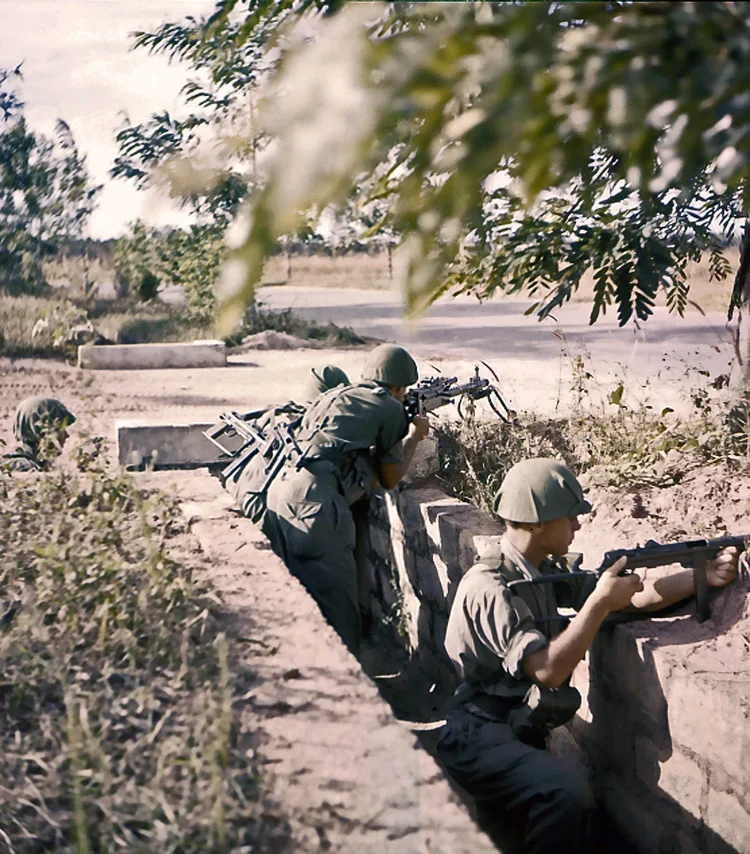
Defensive positions in concrete-lined ditches. Photographer: T. Dahlén.
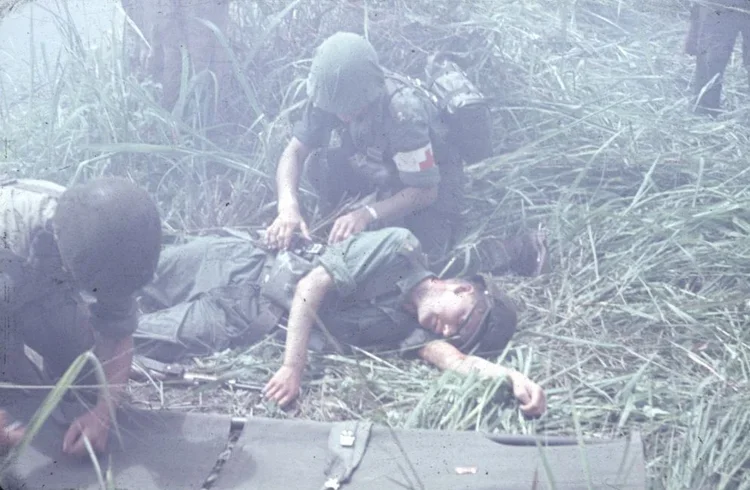
Photographer: Unknown.
18 December 1961
Went to the medical station at 09:00 and then on to the Italian hospital near the airfield. They X-rayed my arm and leg, but they were unable to remove the shrapnel from my calf, and more than 50 years later it is still there. Wounded people kept arriving, some more seriously injured than others. A large number of bodies lay along the wall outside the hospital. While I was waiting for transport back to camp, the 12th Battalion passed by on its way to the airfield to fly home! I had something to eat and then returned to camp.
When I arrived, I learnt that 4364 had been hit by a bullet in the hip after firing a recoilless rifle at mortar-carrying vehicles. He survived and was flown to Leopoldville for medical treatment.
I settled down to sleep at the camp after 21:00.
This is my personal account of what happened during those days in December 1961. Others in the platoon may remember events differently.
Bo L. Andersson
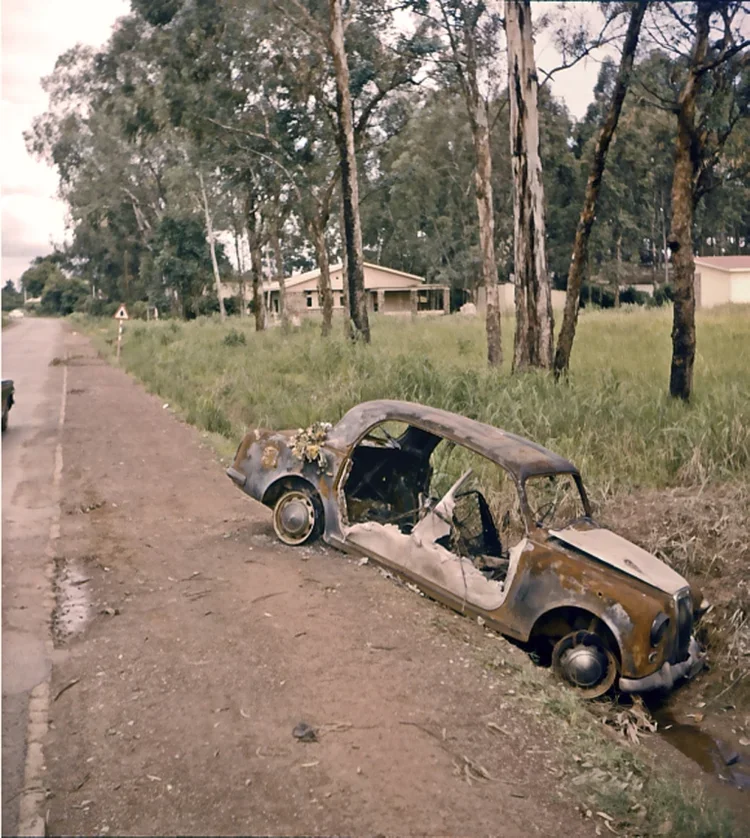
“Vehicle that failed to stop when ordered to. Fresh flowers every day.” Photographer: Torsten Dahlén.
Quisque iaculis facilisis lacinia. Mauris euismod pellentesque tellus sit amet mollis.