
PEACE ARISES – SO IT HAS BEEN SAID – WHEN PEOPLE CHANGE!

Among the many historical documents preserved in Fredsarkivet is the battalion magazine Djungeltelegrafen (The Jungle Telegraph), published during Sweden's UN mission in the Congo from 1960 to 1964. Issue No. 18 of Djungeltelegrafen, dated Thursday, 30 March 1961, contains the following passages relating to the medal ceremony held for the battalion (Congo X) on Monday, 27 March 1961. Following the medal presentation, Battalion Chaplain Lennart Sydhoff conducted a military religious service.
Lennart Sydhoff was born on 23 June 1920 in Hedvig Eleonora Parish, Stockholm, and passed away on 14 April 2003 on Ekerö. Lennart served as battalion chaplain with the rank of captain and was a member of the battalion headquarters staff during Congo X. He later became parish priest for Sånga, Skå, Färentuna and Hilleshög on Ekerö.
Lennart's address contains many passages that are just as relevant today as they were nearly 60 years ago. The title of this article, "Peace Arises – So It Has Been Said – When People Change", is taken from Lennart's thoughtful appeal to the Swedish UN soldiers who had just received the newly established Congo Medal from the Irish general and UN Force Commander in the Congo, Seán Mac Eoin.
Lennart's address also emphasised the need to struggle and work to preserve peace: "Peace does not sustain itself! It does not come free! It must be fought for!" […] "We must fight just as hard to preserve peace." These are words that offer an important perspective.
Veterans who have served as battalion chaplains are warmly invited to contact The Swedish Peace Archives to share their experiences and perhaps contribute material for digitisation. Through their particular role, chaplains have valuable and fascinating perspectives to offer, and these are experiences we at The Swedish Peace Archives are eager to preserve.

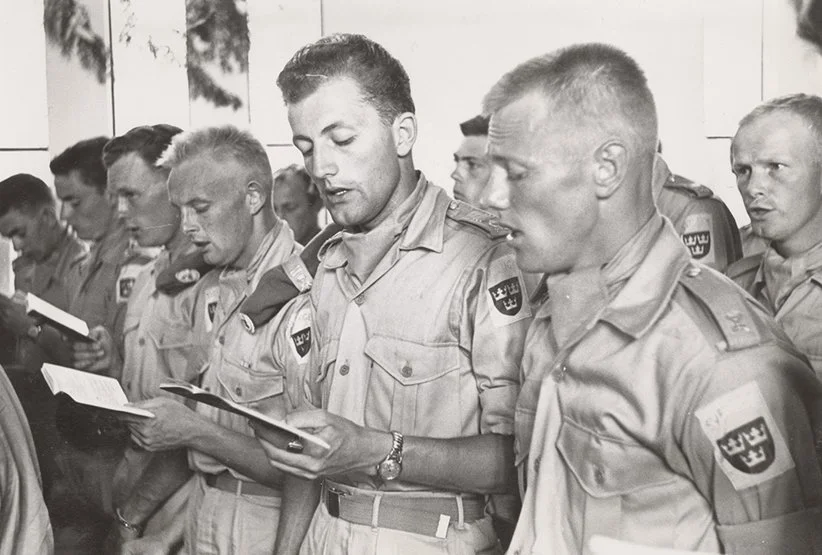
A military religious service in the chapel, led by Chaplain Lennart Sydhoff. The chapel was located in the Swedish camp in the Congo. “SLM P2013-1724 – Military Organisation,” Sörmlands Museum, accessed 5 March 2019. https://sokisamlingar.sormlandsmuseum.se/items/show/420774.
Excerpt from Djungeltelegrafen (The Jungle Telegraph), No. 18, Thursday, 30 March 1961. Military religious service conducted by Battalion Chaplain Lennart Sydhoff:
On the reverse of the medals we have just received are the words: "In the service of peace."
One day, a little boy asked his father how wars actually begin. His father, who happened to be an economist and a learned man, replied that it was a very complicated matter — it depended on economic, social and political factors. The boy was none the wiser for his father's explanation. But a little later, he got into a fight with his brother. This time it was their mother's turn to intervene and separate them. When they had calmed down, she said: "This is how wars begin. People and nations that cannot get along end up going to war with one another." And that the boy understood!
We live in a strange age. It is full of contradictions! An age that speaks of peace more than any other in history, yet prepares for war. An age in which people cannot even agree on what peace means! Some nations understand peace to mean "the continuation of war by other means…" An age in which the world, as never before, is divided into two halves that cannot, and do not even wish to, reach agreement, yet where a major war would mean destruction, probably for both sides.
An age that has made astonishing progress in science and technology, yet when it comes to cooperation, has scarcely advanced beyond the Stone Age! An age that can split the atom but cannot unite the world, send rockets to the Moon but cannot establish peace on Earth. In the deepest sense, peace is not achieved through negotiations and treaties! Peace treaties are often worth no more than the paper they are written on!
Peace arises — as someone once said — when people change!
For the fundamental problem is not economic, social or political in nature — the fundamental problem lies within humanity itself!
We are soldiers in the "army of peace". "In the service of peace." Let us remember that we cannot fight for peace while at the same time carrying hatred in our hearts — whether towards a comrade, a commanding officer, a particular group or a race.
For peace begins within the heart! That is where change must take place! That is where something new must begin to grow! That is where the struggle must be waged against the root causes of all conflicts — against selfishness, envy, greed, pettiness and hatred. We all have a part to play in that struggle!
In the service of peace! The underlying causes of hostility between individuals are the same as those of war between nations. War is merely a symptom of the evil that exists within our own hearts!
Peace is founded when the heart is transformed! This applies in marriage, among friends, within the company, just as much as it does throughout the world! Only the scale is different! Statesmen who sincerely extend their hands to one another in reconciliation become peacemakers between nations. They create peace on Earth!
There is one thing I would like to add. Peace does not sustain itself! It does not come free! It must be fought for! People believe that it is only when their country is at war that they must give their utmost. That is wrong! We must fight just as hard to preserve peace. We must be prepared to sacrifice our lives for peace as well!
We must be capable of acting with the same determination, strength and courage for peace as we do in war. That is why we are here. "In the service of peace." To serve peace. To fight for peace, with weapons in hand if necessary!
If we do not develop the same willingness to sacrifice and the same determination in the struggle for peace, we may suffer the fate described of the victorious powers after the First World War: You won the war — but lost the peace!
Today, wishing for peace is not enough. Neither is making speeches about it. Negotiating for peace is not enough. We must create the conditions for peace and fight for it — first in our own lives, in our own homes, in our own nations. Only then, perhaps, can we pass it on to the great family of nations.
We must allow Him who is the Prince of Peace to determine the programme for peace within our own hearts. Paradoxically, peace begins when we declare war on evil. We cannot successfully wage that war on our own. That is where God enters the picture.

A military religious service in the chapel, led by Chaplain Lennart Sydhoff. “SLM P2013-1725 – Military Organisation,” Sörmlands Museum, accessed 5 March 2019. https://sokisamlingar.sormlandsmuseum.se/items/show/420775.
In keeping with the message of the military religious service quoted above, Lennart Sydhoff would continue his struggle for peace and security during his service with the Swedish congregation in Johannesburg from 1962 to 1970. It was a difficult period, as illustrated by the following account from Tor Sellström, Sweden and National Liberation in Southern Africa, Volume I: Formation of a Popular Opinion (1950–1970), the Nordic Africa Institute, Uppsala, 1999 (page 223):
The general perception of Swedish churches as politically progressive was strongly contradicted in South Africa itself by the Swedish Lutheran congregation in Johannesburg. As late as 1965, there was considerable opposition among members of the Swedish congregation in Johannesburg — most of whom were Swedish citizens residing in South Africa — to even the idea of inviting a black representative to address the question of "Christians and the race question".
Pastor Sydhoff had put forward this modest proposal. However, at a meeting with the Swedish envoy to South Africa, Hugo Tamm [envoy in Pretoria from 1964 to 1966], the majority of the church council opposed the proposal, regarding it as "interference in South Africa's domestic politics" and "a challenge to the country's laws".
They rejected the proposal, considering it an affront to "public opinion, which is opposed to 'mixed' meetings". Sydhoff's proposal was voted down, and it was decided to arrange a meeting on the subject at the Swedish Church in Johannesburg, but without a black speaker.
(Minutes of the meeting of the church council of the Swedish congregation in Johannesburg, 15 August 1965.)

Hilleshög Church on Ekerö. Battalion Chaplain Lennart Sydhoff later became parish priest for Sånga, Skå, Färentuna and Hilleshög on Ekerö. Photo: Holger Ellgaard. CC-BY-SA-3.0.
Quisque iaculis facilisis lacinia. Mauris euismod pellentesque tellus sit amet mollis.