
“MRS LOCHBRUNNER IS LISTED FOR REPATRIATION”
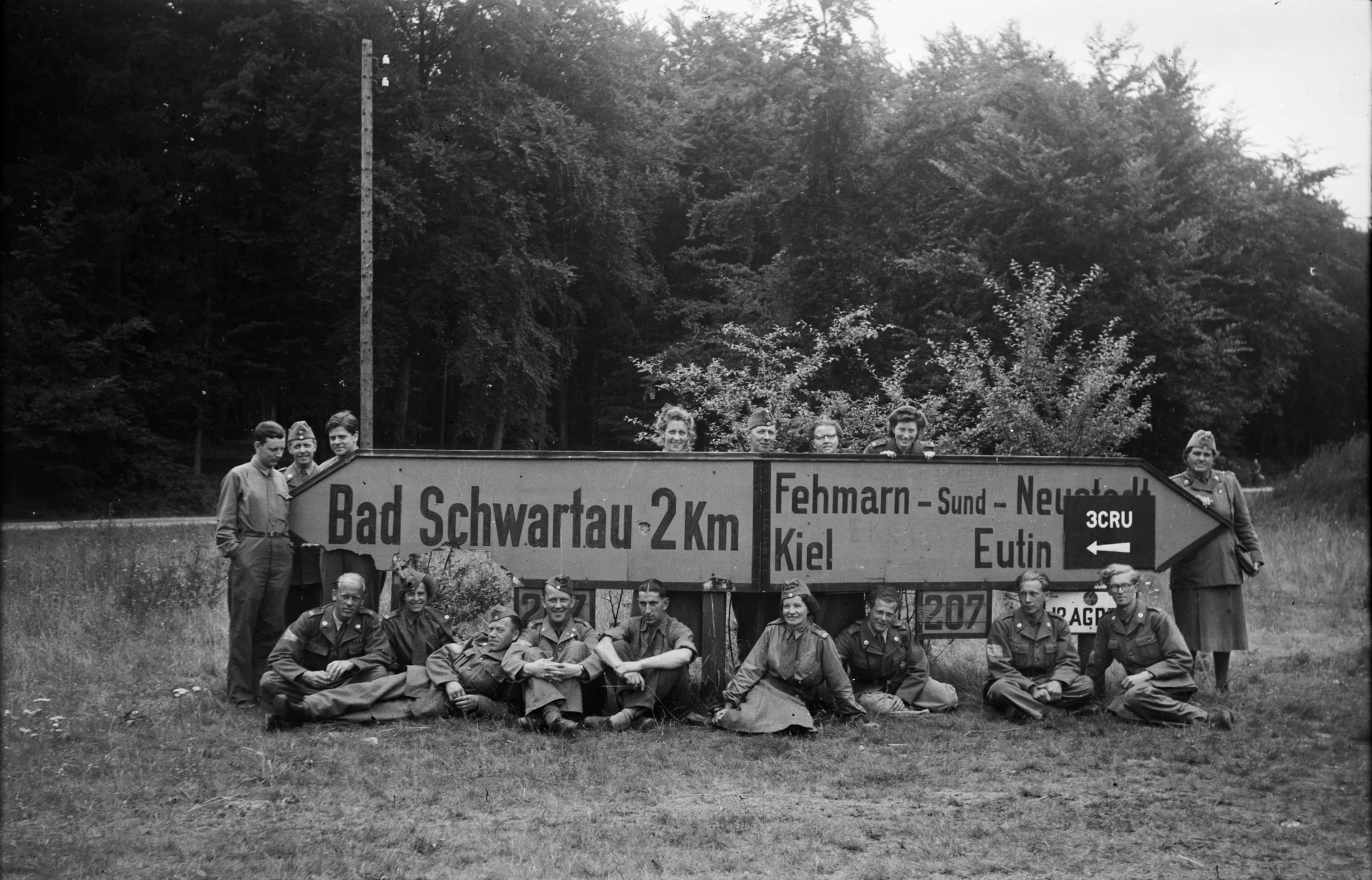
Swedish personnel deployed on the Red Cross mission in Germany after the Second World War. From the Bertil Fröderberg Archive.
Around 100,000 Swedes have taken part in international peacekeeping and humanitarian missions, but few of them have themselves received assistance from a Swedish relief mission earlier in life. Jörgen Backlund is one of them.
In the years surrounding the Second World War, Ingeborg Backlund moved to Derndorf in Germany to study. During her studies, she met a man whom she married, and in May 1944 they had a son whom they named Jörgen. As the war drew to a close in the spring of 1945, Ingeborg’s parents made various attempts to bring their daughter and grandson home to Sweden. An intensive exchange of letters began with various Swedish authorities and organisations. Amid the chaos during and after the end of the war, they lost contact with their daughter. However, with the assistance of the organisation Hjälp krigets offer (Aid to War Victims), they managed to obtain a letter from Ingeborg in July 1945. By this time, she was pregnant again.
During the autumn, Ingeborg’s health deteriorated, and Jörgen, then not quite eighteen months old, developed pneumonia. On 18 October, Ingeborg’s parents finally received word that their daughter and her child had been offered places on Swedish Red Cross buses providing medical transport back to Sweden. Ingeborg herself did not receive the news until just half an hour before departure and was forced to gather her most essential belongings in great haste. Ingeborg’s husband, Mr Lochbrunner, remained in Germany.

“Mrs Lochbrunner is listed for repatriation. Stockholm. 18 october. 1945.”
For understandable reasons, Jörgen Backlund has no memories of the journey to Sweden. His mother, however, told him that progress was extremely slow because the roads had been badly damaged by bombing. Water was in short supply, and on a couple of occasions they had to use water from the buses’ radiators to get by. The journey took them through Denmark, where they encountered considerable bitterness as a result of the years of occupation. On one occasion, people even shouted “murderer’s brat” at Jörgen. They arrived in Sweden in early November and moved in with Ingeborg’s parents in Uppsala.
As Vice-Chairman of the Swedish Red Cross, Folke Bernadotte was involved in organising the repatriation and medical transport operations through which Jörgen and his family received assistance. Later in life, Jörgen served as a civilian expert deployed by the Folke Bernadotte Academy to the European Union Monitoring Mission (EUMM) in Georgia, both in 2008 and from 2010 to 2011. As recently as October 2016, he was also deployed to Georgia as an election observer. Thus, his life crossed paths with Folke Bernadotte’s legacy for a second time.
The correspondence between Ingeborg’s father and various Swedish authorities and organisations in 1945 has been preserved in digital form in The Swedish Peace Archives.
Quisque iaculis facilisis lacinia. Mauris euismod pellentesque tellus sit amet mollis.