
THE INCIDENT AT KASENGA
"I have now moved into a nice villa in Elisabethville, where I live with three other Swedes. I am very happy here, although of course I sometimes long for home. Above all, I long to see you. But hopefully that time will come too. The other day, the gendarmes in Kasenga very nearly brought my life to an end, but fortunately everything turned out well, and I am very grateful for that. I assume you have read about the whole incident in the newspapers back home, and what they have written is probably accurate, provided they reported what was stated in the telegram sent to Sweden. I can give you a brief account of what happened."
These are the words of pilot Lennart Edvinsson in a letter dated 10 August 1963 to his girlfriend, Brittalena. Lennart served with the 20th Swedish UN Battalion (20 K) during the United Nations operation in the Congo in 1963. On 6 August, he and his fellow pilot Olle Andersson were ordered to fly Major Hugo Munthe-Kaas, a Norwegian war hero of the Second World War, to Kasenga.
The major's mission was to investigate whether Katangese gendarmes were present in the area and might pose a threat to the city of Elisabethville. Also accompanying them were the major's bodyguard, Bertil Wedin; interpreter and photographer Roger Asnong; and British journalist Tim Knight.
The following account is based on Lennart Edvinsson's letters to Brittalena and a two-part article written by Tim Knight. Lennart continues:
"We had received orders to fly a Norwegian major and his assistant, along with two journalists, to Kasenga. We took off at around eight o'clock and arrived in Kasenga a little over an hour later. We circled the settlement a few times, and everything appeared calm, so we landed on the small airstrip next to the village.
As usual, the entire village turned out to greet us at the airstrip, and everything seemed peaceful and pleasant. We walked into the village, a distance of about 300–400 metres, and made our way to the building where the people our passengers were supposed to meet were waiting."

Journalist Tim Knight then describes how Major Munthe-Kaas politely asks the visibly nervous head of the local administrative office whether there are any gendarmes in the area. Suddenly, events unfold rapidly. Lennart, who is standing outside the building at the time, describes what happens:
"I was standing outside with a large crowd of villagers around me, but then, all of a sudden, everyone disappeared. And what did I see? Well, about 25 metres away, out on the road, there was a man standing on a jeep with a machine gun. I didn't think much of it at first, assuming they were government troops. But how wrong I was. After a few seconds, he began firing wildly in all directions. I wasted no time taking cover inside the house. My pistol was in my bag, but I realised there was no point in getting it out, as there were so many gendarmes outside."
The gendarmes quickly surround the house and open fire on the building where Lennart and the others are taking shelter. Bertil Wedin, the only one with his weapon readily available, draws his pistol and asks Munthe-Kaas for permission to return fire, but is ordered to hold back.
Moments later, the gendarmes storm the building. In the ensuing chaos, one of them attempts to wrest the pistol from Wedin's grip. Wedin strikes the gendarme, knocking him to the ground, whereupon another gendarme attempts to seize the pistol, which Wedin has now returned to its holster. Major Munthe-Kaas rushes forward and knocks the gendarme down.
Tim Knight describes the emotions during these intense minutes:
“This isn’t real life. It’s as if everything in all the world has stopped. There is no time. No past. No future. Nothing except the screaming and the white men and the black men hitting each other with fists. And the staccato rat-a-tat-tat explosions of the machine guns outside.”
Wedin once again draws his pistol and points it at the nearest gendarme, while shouting to Major Munthe-Kaas to give him an order. The major orders him to surrender and hand over his pistol, which he does.
Lennart writes in his letter:
"After a while, they came inside and drove us out, striking us repeatedly with their rifle butts. A second later, I found myself staring straight into the barrel of a machine gun [...].
I tried to get away from there as quickly as possible, but it wasn't easy because there was so much shooting all around us that the ground seemed to bubble where the bullets struck. But by God's providence, none of us was hit.
Then we were forced onto a jeep and stripped of everything we owned. I had 150 dollars in my wallet, which, in all the confusion, I managed to hide in my underpants, so they didn't get their hands on that! Apart from that, they took everything. They seized all my camera equipment, my passport, savings bank book, chequebook, and all my valuable documents.
We were then driven to one of their storage buildings and lined up against a wall. At that moment, we really thought it was all over. A hysterical gendarme came in carrying his automatic rifle, apparently intending to shoot us, but someone stopped him, and luckily so.
They nearly beat the journalists to death because they couldn't manage to stay on their feet. They fell to the ground when they were struck, which gave the gendarmes the opportunity to kick them as well, and that is exactly what they did.
Fortunately, one of the journalists could speak Swahili, so he began talking to them, and that calmed them down a little."
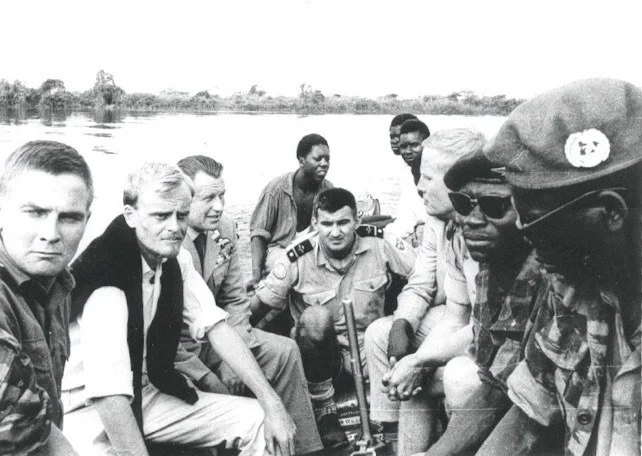
On at least two occasions, they are lined up against a wall to be executed by firing squad, but both times the orders are changed. Instead, they are told that they will be thrown to the crocodiles in the Luapula River. They are driven down to the river and forced into a wooden boat powered by an outboard motor.
Tim Knight writes:
In the photograph, from left to right: Bertil Wedin, Tim Knight, Major Munthe-Kaas, the boat owner, pilot Lennart Edvinsson, two gendarmes, pilot Olle Andersson, a gendarmerie officer, and the gendarmerie commander (wearing Munthe-Kaas’s UN beret).Source: Tim Knight.
"And so we cruise there on the smooth, black Luapula River with the rebel commandant wearing Wedin’s Husqvarna pistol and the major’s U.N. beret, while the crocodiles lurk down there underneath us in the blackness. Waiting, waiting. And all the while, the major and the commandant talk. Finally, the commandant makes a decision, orders the boat to return to the river bank. We drive back to the landing strip and the beautiful de Havilland Otter crouched there on the grass waiting for us. We’re going to live."
"Then, without warning, argument breaks out. An angry group among the rebels still want to kill these foreign spies. They swagger and strut and shout and threaten us with their rifles. But it turns out the commandant is more scared of the U.N. gunships than of his own soldiers. So he orders that if there’s no U.N. attack on Kasenga by sundown, we’re free to fly away. We wait. And watch the sun. And no-one in all of time has ever seen the sun sink so slow. We wait."
"Finally, in a magnificent climax of red, gold and deep purple — the most beautiful I’ve ever seen in all my life — the sun slips below the horizon and it’s dusk."
Lennart writes:
"We were still alive, but that was all we had left, because they had stolen everything else. Everything that wasn't fixed in place in the aircraft was gone, not even a map remained. We asked whether we could have our belongings back, but they replied that we could either keep our lives or our possessions. And since there wasn't much point in having our possessions without being alive to enjoy them, we got out of there as quickly as we could.
Enough about that. In any case, I'm feeling absolutely fine today, and the whole experience now feels like a bad dream."
[...]
"Take care. Lots of love and hugs from your Lennart."
Quisque iaculis facilisis lacinia. Mauris euismod pellentesque tellus sit amet mollis.