
WAR MEMORIES FROM KOREA, 1950
"Inside their helmets, the soldiers had placed little notes of their own, which read: 'If I am so badly wounded that I cannot speak, take me to the Swedish hospital in Pusan.' We could not have received a better endorsement."
Photo: Karl-Erik Rahm
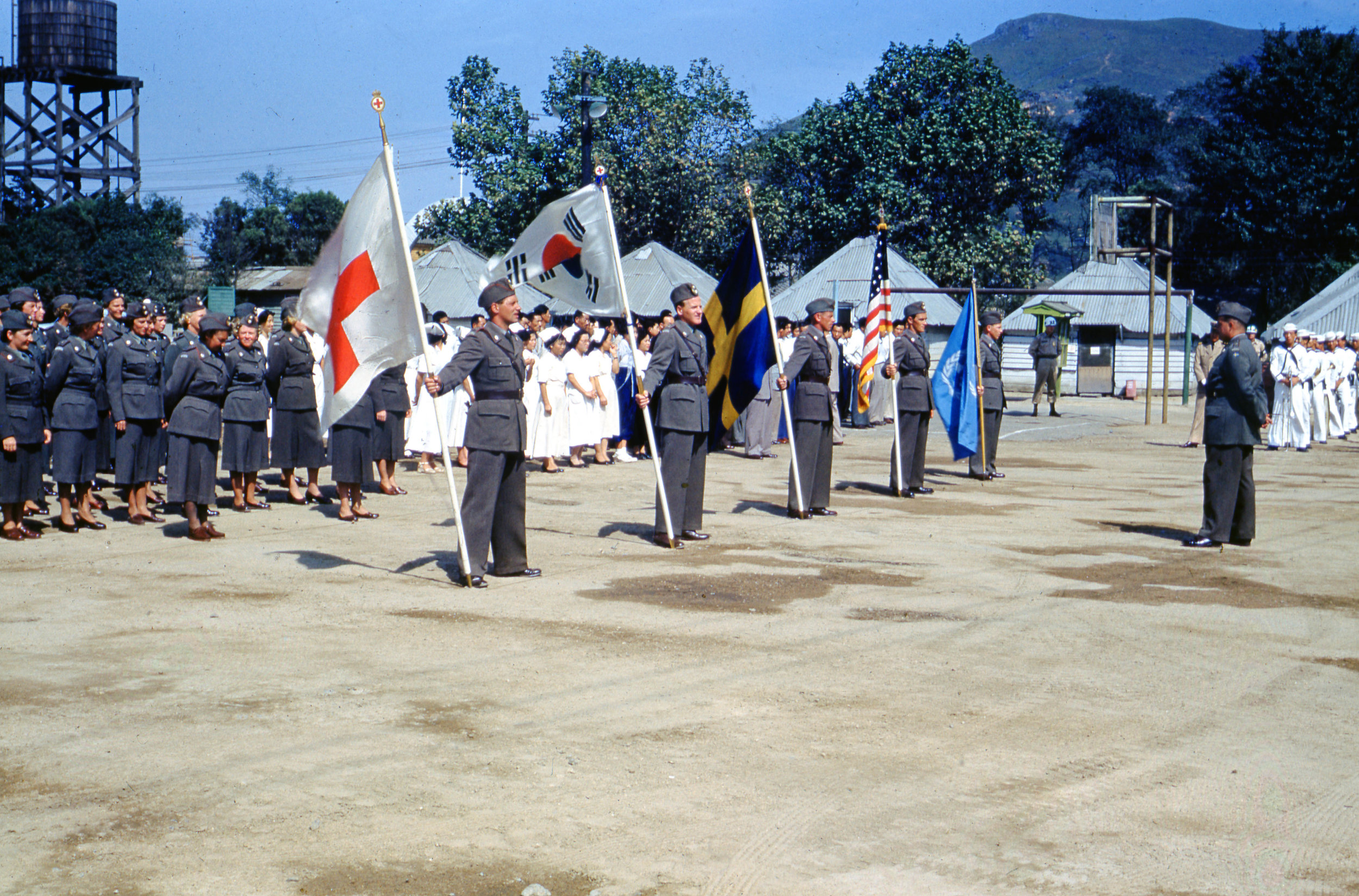
The year is 1950, and Kerstin Jonasson is training to become a nurse at St Erik's School of Nursing in Stockholm when she hears that the Swedish Red Cross is recruiting staff for a field hospital in Korea. She applies, is accepted, and on 24 August 1950, she and 177 other Swedes depart for the United States before continuing on to Korea. Below, you can read her story.
Korea, the Land of the Morning Calm, is a peninsula at the easternmost edge of mainland Asia. The peninsula is surrounded by the Yellow Sea and the Sea of Japan. Korea is a nation with a history stretching back several thousand years which, despite repeated occupations by Japan, China and the Soviet Union, has managed to preserve its culture, traditions and language. Between 1910 and 1945, Korea was occupied by Japan. Two million Koreans were sent to Japan as forced labourers. Not a single tree was spared on the Korean Peninsula.
In 1943, a conference was held in Cairo, attended by Churchill, Roosevelt and China's Generalissimo Chiang Kai-shek and his wife, Madame Chiang. During the conference, Chiang Kai-shek warned of the possibility of armed conflict in East Asia and specifically mentioned Korea. As so often throughout history, small countries have become battlegrounds for the interests of the great powers. Following Japan's surrender in the Second World War, the United States left a small supervisory force in Korea. The Soviet Union also maintained a supervisory force in North Korea.
North Korea is a mountainous country and now has a population of approximately 16 million. Since the division of the peninsula in 1948, the country has been almost completely isolated from the outside world. South Korea is an industrial and agricultural country. Its population is 40 million, of whom 11 million live in the capital, Seoul. At the outbreak of the war, North Korea had been infiltrated by communist influences from China and the Soviet Union, while South Korea upheld democratic principles. Political relations between North and South were extremely tense during the latter years of the 1940s. The United Nations became involved, and numerous conferences were held between the countries concerned. In 1948, the peninsula was divided quite arbitrarily along the 38th parallel. If I remember correctly, it took only 20 minutes during a UN meeting to carry out this procedure. It became increasingly clear that North Korea was preparing for war, mainly with assistance from the Soviet Union. China entered the picture later.
The preceding account is a very brief summary of the background to the events that followed.
On 25 June 1950, North Korea attacked its southern neighbour, and the armed conflict was fully underway. The Swedish government, together with the Swedish Red Cross, decided fairly quickly to send humanitarian assistance in the form of a field hospital. Around 20 July 1950, Henrik Beer, Secretary-General of the Swedish Red Cross, made an appeal on Swedish Radio, calling on Swedish men and women who possessed the necessary skills and courage to volunteer for service in the Far East.
How did I come to volunteer? Well, that is a good question. When Finland was attacked in 1939, I was 16 years old, and I felt very strongly that I wanted to make a meaningful contribution. I helped collect donations in the streets and squares of Stockholm and packed various supplies for Finnish soldiers through the Red Cross. There is not a single building in the Gärdet district of Stockholm whose stairs I did not climb while selling the White Rose of Finland.
When the Red Cross issued its appeal for assistance to Korea, that same feeling returned — the desire to take part and make a humanitarian contribution. I was 27 years old and had no personal commitments tying me down. I had completed my surgical training. I was still a student at St Erik's School of Nursing in Stockholm and had three months remaining before completing my education. I also had some knowledge of English. There was one possible obstacle: whether I would be permitted to interrupt my studies. The headmistress of my nursing school was very supportive of my decision and arranged with the school's governing board and the Swedish National Board of Health for me to receive special permission.
The second organisation I approached was the Red Cross, asking whether they had any use for a student nurse. They urged me to submit my application immediately. All that remained was to find out what my father and mother thought. I was legally an adult and knew what I wanted, but I still wished to hear their opinion. They were accustomed to my being away from home, as I had spent practically every year away since the age of eight. This time, I suppose the only difference was that I would be travelling a little farther. For my own part, I cannot remember giving much thought to the possibility that the assignment might involve danger to my life.
It took the Red Cross just four days to inform me that I had been accepted. After that, everything that needed to be arranged proceeded at a furious pace. Passports, visas (including having my fingerprints taken at the American Embassy and signing a written promise not to murder the President of the United States), numerous vaccinations, equipment, arranging insurance, writing a will, and so on.
On 24 August, Sweden's Red Cross Field Hospital for Korea was ready to depart, just two months after the outbreak of war. Sweden became the first UN nation to come to the assistance of South Korea and the United States. Nineteen other nations followed later. Denmark contributed a hospital ship, while Norway operated a small mobile first-aid station closer to the front. The Swedish hospital became a permanent medical facility in the city of Pusan. The other seventeen UN nations provided military assistance.
There were 178 Swedes, including 34 women, who were transported across the Atlantic with the assistance of SAS, travelling on four separate flights. In the United States, we were to receive additional equipment, continue our vaccinations and undergo further training in preparation for what lay ahead.
I was among the 48 people in the first group to leave Sweden. It was a solemn and emotional moment at Bromma Airport as, one by one, we boarded the DC-6 that was to transport us. The aircraft made its way across the Atlantic at an altitude of 2,000 metres, stopping twice to refuel: at Keflavik in Iceland and Gander in Newfoundland.
Eventually, we arrived at Idlewild Airport, now Kennedy Airport, in New York. We received an extraordinary welcome. The fact that a small, relatively poor country in the Nordic region had managed to equip an entire field hospital for Korea was considered a great sensation. Television crews were there — it was the first time we Swedes had encountered that medium — and representatives of major military organisations welcomed us. Life magazine was also there taking photographs. One of the girls even became a cover girl. The Swedish flag flew alongside the flags of the United Nations and the United States on the airport's main building. Naturally, we were overwhelmed by this reception, particularly as we had not yet accomplished anything. From the airport, we travelled under police escort to the military camp at Fort Dix in New Jersey, approximately 160 kilometres from New York. Here, we were to wait for the rest of the group. The vaccinations continued, and for about a month we walked around feeling slightly feverish from all the injections we had received.
The Americans did everything they could to make us as comfortable as possible. Eventually, everyone had assembled, and the next stage of our journey began. We flew from Philadelphia to San Francisco aboard what was then the world's largest passenger aircraft, the Constellation, divided between two flights. We had an enormous amount of luggage: surgical instruments and other medical equipment, all our personal suitcases, and large quantities of Macrodex, the new plasma substitute developed by Pharmacia, which was used on a large scale for the first time in Korea.
In San Francisco, we were accommodated at Camp Stoneman, another large military camp and the embarkation point for all American soldiers bound for Korea. We stayed there for five days, and the atmosphere was very serious.
Around 10 September, we boarded the "General Anderson", a warship that had been converted into a troop transport. Besides the 178 Swedes, there were 2,000 paratroopers on board, along with a large crew. The ship departed from Fisherman's Wharf, and as we sailed beneath the Golden Gate Bridge and out into the Pacific Ocean, all the paratroopers threw their caps into the sea. Many of them were crying. At that moment, my knees began to tremble, and I wondered what I had got myself into. The voyage across the ocean took twelve days. We followed a zigzag course for much of the journey and, among other places, passed close to Hawaii. The ship was equipped with radar and felt safe, but the Russians naturally knew what kind of transport it was, so it was important to keep out of their way. The paratroopers were to be dropped behind enemy lines to cut off lines of communication and supply routes. Later, we treated many soldiers from the 187th Airborne as patients, after they had been shot by enemy marksmen while descending through the air during their parachute jumps.
We crossed the International Date Line in the Pacific, so we had two Thursdays in the same week. Throughout the voyage, we received instruction on the organisation of the American military compared with that of the Swedish armed forces. Realistic films from the Korean front were shown out on deck after darkness had fallen. We were also taught how to handle small arms. Sometimes, we were awakened in the middle of the night and ordered to reach our designated lifeboats within 30 seconds. As we approached the Philippines, we encountered a typhoon. The wind was said to have reached approximately 35 metres per second. It was an incredible spectacle to watch the enormous, green-shimmering waves. Only one other girl and I escaped seasickness, which was certainly a pleasant discovery. The typhoon lasted approximately five hours, and the ship was tossed about like a tiny nutshell.
Aboard the General Anderson
On 21 September 1950, we arrived at a small port town in Japan called Sasebo. The Swedes were not allowed to go ashore until the 187th Airborne had left the ship. During the night, I was awakened by the sound of marching boots as our fellow passengers disembarked to continue their journey towards uncertain fates. We had not been permitted to socialise with the paratroopers during the voyage. Their military discipline was so strict that it was considered that we, most of whom had no military training, might disrupt it. The Swedes were accommodated on the uppermost deck alongside the American officers, so we enjoyed rather luxurious conditions on board.
On our second day in Sasebo, we were allowed ashore to await another vessel that would take us to Korea. We spent the entire day sitting on our luggage in the harbour, supplied with American military field rations. They were high in calories but rather dry. Towards evening, an old ship came alongside the quay. This was the vessel that would carry us on the final leg of our journey. Everyone was sprayed with DDT because there was a risk of vermin on board.
Night was approaching when the ship departed from Sasebo. Most of us sat out on deck, singing Swedish folk songs for much of the night. Small fishing junks were out fishing in the moonlight. Apart from the steady throb of the ship's engine, everything was very peaceful. We neither heard nor saw any signs of war.


We renamed the school's main building "Folke Bernadotte". The ground floor housed offices, an admissions department, an X-ray department, a preoperative room, three operating theatres, a sterilisation room and a postoperative recovery room (intensive care) with space for twelve patients. On the first floor, there was room for 150 patients. The wards were equipped with proper beds. This was where American and UN soldiers with more serious injuries were primarily treated. The hospital was designed to accommodate 250 patients.
Those who have seen the American television series "M.A.S.H." may have some idea of what conditions were like for us, as the equipment and surroundings were exactly the same. A number of tented barracks were erected in the schoolyard, each accommodating 36 patients. The patients lay on stretcher-like camp beds, provided with a pillow and two blankets. As we were an evacuation hospital, patients remained with us only until they could be transferred to a large military hospital in Japan without the risk of going into shock. One barrack was reserved for patients suffering from tetanus. We had many such cases among the wounded Korean soldiers. Another barrack was reserved for those who had died. Fortunately, our mortality rate was low, and we became known for it. Inside their helmets, the soldiers had placed little notes of their own, which read: "If I am so badly wounded that I cannot speak, take me to the Swedish hospital in Pusan." We could not have received a better endorsement.
Several of the Swedish men lived in barracks. The American liaison officers lived in twelve-man tents, each with a large oil-fired stove in the centre. Considering the circumstances, their accommodation was actually quite comfortable. A large corner of the schoolyard had been set aside as the motor pool, housing ambulances, jeeps and other vehicles. Another part of the yard contained the main entrance, guard facilities and the water tower. The female staff lived in a wooden barrack divided into small cubicles, each containing three bunks stacked one above the other. It was impossible to sit upright in either of the two lower bunks. There was also one chair in each cubicle. Clothes were kept at the foot of the beds. Whoever occupied the top bunk used her suitcase as a desk when writing letters.
There was a kitchen barrack with an adjoining dining area, which also served as a sitting room, meeting place and cinema. A small tent served as both a church and a post office. Another tent housed the laboratory and laundry facilities. There were washing and toilet facilities in the staff quarters, although we did not always have running water. The women's toilet was guarded by soldiers carrying rifles fitted with bayonets. It was a little disconcerting at first, but one becomes surprisingly accustomed to unusual circumstances.


It took a couple of days before we were able to receive patients on a larger scale. We went to the large American field hospital in central Pusan to provide some relief for the staff there, who had been working extremely hard without a break for three months. This also gave us an opportunity to get to know one another.
When the first patients arrived at our hospital, everyone wanted to pitch in and work. However, it was important from the outset to adhere strictly to the boundaries of shift work and conserve our strength for our own shifts. We worked twelve-hour shifts, except on Saturdays, when we worked eighteen hours so that one of the shifts could have an additional six hours off.
A curfew was in force for most of our stay. On the rare occasions when it was lifted, we were never allowed to leave the hospital grounds unless we were in a fairly large group. Guerrilla units were operating right on our doorstep. They cut electricity cables, set fire to the water tower and blew up a UN ammunition depot one kilometre from the hospital. The explosion shattered every windowpane in the hospital, and glass was in extremely short supply. At night, we sometimes treated sick civilians, and word of this spread very quickly. As a result, the Swedish hospital became popular among the Koreans. The guerrilla activities directed against us gradually ceased, and we began to feel safer.
We worked very well with the Americans and the United Nations. On one occasion, we had patients from sixteen different nations, speaking thirteen different languages. Before the wounded were admitted, they had to pass through a delousing tent, where they surrendered all their clothing and had all their dressings removed. Each patient was given two clean blankets to wrap around themselves, after which the admissions procedure began. This was sometimes quite problematic, as most Koreans seemed to be named Kim or Lee, and everyone had their birthday on Korean New Year's Day.
In the preoperative department, patients were prepared for the various surgical procedures they were to undergo. We encountered the entire range of gunshot wounds and injuries. I have always felt that amputation is an extremely traumatic experience. It is even worse when there is no possibility whatsoever of obtaining an artificial limb. Gunshot wounds to the abdomen are also generally very serious, as are injuries caused by napalm bombs.


Among our group were two young men from Vejbystrand who were exceptionally skilled at applying plaster casts. They became very popular with the American doctors. A major problem arose when wounds had not been completely cleared of maggots. After a couple of days, the maggots could begin crawling around beneath the plaster casts. One of the doctors and I became quite skilled at removing any visible maggots. This description may sound unpleasant, but we soon learned that the maggots fed on old, damaged tissue, leaving the wounds relatively clean and healthy. Maggots were found in soldiers whose wounds had remained untreated for a long time and who, in their weakened condition, had been unable to keep the flies away.
It is difficult to say what made the strongest impression on me, or what has remained most deeply etched in my memory, when it comes to the work itself. I think it must have been the evening when the first prisoners of war arrived. Terrified, wounded and emaciated North Korean soldiers, and later Chinese soldiers as well, arrived in small groups. They squatted outside the delousing tent with the letters POW (Prisoner of War) painted in large red letters across their backs. Their South Korean compatriots walked around the group of prisoners carrying rifles fitted with bayonets and spoke to them very aggressively. The American and UN soldiers were upset that we Swedes treated the prisoners without discrimination. They had no knowledge of the Geneva Convention. We received 1,200 prisoners of war before that part of our work came to an end. The American and UN soldiers naturally had every reason to react as they did, since they knew how they themselves were treated when taken prisoner of war.
North Korean prisoners of war. Photo: Gerhard Rundberg.
The front line was constantly shifting, as were the fortunes of the opposing forces. At one point, the front was only 30 kilometres away from us. All communications with the outside world were then cut off for an entire week. We admitted 650 patients into a hospital designed for 250. I can assure you that conditions were extremely cramped, and how we managed to cope with the situation is almost beyond comprehension. We were so busy that we hardly had time to realise we were in danger. I think it was probably worse for our families back home.
Most patients arrived in the evening or during the early part of the night, which meant that the nights were the busiest. The surgical team to which I belonged performed thirteen major operations during our first night on duty. On another night, when the hospital was overflowing with patients, the same surgical team performed sixty major operations. Seven doctors were working that night, all seven of whom had arrived with the first group. During the first year, we treated 10,200 patients.
On 29 October 1950, King Gustaf V of Sweden died, and on that same day, 250,000 Chinese troops crossed the 38th parallel. The situation was beginning to look grim for General Douglas MacArthur and the American and UN soldiers under his command. It also became a memorable day for me. I tripped over a tent rope in the darkness while returning from the kitchen, where I had been collecting sandwiches for the hungry operating theatre staff. The knee injury I sustained was serious enough to require two operations. Among other things, my anterior cruciate ligament had been torn. Fortunately, there were no infectious complications, but restoring normal mobility proved difficult because of pain and scar tissue. I was able to sit and administer anaesthesia, even though my leg was in plaster, and I also helped in the admissions department, which was a very valuable learning experience.
We occasionally received some very distinguished visitors. Among them were five-star generals, although MacArthur himself never came. Bob Hope was one of many entertainers who performed for the patients and for us. Films were shown almost every day for patients who were well enough to get out of bed and for members of staff who were off duty. Otherwise, our existence consisted of little more than working, eating and sleeping.
The initial contracts for the first group of personnel sent to Korea were for six months. Some extended their contracts, but most of us in the first group were beginning to look forward to being relieved. We had, quite understandably, become rather exhausted. Our journey home began on 12 February 1951, aboard a Hercules aircraft bound for Tokyo. From there, we travelled with SAS. It was the first time an SAS aircraft had visited Japan. From Tokyo, our journey took us via Okinawa, Bangkok, Calcutta, Karachi, Lydda, Rome and finally Stockholm. For those of us who had been there from the beginning, the entire journey had effectively taken us around the world.
We were given five days' holiday in Bangkok. At that time, the city truly was the jewel of the Far East, with its beautiful temples, elephants wandering through the streets and virtually no motor traffic. Transport consisted almost entirely of bicycle taxis, known as rickshaws. Everything was wonderfully exotic. Nowadays, I understand that Bangkok has four million cars and so many high-rise buildings that the temples are no longer visible. And there are no elephants wandering through the streets.
We arrived in Stockholm on a cold February evening. After everything I had seen and experienced, it felt as though I had been away for several years. I had encountered a culture so completely different from our own and had witnessed the horrors of war at first hand. It had also been interesting and educational to experience how a small group of people from another country could establish themselves in a completely unfamiliar environment and, at times, work under extremely difficult and primitive conditions.
When I returned to my nursing school, the headmistress had arranged with the relevant educational authorities for four of my six months in Korea to count towards my surgical training. The surgical knowledge and experience I had gained over there were things I could never have acquired at home.
The Korean War has been called the Forgotten War. In 1995, the United States, together with the United Nations, decided to erect a memorial in Washington and invite Korean War veterans to attend its dedication. Eight veterans from Sweden attended, including myself. It was an extraordinary experience that lasted six days. On the first day, we took part in a deeply moving and solemn ceremony at Arlington National Cemetery, where all the veterans, many thousands of them, were given the opportunity to lay flowers at the Tomb of the Unknown Soldier. The memorial was then dedicated in the presence of President Clinton, Vice President Gore and South Korean President Kim. It stands opposite the Vietnam Veterans Memorial.
On the final day, all the veterans, representing 21 UN nations, marched behind their respective national flags along Constitution Avenue, a distance of approximately 1.5 kilometres. According to police estimates, some 200,000 people lined the pavements. As our small Swedish contingent passed, many people shouted, "Thank you, Sweden! Thank you, Sweden!" Tears streamed down my cheeks, and I felt an overwhelming sense of gratitude that I had been given the opportunity to make a contribution and had returned home safe and sound.
Forty years after our mission, in 1990, I returned to Korea. It was an almost unbelievable experience to see this once utterly devastated country now flourishing as one of the world's major industrial nations. Trees and shrubs had been planted, and everything looked remarkably prosperous. Despite all attempts at mediation, no solution has yet been found to the conflict between the two countries. The area around the 38th parallel remains the most heavily guarded in the world.
-Kerstin Jonasson
Quisque iaculis facilisis lacinia. Mauris euismod pellentesque tellus sit amet mollis.