
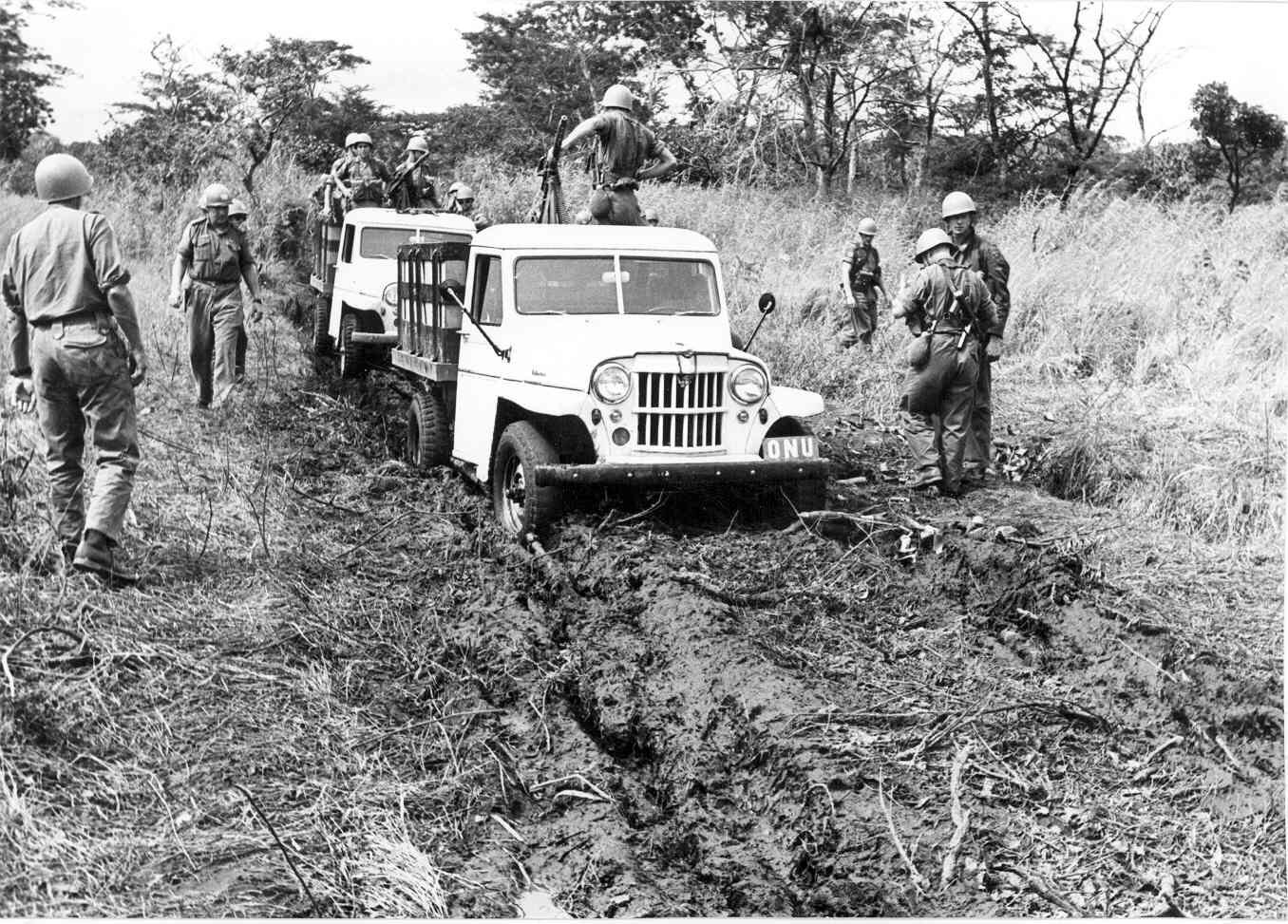
NINE-DAY PATROL IN THE CONGO

In this account, we share Rolf Larsén’s memories of a long-range patrol in the Congo while serving with the 3rd Platoon, 3rd Company, of the 10th Swedish UN Battalion. The patrol took place from 9 to 17 March 1961.
This account is based on the notes I wrote down each day during the patrol. My role as a soldier was that of a machine gunner and sniper.
The purpose of the patrol was to monitor and observe how far Tshombe’s gendarmes had advanced northwards towards the Baluba territories and to visit mission stations in the area. Another objective was to demonstrate the United Nations’ presence in the region.
The patrol was the longest undertaken by any unit, lasting nine days and covering 1,850 kilometres. The 3rd Platoon was reinforced by several specialists, including interpreters, doctors, and a headquarters photographer. In total, the patrol consisted of approximately 40 men.

2533 Bertil Svensson, 2529 Åke Carlsson, and 2531 Lennart Staaf, 3rd Squad in firing positions.

4th Squad on high alert during the patrol. From left to right: 2537 Sandqvist, 2540 Larsén, 2538 Hellström, 2542 Nilsson, and 2539 Bengtsson.
Patrol Composition, Vehicles, Weapons, and Communications Equipment:
Platoon Commander: Lieutenant 2507 Torvald Fält.
Deputy Platoon Commander: Sergeant 2508 Bengt Rahm
Medic: 2509 Bengt Göransson
1, 2, 3 och 4 grp
Interpreters: Lieutenant 1679 Stig von Bayer and Second Lieutenant 2142 Per Brandström
Medical Officer: Captain 297 Bengt Veide
Headquarters Photographer: Sergeant 2134 Lennart Gullberg
3 Jeeps
3 Trucks
Weapons:
Submachine gun with 6 magazines
m/42B machine gun
Ag 3 rifle (with telescopic sight)
Carl Gustaf recoilless rifle
Pistol
Bayonet
Hand grenades
Smoke grenades
Communications Equipment:
RA 120 shortwave radio

The Extended Patrol. Map sketch drawn by Deputy Platoon Commander Sergeant Bengt Rahm.
Thursday, 9 March
Reveille at 0400 hours. Packed my bag and left it by the truck in which three others and I were to travel.
0500 hours. Breakfast: hot chocolate and a cheese sandwich.
0530 hours. Assembly. Lieutenant Fält briefed us on the day's route.
0545 hours. We reported to the battalion commander, Colonel Kjellgren, who emphasised the importance of our mission and wished us good luck. (Thank you.)
0600 hours. We set off, with Jadotville as our first destination. The sun was rising above the horizon, and it looked as though we were in for fine weather.
0800 hours. A five-minute break a few kilometres before Jadotville.
We arrived in Jadotville at 0845 hours. All the vehicles were refuelled at the Fina petrol station on Avenue Astrid, and we continued our journey.
After about ten kilometres, it began to rain. The roads became as slippery as soap and, for the most part, resembled badly ploughed fields. The sun eventually reappeared, and the road conditions gradually improved. However, the roads never really become good, as they are badly damaged by traffic during the rainy season.
We passed through many small native villages, where people waved and shouted at us: "ONU eloppopå, ONU eloppåpå ane va na."
At 1100 hours, we stopped for lunch, having passed through the village of Mwepu-Busepa a few kilometres earlier. We were served boiled sausages and potatoes. After 25 minutes, we continued our journey.
We began climbing into higher terrain, with the road winding along mountain ridges and down into valleys. It was a beautiful sight as we descended into the valley where the village of Bunkeya lay. There is a convent in the village, where we stopped to ask for directions.
We then continued through a flat area of bushland where everything looked much the same. We saw no villages from the road either, and the whole area seemed rather deserted.
We had to stop several times, including when one of the vehicles slid into a ditch. It had to be pulled out by another vehicle. As we realised that we would not reach Mitwaba that day, we decided to stop at a hotel called Chutes de Kiubo.
Nearby lies the village of Musabira and a large waterfall. Here, the Lufira River plunges over the cliffs with a tremendous roar.
A magnificent sight.
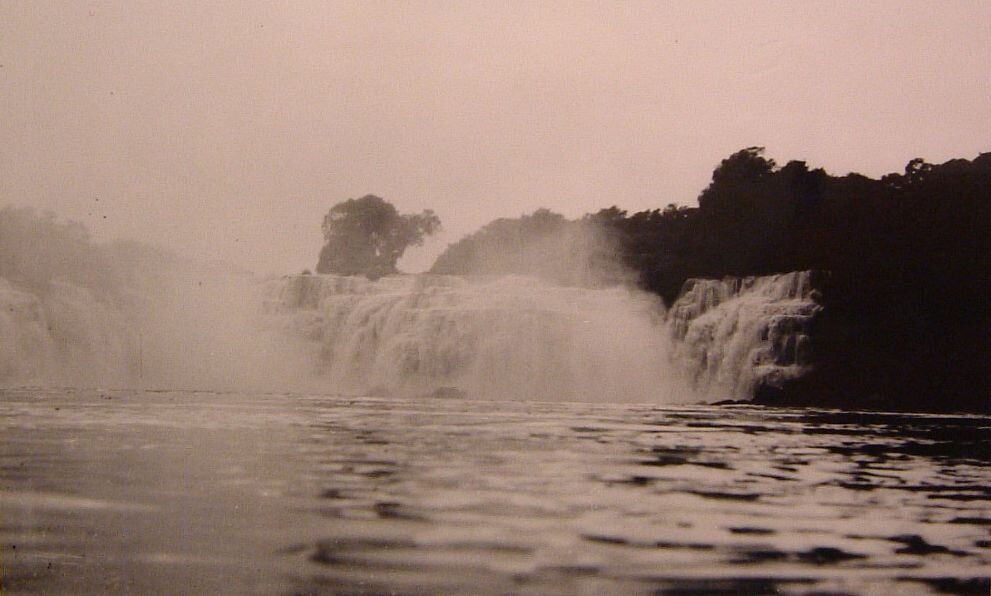
Kiubo Falls
Here we were accommodated in small rooms, with seven men sharing each room. The vehicles had kicked up so much dust that we were covered in the Congo's red earth. After finding a bed, it was wonderful to be able to take a shower. Then it was time for dinner, which consisted of Fray Bentos corned beef, potatoes, and an apple. Each man was also given either lemonade or Simba beer. I chose Simba.
After that, it was time to go to bed so we would have enough energy to get up the following morning. Tomorrow, the waterfall would be filmed, the vehicles loaded, and we would set off on new adventures. A couple of kilometres upstream from the falls, there are hippopotamuses, while crocodiles inhabit the river below. The waterfall has a drop of approximately 35 metres and is about 150 metres wide. The river below the falls is around 40 metres deep.

Simba – The World's Best Beer!
Friday, 10 March
Reveille at 0600 hours. Coffee and breakfast, followed by loading the vehicles. Departure at 0820 hours.
It was raining and gloomy. The roads were like little streams, with water flowing along them. Eventually, the rain stopped, but there was no chance of the sun making an appearance.
Yesterday, we travelled through miserable bushland, and every ten kilometres looked much the same. Today, we left the flat landscape behind and travelled through beautiful valleys and up into high mountains. The scenery was magnificent. In places, we could look down into beautiful valleys where the native villages resembled clusters of beehives. At one point, we passed a stream where lianas grew and climbing plants had wrapped themselves around the trees like clothing. Birds chirped cheerfully from the bushes.
The villages now began to appear more frequently. Both small children and adults stood watching us, waving and shouting, "ONU, ONU!"
We reached our destination, Mitwaba, at 1415 hours. By now, the sun was shining again. Here, we are to be accommodated in an old cinema and a tavern. We cleaned the premises and prepared our sleeping places, after which it was time for a meal of porridge and sandwiches.
Then it was time for weapons maintenance. Dinner consisted of Swedish sausage pudding (korvkaka), fruit compote, and Simba beer.
Tomorrow, a patrol will head approximately 100 kilometres north. Tonight, the 3rd and 4th Squads will stand guard at our quarters.
Mitwaba lies at an altitude of 1,500 metres and is spread out over a large area. The surrounding countryside is very beautiful.
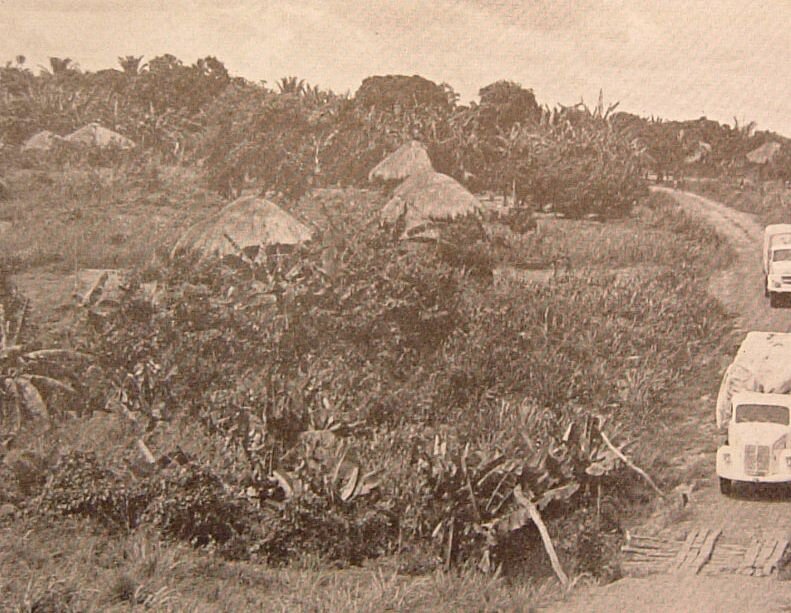
The patrol passes through a village.

Mitwaba – The Patrol's Quarters
Saturday, 11 March
Reveille at 0600 hours. Breakfast at 0630 hours. Assembly at 0700 hours. I was on guard duty last night from 0300 to 0500 hours.
After assembly, a jeep patrol consisting of the 1st and 3rd Squads set out in three jeeps for the village of Djobo, approximately 74 kilometres north of Mitwaba. On their way, they would pass through the village of Tambo, where, on Wednesday, a patrol from the Katangese Army had been attacked by ANC soldiers. No Katangese soldiers were wounded, but they had managed to "silence" a machine gun. They did not know whether its crew had been killed.
While waiting for the patrol to return, we visited an area where people were prospecting for gold by digging in the ground. We also filmed the magnificent view overlooking Upemba National Park.
At 1200 hours, the patrol returned without incident. They had encountered gendarmes shortly before reaching Djobo. The ANC had burned a bridge, preventing them from continuing. Lunch was waiting, and the vehicles were refuelled. We would then proceed to the village of Kisele, where the trucks were to remain.
The jeeps would continue on patrol to the village of Kishiale before returning to Kisele. From there, we would head towards Pweto, travelling via the villages of Dobie and Luaza. At 1315 hours, we departed Mitwaba, heading for Kisele. After approximately 45 minutes, it began to rain. We encountered a truck in the bush that had run out of petrol, so we gave the driver some of ours.
We continued our journey. We were now travelling through very hilly countryside, where small streams cut through the valleys like blue ribbons. There were beautiful flowers and lush vegetation everywhere. At around 1700 hours, the road collapsed beneath one of the trucks.

Time to get to work again!
The truck sank into the ditch with its left wheels. While we were working to free it, another truck also sank into the soft ground as it tried to reverse towards the one in the ditch to tow it out. Two vehicles carrying soldiers from the Katangese Army approached from the opposite direction. They helped us get the trucks back onto the road.
To provide traction and reinforce the damaged road, we had to dig, cut down trees, and place branches and timber beneath the wheels. We also had to unload one of the trucks, as its cargo consisted of petrol drums. Once we had freed both trucks, we managed to drive about 600 metres before exactly the same thing happened again, this time on a downhill slope. We had to repeat the whole procedure.
After that, it was time to set up camp. The tents were pitched, and the cook prepared something for us to eat. Tord and I slept in the truck. It was around 11 o'clock at night when I went to bed.
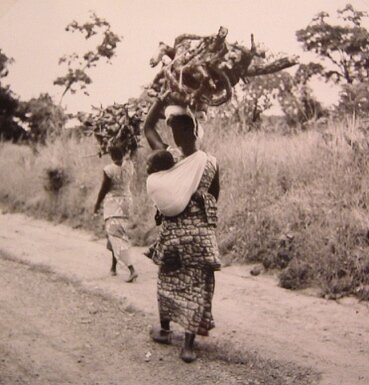
Firewood on the way.

Curious children in a village.
Sunday, 12 March
Reveille at 0600 hours. Breakfast at 0700 hours. At 0800 hours, we set out on a jeep patrol with the 2nd, 3rd, and 4th Squads. Our destination was Kishiale.
The road was good for approximately 15 kilometres. Shortly after the village of XX, we turned onto a newly cleared road that had been used by the gendarmes. After only a few kilometres, one of the jeeps became stuck in a long stretch of mud. We had to push, dig, pull, struggle, and tow it with another jeep before we finally managed to free it. And so it continued along the entire road. When we reached another, older road, conditions improved.
As we travelled through the swamps, we were attacked by enormous swarms of tsetse flies. Fortunately, there was no sleeping sickness in this area, but it was still very unpleasant. The flies even bit through our clothing. Whenever we arrived at a village, it appeared to be deserted. After a while, one brave member of the local population would emerge, and once they had learned who we were, everyone else came out of the jungle.

2nd and 3rd Squads ready to depart in Kisele.

2508 Rahm checks, 2540 Larsén at the machine gun, while 2536 Jansson waits.
When we entered Baluba territory, we encountered roadblocks every hundred metres. Most consisted of felled trees, while in some places there were so-called "elephant pits". We had to drive around them to get through. Here, we were in the jungle, where monkeys moved among the trees, while parrots and guinea fowl flew off as we approached. There were also many birds that we could not identify. They were very beautiful. The terrain was quite hilly, so we certainly couldn't complain about the views—on the occasions when we were actually moving. Most of the time, we were stuck in the mud.
We passed through many burned-out villages. Weeds were growing wild where the local inhabitants had once tended their small garden plots. The first villages had been destroyed by the Baluba. A little farther north, the gendarmes had been responsible for the destruction. It was clear that these villages had been burned more recently, as the soot on the ruins had not yet been washed away by the rain.

Roadblock
The patrol arrived in Kishiale at around 3:30 p.m. A platoon of gendarmes was stationed there, with their weapons loaded, safety catches off, and ready to fire from their defensive positions. When they realised that we were from the UN (ONU), they immediately came forward and appeared nothing but pleased to see us. We spoke with them for a while and filmed the village. It had been burned down by the Baluba, but the gendarmes had returned and established defensive positions.
We then set off on the return journey along the same route. This time, we had both darkness and the poor road conditions to contend with. However, it turned out that we had learned how to negotiate the mud holes. The return journey went remarkably well, without a single vehicle becoming stuck badly enough to require towing. We arrived back at camp, where the 1st Squad had been anxiously awaiting our return. We had originally been expected back at 1:00 p.m., but instead we were six hours late, finally arriving at around 8:00 p.m.

4th Squad leads the advance towards Kishiale, followed by 2nd Squad.
While we had been away, a UN aircraft had flown over the camp and dropped messages. They were from Headquarters (HQ), stating that the Baluba had received orders from ANC troops to eliminate all UN (ONU) units except the Nigerians. The Swedes were regarded as Belgians in disguise.
We in the 3rd Platoon were instructed not to travel to Djobo, where we had been on Saturday. Nor were we to go to Kishiale, where we had been today, as there was a possibility that the Baluba or ANC forces might attack.
After eating, we turned in for the night. Later, I was woken for my guard duty from 0300 to 0500 hours. Tomorrow, we will continue first to Dubie before proceeding to Pweto.

Tent Camp
Monday, 13 March
As usual, we got up at 0600 hours. Breakfast, followed by packing up the tents and other equipment. At 0800 hours, we set off. The 4th Squad travelled in the jeep again today. I prefer travelling in the jeep, as it gives me the opportunity to film whenever the vehicle stops. Everything went smoothly, and the road was good. In the village of Kibemba, we stopped to take photographs and hand out some toys to the children.
Then we continued our journey. Everything went well until we were a few dozen kilometres from Dubie, when the trucks became stuck. After a couple of hours of hard work, we managed to free them and continue. We encountered several more places where we could easily have come to a complete standstill. Eventually, the road became really good. Then it started to rain. Those of us travelling in the jeeps naturally got soaked. The roads turned into rushing streams, but the vehicles managed to keep moving. About ten kilometres from Dubie, the rain stopped.
We arrived at the village of Dubie and continued to the Dubie mission station, where we were given accommodation and the cook prepared a meal. It was 3:30 p.m. when we began unloading our equipment, camp beds, bags, and other belongings. When we arrived, we were dirty, unshaven, and hardly a pleasant sight. But a razor, water, and soap worked wonders.
We had not washed for two days and had spent much of that time digging, pulling, and struggling with filthy vehicles. Our boots were like lumps of mud on our feet. There was certainly no doubt that we needed a thorough wash. Here, we are sleeping indoors, which is a good thing, as camping in the rain is far from pleasant.
Tonight, at 0600 hours, we are going to listen to the World Championship boxing match between Ingo and Floyd. Tomorrow, we will continue to Pweto. From there, a jeep patrol will set out for Mwenge.
I have just been outside listening to and watching the pupils from the mission school, boys aged around 10–12, singing and dancing to traditional songs from their country. These are the kinds of memories one never forgets.
Tuesday, 14 March
Got up at 5:30 a.m. to listen to the World Championship boxing match. We had difficulty tuning in to the right frequency, but managed to hear the result on an English-language radio station.
At 0700 hours, we set off. The roads were now good, and we travelled at quite a speed on the downhill stretches. There were a few uphill sections at first, but after that it was almost entirely downhill until we were a few kilometres from the village of Luansa, where two jeeps turned off towards the mission station. The trucks continued towards the ferry on Lake Mweru (Lac Moero).

The Ferry Crossing.
The ferry crossing is just before Pweto, across the Luvua River. We drove to Luansa, which was situated on the slope overlooking the lake. A very beautiful place. After waiting for about an hour, we were able to continue towards the ferry.
By now, we had taken on some extra passengers in one of the jeeps: three local people with two small children. They were on their way to the hospital in Pweto. Space became rather cramped, as they had brought all their luggage with them: four sacks of flour and a couple of large bundles. Nevertheless, we managed quite well along the very hilly and rather poor roads.
At the ferry, we had to wait a while before it was our turn to cross. And so, at last, we were in Pweto. Three times I had packed my belongings in preparation for going there, and now I had finally arrived.

The Camp at Pweto.
The camp was the same one that had been used when the detachment was stationed here. A large number of children gathered and sang for us. After we had eaten, arranged our accommodation, and taken care of other tasks, we drove to the ferry landing to collect water. In the evening, we had a campfire. The children sang songs from their homeland, and we sang ours.
Pweto is a long, sprawling village with a hospital and a church. It is beautifully situated at the northern end of Lake Mweru (Lac Moero). Behind our camp is a village inhabited entirely by people suffering from leprosy. The sights that greet you there are far from pleasant.
Tomorrow, a jeep patrol will set out for Mwenge at around 0700 hours. It will consist of the 1st, 2nd, and 4th Squads, as the 3rd Squad has already been there. I'll see whether I can buy a bow and arrows in the village of Kabansa. The weather today was not particularly good, with frequent light rain.
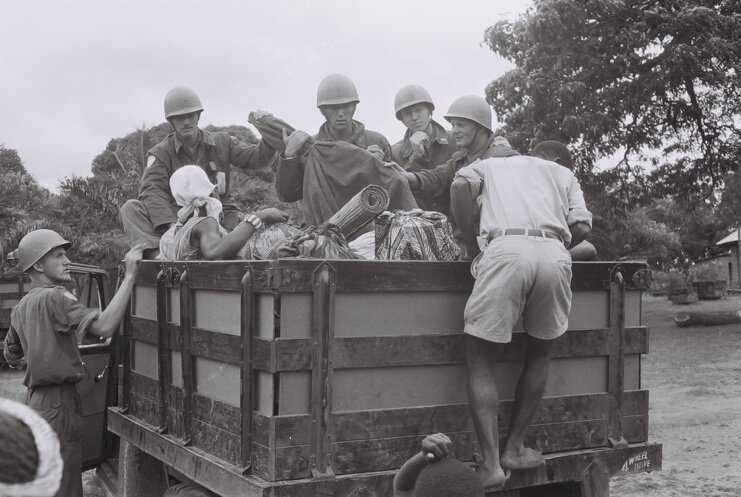
On 14 March, a family was given a ride to the hospital in Pweto.
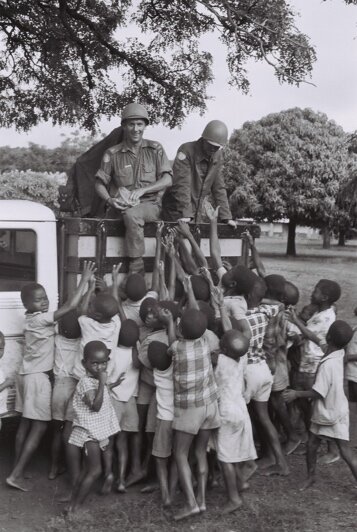
Nilsson and Sandqvist Hand Out Sweets
Wednesday, 15 March
Reveille at 0600 hours. Breakfast at 0630. At 0700 hours, the patrol set out for Mwenge. It was the 1st, 2nd, and 4th Squads that departed. The road was good, and we travelled at high speed. The terrain was quite hilly, with beautiful views.
We did not stop for any breaks. The only interruption came when a truck blocked the road. Out came the spades, and we dug away part of the roadside embankment so that the jeeps could get through. The countryside was quite hilly, and in places we had magnificent views.
We passed through many villages where the people cheered us. The Swedes are popular up here because we have helped the local population against the Baluba on many occasions, including around New Year.

Road Obstacle
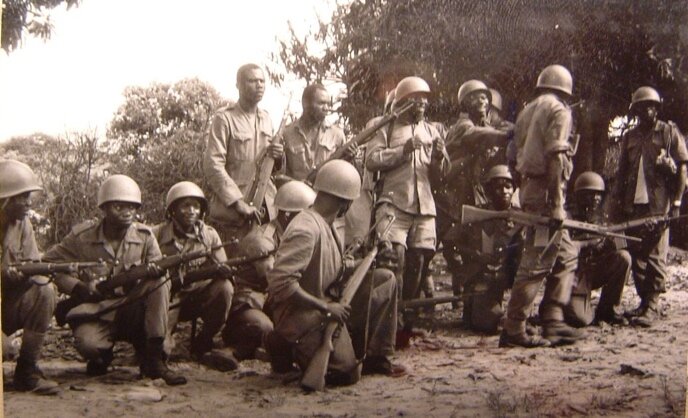
Katangese Soldiers
The journey went well, and at around 1000 hours we reached our destination, Mwenge. Katangese gendarmes were stationed here in newly built grass huts. After talking to them for a while, it was time to load the machine guns and prepare the hand grenades, two per man. At 1030 hours, we crossed the border into Baluba territory.
We were now on maximum alert, and there was a certain tension in the air. Anything could happen here, some 20 kilometres into an area where the Baluba might be lurking behind every bush and in the tall elephant grass. We passed several burned-out villages, where nature had quickly reclaimed what it had once lost to its Black inhabitants. We reached a crossroads where a message was hanging in a tin can. It had been written by the people living along the border with Baluba territory. It stated that they did not want to fight but simply wished to live their lives. However, if the Baluba refused to make peace and instead chose war, they would be met in kind.
We travelled deeper and deeper into "no man's land", but so far we had not seen any of the feared Baluba.
We passed several burned-out villages, with all our senses on high alert and our weapons ready, and... We reached our destination, Mwpanga, without having seen any Baluba. The bridges across small streams had been torn down, forcing us to make detours and cross at other places. We now turned back towards a fork in the track, intending to take the other route to a place called Mya Mwpanga.
However, we were unable to reach it and had to turn back after travelling a couple of kilometres. The bridge across a stream had been burned, and the banks were so steep that it was impossible for the jeeps to get through. There was nothing to do but turn the vehicles around and head back towards Mwenge. After taking a break there and unloading the machine guns, we continued our journey back to Pweto. On the return journey, we asked about bows and arrows in several villages, but the villagers did not want to sell any because they had so few.
In one village, we stopped for quite a while to hand out toys to the children. Even the adults were delighted to receive something as simple as a balloon. While we were there, a UN aircraft, a DC-3, appeared and swooped down over us. Another message was dropped. It read: "Detachment Fält is wished the best of luck. Hope all is well. Carry out your mission. Colonel A. Kjellgren."
By the time we returned to Pweto, it was raining, and we were able to turn in early. I was due to stand guard during the night. Tomorrow, we begin the journey home.

1679 Stig von Bayer Interpreting in Swahili.
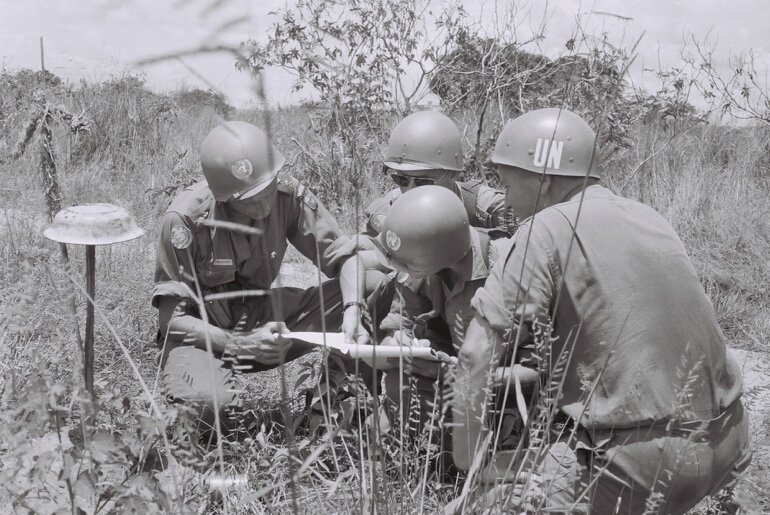
15 March: The interpreters Per Brännström and Stig von Bayer write a message to the Baluba, urging them to stop committing atrocities against the local population.
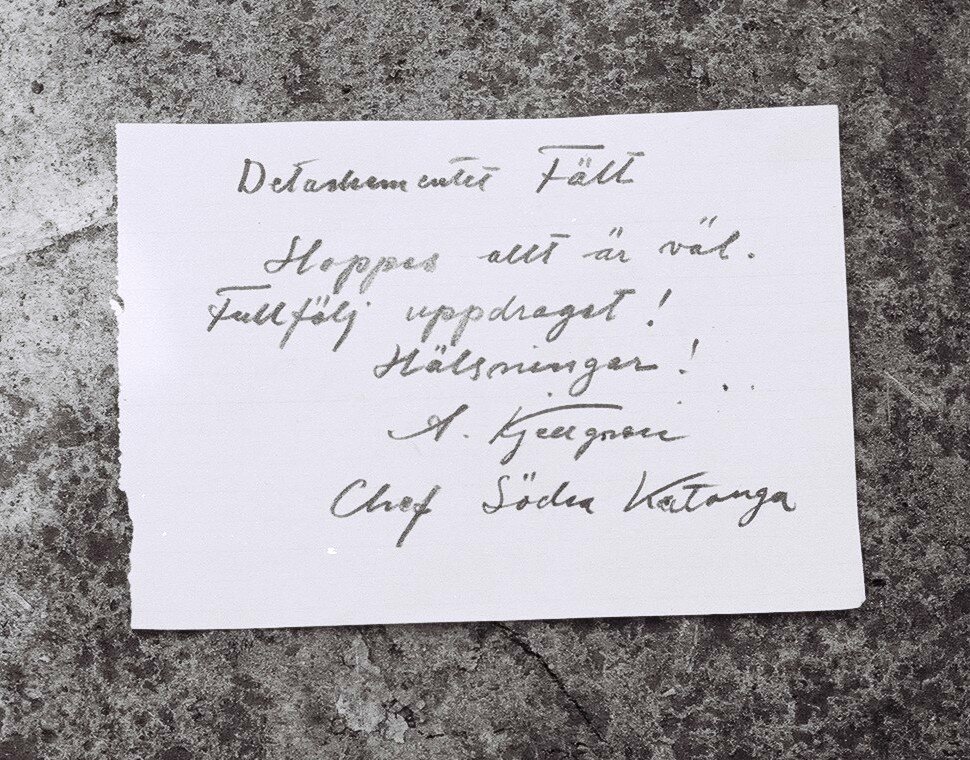
That same day, a UN aircraft dropped a message from the battalion commander to the platoon. The battalion headquarters had become concerned because of the poor radio communications during the patrol. They feared that we had become engaged in combat with the Baluba.

There was nothing to do but unload the vehicle, dig, and tow it out. Platoon Commander Fält surveys the situation.

Our bags and fuel drums are waiting by the roadside ditch!

Here, the patrol officers—interpreters von Bayer and Brännström, Platoon Commander Fält, and Deputy Platoon Commander Rahm—discuss what to do next. The bridge has been sabotaged. Can we get through? On the left, Dr Veide takes a calming puff on his cigarette.

The Destroyed Bridge.

2536 Jansson Tries Out a Bow.
Thursday, 16 March
Shortly before 0400 hours, the first truck set off for the ferry. The others followed as soon as they were ready. We travelled with one jeep and a truck to Luansa, where a couple of fuel drums were to be left. The others waited at a village. At the mission station, we were treated to fruit cordial and biscuits. Then it was time to set off again.
The journey went very well along roads we had not travelled before. Our destination was now Kiubo Falls, where we had spent our first night. Once again, we passed through several villages where people waved and shouted to us.
We arrived after a fast journey along fairly good roads. There was just one incident when one of the trucks ended up in a ditch for no apparent reason and became stuck. It was a relief to arrive and be able to wash off the mud. It had rained all afternoon, so we were hardly looking our best. We were also rather tired, as it had been a long day.
Friday, 17 March
After photographing the falls, we assembled for departure. I was soaking wet after having been down by the river below the falls. I had also gone out onto the river in a boat (a hollowed-out tree trunk) with a local man to do some filming. We were now heading directly home to E-ville (Élisabethville) via J-ville (Jadotville). The journey went very well, as the roads had actually improved after the rain, strangely enough.
We saw several troops of monkeys along the way, including two large baboons that leapt across the road in front of the jeep. We reached Jadotville in record time. From there, the road was paved all the way to E-ville, so we arrived back in Élisabethville an hour ahead of schedule, having travelled almost 2,000 kilometres over nine days on some of the most appalling roads imaginable. Our tropical uniforms were so filthy they could practically stand up on their own. The equipment also needed cleaning and maintenance. It was good to be back at camp again.
Written by Rolf Larsén in November 2005. Photographs from Larsén's archive.
Film footage from the extended patrol is also available from the personal film collections of veterans Rolf Larsén and Tommy Nilsson.
Produced by: Tommy Nilsson.
Watch the film by clicking on the title below (Youtube, opens in a new window): Katanga 1961 UN troop in the mud.

Dugout Canoe
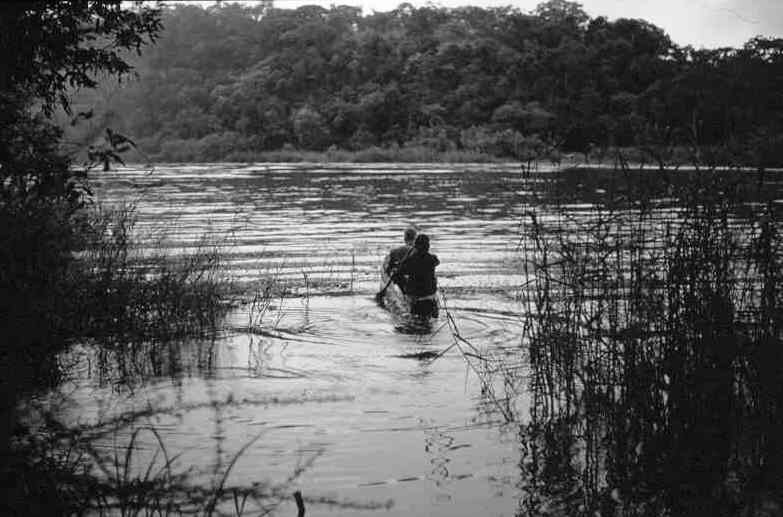
Me Heading Out onto the River

Troop of Baboons
Personal Recollections
The reason aircraft had to search for us on two occasions and drop messages was the extremely poor conditions for establishing contact with our camp in Élisabethville using our Ra 120 shortwave radio. There had been considerable concern within the 3rd Company and at battalion headquarters about how our mission was progressing, as they were not receiving the regular radio reports that had been planned. They feared that we might have become involved in clashes with the Baluba.
On Sunday, 12 March, during our patrol to Kishiale, we returned six hours later than scheduled, long after nightfall. When we finally arrived back at the tent camp near Kisele, where the others had been waiting anxiously, there was tremendous relief and joy. They had been convinced that "something terrible" had happened to us. 2516 Ekstrand of the 1st Squad openly wept with relief as he served us the reheated food.

2516 Ekstrand Hands Out Malaria Tablets to 2540 Larsén.
During our patrol to Mwpanga on 15 March, a serious accident could have occurred. We had loaded the machine guns and stopped briefly during the journey. In the last jeep was the 2nd Squad, with a "soldier" serving as the machine gunner. When their jeep started moving again after the stop, the "soldier" lost his balance and grabbed hold of the machine gun, which had not been put on safe. He accidentally fired a burst of machine-gun fire just above the heads of those of us travelling in front. We could feel the rush of air as the bullets passed overhead. It was pure luck that nobody was hit.
The "soldier" had distinguished himself on an earlier occasion as well. While we were taking down the tents and loading our equipment before departure one morning, I had placed my submachine gun on our jeep, belonging to the 4th Squad. Meanwhile, O. came along and moved my submachine gun to the fork of a tree, believing that it was the 2nd Squad's jeep. It was only after we had travelled about two kilometres that I discovered my submachine gun was missing. We had to turn around and drive back to retrieve it, and there it was, still hanging in the tree. Neither Lieutenant Fält nor I was particularly amused by this incident. Naturally, I bore a large part of the responsibility myself. A good soldier never leaves his weapon unattended.
When we were stopped by roadblocks, felled trees, and well-camouflaged elephant pits intended to prevent our advance, we remained constantly vigilant and prepared for an attack. Some villages were completely deserted when we entered them. When our interpreters loudly announced in Swahili who we were, the bravest villagers eventually began to emerge. When we explained that we were UN troops, they had no idea what the United Nations was. When the interpreter spoke to them about "freedom", they wondered how long this freedom would last. They wanted to start working and earning money again, something they had been unable to do since "freedom" had arrived.
17 March. It was exciting to venture out onto the river in a hollowed-out tree trunk near Kiubo Falls. Not far from the boat, crocodiles lay watching us.
Handing out toys to the children in the villages was an especially rewarding experience.
The adults laughed until tears ran down their cheeks when Fält inflated a balloon and accidentally let it go. It flew off into the crowd, and at first the people were frightened, but then they burst into laughter. They had never seen a balloon before.
The food we carried consisted mainly of American military rations known as "Six in One". Each carton contained enough food for six men for one meal. We refuelled the vehicles using a hand pump, drawing fuel directly from the drums we carried on the trucks. Drinking water was purified using hand-operated water purification equipment and purification tablets.

On the left of the photograph is a tin of “Fray Bentos Corned Beef”.
During the patrol, communication with the local population was handled primarily in Swahili by the interpreter, Lieutenant Stig von Bayer. The staff photographer, Gullberg, took photographs and filmed throughout the entire patrol. I wonder where this material is today? The Swedish Military Archives? Some of the photographs he took have appeared in books about the Congo. Certain film sequences from the patrol to Kishiale are included in UN films about the Congo.
2541 Engelbrektsson of the 4th Squad did not take part in the patrol. He was engaged in another assignment with his dog.
After Sergeant Rahm had announced a ban on photography, he would occasionally call out, "Larsén, what aperture setting should I use?" "Aperture f/8, Sergeant!" The soldier had a camera equipped with a light meter.

2540 Larsén Filming at f/8.
In Kisele, during a night guard duty between 12 and 13 March, at around 0300 hours, I noticed what looked like "glowing flies moving through the air". They appeared from the side and crossed the road about 50 metres in front of the jeep where I was standing. I crept forward, silently and without being noticed, and saw about ten refugees, two families, crossing the road along a footpath. What I had seen glowing in the darkness was the embers they were carrying in a metal basket to light a fire. I let them continue towards their destination, wherever that might have been.
Whenever our vehicles became bogged down, which was more the rule than the exception, everyone joined in the work without complaint. Everyone showed tremendous endurance and patience in the extremely difficult road conditions, with vehicles constantly getting stuck.
There was an excellent atmosphere throughout the patrol, and relations between officers and soldiers were very good, with mutual respect on both sides. No conflicts arose, despite the sometimes extremely demanding circumstances. For those of us who took part, this patrol was probably one of the most memorable experiences of our time in the Congo.
When we were stationed in Pweto, near the leprosy settlement, I gave a young boy some money so that he could buy himself a shirt. That evening, he came looking for me at our camp, carrying a bunch of bananas as a thank-you. It really warmed my heart!

Larsén with the Boy Who Came to the Camp with a Bunch of Bananas.

Roster of Personnel in the 3rd Platoon.
Quisque iaculis facilisis lacinia. Mauris euismod pellentesque tellus sit amet mollis.