

TATTERED BOYHOOD DREAMS
The following story is perhaps best described as autofiction, in which real events are blended with fiction and presented in the form of a novel. The story was written by a member of one of the Swedish battalions deployed to Bosnia in the 1990s. All names are pseudonyms chosen by the author, including the author's own name. This was done to prevent, as far as possible, the individuals in the story from being identified.
Over the years that the Swedish Peace Archives has been collecting personal archives from veterans of international missions, it has become clear that approximately one generation — that is, 30 years — needs to pass after the end of a mission before a veteran is ready to hand over their personal archive.
Letters, diaries and notes written during these missions sometimes describe the author or their comrades in revealing and highly personal terms. These descriptions can be both positive and negative. This story is no exception. However, as the author wrote in the accompanying letter:
Human weakness is, in fact, what makes stories and people interesting. Unless you understand a person's vanity and shortcomings, you will never truly get to know them.
Thirty years have not yet passed since the deployment of the Swedish battalions to Bosnia, but that milestone is fast approaching. Hopefully, in the coming years, more veterans of the Bosnia mission and other more recent international operations will contribute their personal archives to the Swedish Peace Archives.
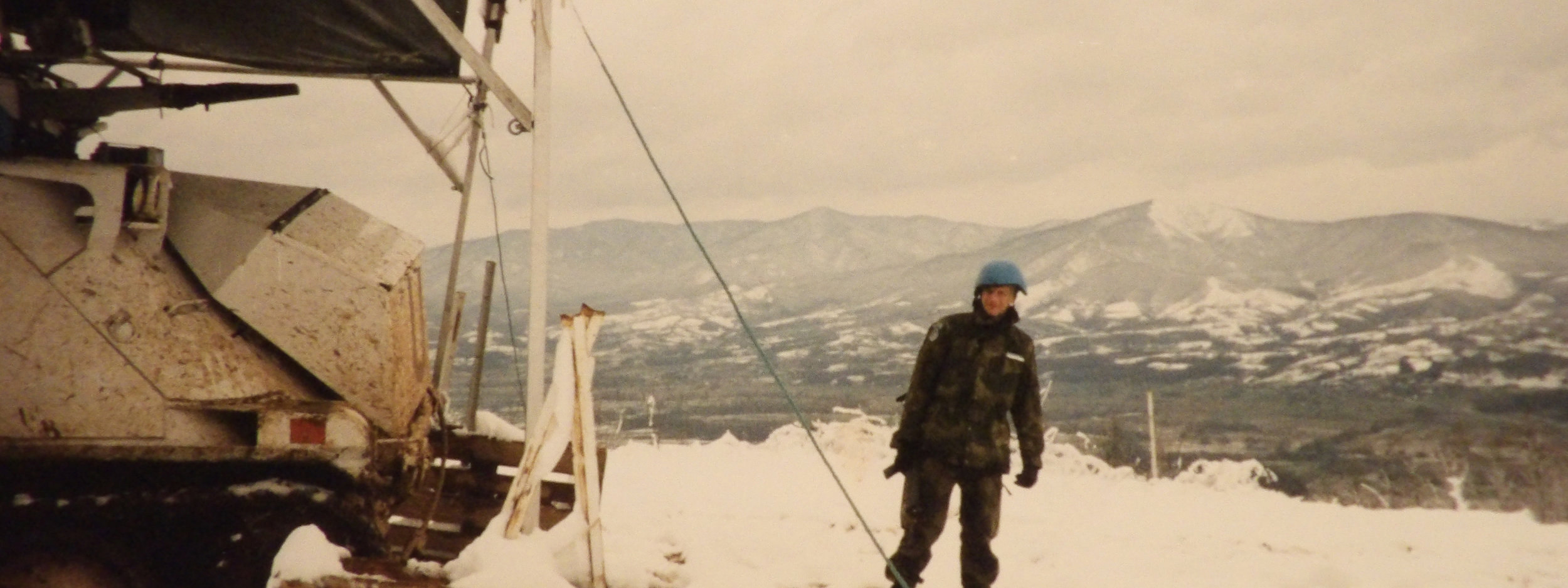
Tired, yet still unable to fall asleep, I was coming to the end of my second day at the temporary observation post, which had been given an evocative name that invariably made me think of Star Wars. Lying on the floor in the rear of the tracked armoured vehicle, I watched the flame of the kerosene heater that helped keep the winter cold at bay. Above me, suspended from the ceiling, hung a stretcher made of metal tubing covered with canvas. It was suspended by two hooks and two chains. Vedholm lay on his back on the stretcher, the rhythmic sound of his breathing revealing that he was asleep. It was midnight, and there were four hours left before I was due to be woken. Outside, snow was falling heavily.
The vehicle served as a means of transport and a shelter, but also as rather Spartan living quarters for six men, two of whom were on guard duty at the front of the vehicle, usually in the driver's seat and the turret. So far, my experience of the vehicle was very limited, but I had begun to appreciate the physical protection it nevertheless provided. I could lie stretched out on the floor and even sit up, but not much more as long as Vedholm was lying on the stretcher above me. The alternative was to sleep sitting side by side in the vehicle's seats, but that was hardly good for one's back.
Various pieces of equipment were strapped down beside me, and through narrow gaps I could see Andersson and Höken on the other side, asleep on the floor and in the stretcher suspended from the ceiling, respectively. During the previous two days, I had slept through my rest periods wearing body armour and a helmet. I thought that perhaps this might provide the small additional margin of protection needed if we were unlucky enough to be hit. There was, admittedly, a ceasefire in place, but the parties' understanding of what a ceasefire meant did not correspond to what the word meant in my own mind. Snipers were active around the clock. Exchanges of artillery and mortar fire occurred sporadically, and during the previous twenty-four hours some of the guns positioned closest to our observation post had been in action on several occasions.
It was a strange, almost mystical feeling. Many years of diligent preparation in my boyhood bedroom, immersed in the world of books, had shaped the boyhood dreams that are commonly described as the romanticisation of war. It is a peculiar kind of romanticism, but at that moment it resulted in a rather absurd feeling of well-being. I was in the place where I felt I belonged, even though it was far from home.
I do not remember what I was thinking as I fell asleep, but I do know that, for the first time, I decided to remove my cumbersome body armour so that I could sleep more comfortably. I placed it on the floor as insulation, rolled out my sleeping bag, lay down on top of it and pulled my field jacket over myself as a blanket. I kept my helmet on. Partly because it held my head in a convenient position; there was very little room to move it within the confined space. I had also calculated the risk of the chains overhead breaking, which would have resulted in Vedholm falling on top of me.
I woke briefly at 01:50 when Vedholm was roused. In his case, the changeover was somewhat more complicated because Erlandsson had to open the rear hatch, allowing all the warmth to escape from the vehicle. This was, however, the only reasonable way for Vedholm to get out of the stretcher suspended from the ceiling. Feet first, he slid his way out, eventually landing on the ground behind the vehicle. During the process, the stretcher swayed ominously back and forth, but, as always, everything went well.
At 03:50, Second Lieutenant Dahlstedt woke me with the expected announcement that it was time for me to relieve him and join Vedholm at the front. The four-hour shifts overlapped so that one of the sentries would always have been awake for at least two hours. In my case, this was particularly necessary. It often took nearly half an hour before I had completely shaken off the grogginess of sleep.
Having made sure that I was reasonably awake, Dahlstedt closed the hatch. Kneeling on the floor, I spent the half-minute I needed to put on all my equipment. Shortly before 04:00, I relieved Second Lieutenant Dahlstedt in the gun turret.
There had been sporadic firing during the earlier part of the night, but now everything was relatively quiet and still. The handover was brief and to the point. Dahlstedt was tired. Without a word, he took my place on the floor at the rear of the vehicle and was soon asleep.
The moonlight illuminated the snow-covered landscape. The snowfall, however, had stopped. Vedholm poured himself a cup of cold coffee from his thermos. Although he knew what my answer would be, he always offered me some, and I politely declined. I rummaged through my supply of biscuits and duck liver pâté. The small tin bore an intriguing, somewhat incomprehensible inscription in French, but its contents invariably tasted of galvanised sheet metal. I tried to conjure up the sensation of enjoying a roast goose dinner, but the thought was far too remote.
I peered outside, my head protruding about ten centimetres above the turret opening. I could smell the smoke from Vedholm's cigarette. There was a certain reassurance in having him sitting in the driver's compartment. Apart from Hökmark, he was the only one capable of driving the vehicle away from there if the need arose. To almost everyone else in the platoon, the vehicle was an unfamiliar beast, but Vedholm had extensive experience and considerable driving skill.
He was the only one among us who was, at every moment, actually performing the duties of his assigned position under operational conditions. Our lives were literally in his hands whenever we drove through the mountainous terrain. Like almost every armoured tracked vehicle driver I had encountered, he was rather short. This was a prerequisite for fitting into the driver's compartment.
Some of the drivers radiated a casualness that one would not normally associate with military life. They could get away with this because of the prevailing relationship between supply and demand. Everyone around them, and particularly the drivers themselves, was well aware of the importance of their skills and the shortage of people possessing them.
Their duties and physical work, however, were anything but leisurely. Every day they faced a considerable amount of work to keep the overloaded, twenty-five-year-old vehicle roadworthy and combat-ready. For every hour of driving, there was usually an hour of maintenance awaiting us, sometimes more, and in practice this work was generally carried out by the crew. I held Vedholm in the highest regard for his skill.
I took out a fresh log sheet. The surrounding area was divided into sectors radiating outwards from the vehicle's position, like slices of a pie. Activities within each sector were classified according to numerous different categories, several of which were, in reality, almost impossible to distinguish from one another with any certainty.
These included firing by small arms, machine guns, heavy machine guns, automatic cannons, mortars, field guns and howitzers. There were separate columns for outgoing rounds and incoming impacts. Space was also provided for notes on incidents that fell outside the predefined categories. Everything was reported to company headquarters by radio every half-hour or hour.
The first hour in the turret, however, was quiet. It was the calm before the storm.
Shortly before five in the morning, the relative restraint from violence that the parties regarded as a "ceasefire" came to an end. What was happening on the ground at the same time was impossible for us to determine from our position, since most of the mountain, the line of confrontation and the valley below us were covered in dense woodland consisting of slender-trunked deciduous trees.
What we could observe was the sudden beginning of an intense artillery bombardment on a scale that we initially interpreted as preparatory saturation fire — in other words, a preliminary bombardment intended to make an attack possible.
For every outgoing round and every detonation, I made a mark in the appropriate column after a quick and rather cursory assessment. The echoes and the shape of the valley made it difficult to determine the precise direction of the sounds. The shell impacts, however, were much more distinct. Brilliant flashes of light illuminated the night sky. No New Year's fireworks display could have compared with this.
For the unfortunate souls on the receiving end of the shellfire, however, it was a deeply unpleasant awakening.

Hökmark at his post in the turret.
In my mind's eye, I could picture what was happening. I had spent hundreds of hours, my heart in my mouth, lying in bed reading military manuals, eyewitness accounts and war novels based more or less on real events. I remembered an illustration in a book showing how different types of dugouts and defensive positions would affect your chances of survival. Or rather, and this was remarkably grim, it did not actually refer explicitly to your chances of survival. Instead, a table showed how many tonnes of ammunition would be required to kill an estimated half of your comrades. The better the protection you had prepared, the greater the quantity of ammunition required. It was a frightening yet fascinating kind of mathematics. Expressing killing in mathematical and economic terms was almost perfectly designed to capture my childish curiosity.
Although, at that moment, in my boyish eagerness and excitement, I was utterly absorbed by the explosions and displays of light, I nevertheless had a knot in my stomach reminding me that there were living human beings over there. There was also a fleeting thought that I myself might end up in the path of the fireworks, but then again, that was precisely what made the situation so extraordinarily exciting.
Vedholm and I had to share the administrative work. It was simply impossible to keep up with recording everything happening around us, in the valley, on the heights in front of us and in the areas beyond. Individual tally marks became groups of five, and eventually I changed my method and made a single mark for what I estimated to be every ten detonations.
Vedholm was not nearly as excited as I was. He had experienced this before, during the previous winter. He reported the events to company headquarters by radio. The rules of the game had changed during the night. None of the four men in the rear of the vehicle could sleep any longer because of the intense noise of battle.
The task of recording the hundreds of detonations occupied our eyes, ears and hands. My thoughts, however, returned to my boyhood dreams. I imagined how the soldiers dug into their positions along the front line must have felt at that moment. What protection did they have? What psychological effect did the indiscriminate and merciless impact of the shells have on them?
Some were young men in their twenties, like me. Others were probably twice that age, perhaps with families waiting for them at home. Very few of them had voluntarily chosen military life as I had. Not all of them would survive the night.
I knew, of course, what artillery fire was intended to achieve and what its effects were supposed to be. In my world, these were clinical concepts, presented as bullet points, which I had learned first in my boyhood bedroom, then in the classroom at the regiment and during exercises on military training grounds: "Force the enemy to take cover." "Destroy his vehicles and equipment." "Force him to move constantly." "Prevent him from moving without suffering casualties." "Deny the enemy the opportunity to sleep." "Break his will to resist."
This time, however, these were not my enemies. They were two opposing sides whose leaders had decided to fight one another with weapons. Yet the men dug into their positions ahead of us were ordinary human beings.As usual, my thoughts returned to the literature. There was a list firmly imprinted on my mind.
"How do psychological combat stress reactions manifest themselves among your comrades?"
What followed was a series of clinical words and concepts presented as bullet points. I pictured apathetic soldiers with ruptured eardrums, lying in their defensive positions with their trousers soaked in urine and soiled with faeces.
Perhaps, at that very moment, someone was choosing to abandon his shelter in the hope of sustaining an injury serious enough to spare him any further experience of the hell beneath the rain of shells. Would his comrades manage to stop him in time?
Perhaps I had read too many war novels and military manuals for my own good. I had read certain passages so many times that I could recite them almost word for word.
"Suddenly, the fire slackens. And now you must get up! However shaken and frightened you may feel, your only thought must be: NOW, spring up like lightning and fire — fire quickly and accurately!"
Was this what the soldiers in the lines ahead of us were thinking? We could not know, but it was unlikely that any of them had read the 1960 edition of Soldaten i Fält (The Soldier in the Field). At any rate, none of them could have read it as many times as I had.
From time to time, there were pauses in the firing. The anticipated attack on the Serbian positions, however, never materialised. I became increasingly uncertain about the objective and purpose of the bombardment. Only a very small proportion of the shells landed in areas adjacent to what we believed to be the front line.
During a longer pause, I lowered myself into the turret and sat down. I unfolded the map and, by the light of a torch held in my mouth, tried to analyse exactly where the shells were landing.
Most of the firing came from artillery positions near our observation post and from the valley to the south of us. The Bosniaks were primarily shelling a large area controlled by the Bosnian Serbs. The area was extensive, approximately two by two kilometres, perhaps even larger. Determining the direction of the impacts was not particularly difficult, thanks to the flashes of light produced by the exploding shells. Estimating the distance was considerably more difficult.
What struck me was that reality did not quite correspond to my dramatic and colourful fantasies of psychologically shattered soldiers in trenches, or to what I had been taught about the use of artillery. The area under bombardment lay well behind the front line and was not directly visible, since a ridge obstructed our view. The shellfire was concentrated almost directly over the centre of a town situated a considerable distance from what we believed to be the front line.
"DOBOJ" was printed in large letters on the map. Before the war, it had been a town whose population could be compared with that of Örebro, Linköping or Helsingborg in Sweden. By this time, most of its inhabitants had fled, but Vedholm and I knew nothing of this as we watched the fireworks that night.
The shells were falling mainly on a town whose inhabitants were certainly not enjoying a peaceful night's sleep. It was not only soldiers who were taking cover from the rain of shells. In all likelihood, most of those sheltering in the cellars of buildings during the bombardment were civilians.
The warfare followed a pattern of mutual retaliation through the shelling of civilian residential areas. This type of warfare continued year after year, but ultimately it also contributed to the international community's decision to bring the war to an end.
During the following hour, Vedholm and I witnessed a ruthless and militarily pointless terror bombardment. Over the course of just over an hour, nearly a thousand shells fell on the town. There was nothing we could do except report what we saw. My boyhood dreams had suddenly become rather tattered. This was nothing like the romantic vision of war I had read about in my boyhood bedroom. The closer one came to war, the less fascinating the colourful euphemisms of war novels and the clinical terminology of military manuals became.
The picture presented by Swedish and Western media was, in several respects, slanted in favour of the side responsible for the atrocities that night. Admittedly, the media did report that participants on all sides of the conflict were committing acts that we in Sweden would regard as war crimes. Yet the human need to generalise and simplify in order to understand reality often makes both news reporting and the selection of news stories misleading. Those of us whose reasons for travelling to a war zone were motivated, at least in part, by idealism were particularly eager to understand what was happening and to know where we should stand. Reality, however, offered no simple answers. It was difficult to sympathise with either side. The reality reflected poorly on all parties involved in this cruel war.
According to the broadly shared conclusions presented in the media, the Bosniaks were suffering most from the arms embargo. They lacked almost everything, while the Serbs had access to stockpiles and equipment inherited from the former Yugoslav army. The reality on the ground that morning presented an entirely different picture. Why would anyone expend almost a thousand artillery shells bombarding a residential area if ammunition was in short supply?
"Do you think the ceasefire is over now, Vedholm?"
"I should think so," he replied, lighting his next cigarette from the glowing tip of the previous one.
A new day was dawning, and the sun was slowly beginning to illuminate the sky from somewhere far beyond the mountains to the east. At 06:00, Hökmark relieved Vedholm in the driver's seat. During my third hour in the turret, the firing gradually became less intense. The Serbs were returning fire against the Bosniak positions in the valley below us, but on a much smaller scale. We could not see the impacts from our observation post. Nevertheless, it was clear which side had the greater supply of ammunition. The shells fired from the Serbian side were few and far between. What was happening on the ground along the front line was impossible to know, but we observed sporadic exchanges of small-arms, machine-gun and automatic-cannon fire, which became intense for brief periods. Some kind of advance was probably being attempted, but we could not see it from our position.
Sometime between six and seven in the morning, the sun rose above the mountains behind our observation post. Shortly afterwards, something happened that I laconically described as "RakArt" in the little black diary I still possess. That brief description refers to one of the most exhilarating experiences I had ever had up to that point in my life. The fact that I recorded it in just one word, and an abbreviation at that, was because I was so convinced at the time that, however long I lived, I would never forget the details of the event. That conviction now seems somewhat ridiculous, and perhaps not entirely justified. Nevertheless, I remember the spectacular display, and particularly the sound, with remarkable clarity.
Our attention turned southwards, down towards the valley, where the rocket artillery had begun its deafening barrage of Katyusha rockets. Rocket after rocket disappeared into the sky with a piercing howl, followed by a prolonged hissing sound. The rocket motors painted thick trails of smoke across the valley, while a dense grey cloud rose from the launching platform. It was a fascinating but rather frightening spectacle. The rockets struck far behind the line of confrontation, deep inside Serbian-controlled territory. After a considerable delay, we could hear the detonations, which we counted and entered into our log.
At 08:00, Andersson relieved me. The second lieutenant and Erlandsson had abandoned any hope of sleeping because of the commotion along the front line. Second Lieutenant Dahlstedt was at least as excited as I was, and even worse at concealing it.
Once daylight had fully arrived, the detonations became increasingly infrequent. Only occasionally could one hear the distant, chattering sound of machine guns firing. Once again, I allowed myself the luxury of removing my helmet and body armour. Lying in the rear of the vehicle, I may have slept for half an hour or more. I do not remember exactly.
Sometime after ten, my stomach began to rumble. I opened the left rear hatch and climbed out into the relative shelter behind the vehicle. Hökmark had been relieved and was crawling onto the stretcher suspended from the ceiling. We had erected the frame of a medical tent behind and partly over the vehicle. The roof and rear sections of the tent canvas had been fitted to create a sheltered space extending almost two metres behind the vehicle. At the far end of this space, against the canvas, stood a plastic crate containing half-frozen food, mostly tins. There was also a so-called troop stove, a simple kerosene cooker which, after some practice, could be made to work provided the wind was not too strong. We had also placed our personal kit there to give ourselves more room inside the vehicle.
The weather was clear and felt mild, perhaps only a degree or so below freezing. For some reason, the events of the night had given me an unreal sense of being in control of the situation. It was certainly a real war, but I was merely a spectator, albeit one with a front-row seat. Twenty-four hours earlier, I had not dared to sleep inside the armoured tracked vehicle without my helmet and body armour. Now I stood relaxed in the slushy mud behind the vehicle, wearing neither. I did, however, keep hold of my assault rifle.
I looked along the side of the vehicle towards the untouched, snow-covered field. The view was extraordinarily beautiful. Perhaps one of the Serbian artillery observers was looking in my direction through his binoculars at that very moment. I do not know, but I have thought about it many times since.
I inspected the meagre selection of tinned food beside the kerosene stove. I know that I took out a Weetabix biscuit. At the same time, perhaps five kilometres away, an unknown soldier was aiming a mortar. His comrade held a mortar bomb above the muzzle and allowed it to drop down the barrel under its own weight. The report of the propellant charge was dull, and it took quite some time for the sound to reach Andersson's ears as he sat in the driver's compartment with binoculars in his hand. By then, the fin-stabilised mortar bomb was already more than halfway along its trajectory through the air and had begun descending towards the ground.
Erlandsson climbed out of the vehicle on the right-hand side and watched my modest breakfast. I opened a jar of half-frozen German strawberry jam and dipped the thick, dry, tasteless biscuit into it. I took a bite and tasted the sweetness of the jam. I wondered whether it was worth the effort of lighting the kerosene stove to make some hot coffee.
I had no time to reflect on the matter, but I know that, for a fraction of a second, I heard a hissing sound, immediately cut short by an explosion as the mortar bomb detonated in the vegetation behind our observation post.
The air was forced out of my lungs. The Weetabix biscuit went flying, along with the contents of my mouth. I remained on my feet and resisted the conditioned reflex that would normally have made me throw myself to the ground. The protection was inside the vehicle.
Erlandsson hurled himself inside through the right-hand hatch. I wrenched open the left rear hatch and threw myself in, landing on top of the second lieutenant, who was lying on the floor. He stared at me in terror, his eyes wide open. He had a habit of stuffing his mouth with absurdly large quantities of snus, Swedish smokeless tobacco. When he became stressed, he could not quite keep the loose tobacco under control in his mouth. It looked grotesque.
I realised that I was unhurt, but at that very moment I cursed myself, my stupidity and my lack of judgement. I had spent so many months, more than a year of my young life, preparing for this. Yet when I finally needed it, I had failed to make use of the little protection available to me. It took only a few seconds, however, before I had put my body armour and helmet back on.
You take cover when the first shell arrives. Not so much because of the limited chance of protecting yourself from that particular shell, but because you want to avoid the effects of the shells that may follow immediately afterwards. Now all our senses were on high alert.
Inside the vehicle, there was a deafening commotion. Second Lieutenant Dahlstedt was trying to communicate with the boys at the front of the vehicle. He wanted to know whether they were unhurt. Andersson did not answer.
Through the gap between the missiles, I could see Erlandsson sitting there. He was looking at the second lieutenant with a grim, searching expression. He had experienced shellfire before. He understood what the second lieutenant and I were thinking at that moment.
Hökmark had been resting on the stretcher suspended from the ceiling when the mortar bomb struck. He had a habit of taking off his uniform when he went to sleep. Half-naked, he had wriggled out of his sleeping bag, crawled forward along the suspended stretcher and somehow squeezed his body through the gap leading into the cramped turret compartment.
It must have been a painful manoeuvre, but surprisingly quickly he was in position at the cannon. He cranked the turret around, searching for targets.
The seconds passed. The second lieutenant shouted for Höken and Andersson. Hökmark was completely occupied with trying to find something to shoot back at. Andersson did not respond. Erlandsson watched the second lieutenant, while I wondered what I ought to do to make things easier if we had to get out of there.
When we had practised a similar scenario back home on the training ground, I had been appalled by how loud and agitated Dahlstedt had become. On that occasion, he had stressed Vedholm so badly that Vedholm had reversed the vehicle over our tent and equipment. Anyone who had hoped Dahlstedt would be calmer when it happened for real was to be disappointed.
The question was what we should expect next. If this had merely been a ranging shot, the next mortar bomb would arrive within a minute or so. The artillery observer would need to correct the fire if he wanted to hit the vehicle.
I offered to go outside again and load our equipment into the vehicle in case we needed to drive away. Dahlstedt reacted with undisguised fury.
"The equipment is priority ONE THOUSAND! You stay exactly where you are!!!"
Specks of snus sprayed into my face, but I remained perfectly still on the floor of the vehicle, gripping my assault rifle tightly. The lingering taste of strawberry jam in my mouth was an absurd contrast to the situation. I noticed a lazy smile spreading across Erlandsson's lips.
Dahlstedt was absolutely right. This was not an appropriate moment to leave the protection of the vehicle, certainly not to rescue six rucksacks containing long underwear, socks, insulated trousers and field jackets.
Höken and Andersson were physically unhurt, but Andersson had fallen into some kind of apathetic state. He did not respond when Höken tried to get him to report what had happened to company headquarters.
Eventually, Hökmark had hoisted his naked upper body out of the turret and reached down to retrieve the radio handset from Andersson's driver's compartment. Somewhat shaken, he managed to contact the radio operator, who was sitting some twenty kilometres away, monitoring his radio.
By then, Höken was beginning to realise that the temperature outside was below freezing and that he was wearing nothing but the Swedish Armed Forces' white underpants, size 52.
Andersson was looking for his helmet. For some reason, he could not find it, even though it was lying beneath him in the driver's compartment.
No more mortar bombs came that time, however. That was how it was on most occasions during the months that followed. Individual shells would land. Sometimes they were followed by others, but usually they were not. It was fortunate that the Bosnian Serbs were short of ammunition, at least as far as we were concerned.
Eventually, the second lieutenant calmed down. It was only several years later that I began to understand the full significance of what he had experienced that morning. For him, this was not merely an adventure or the fulfilment of a boyhood dream. This was the work he had spent seven years preparing himself for. He was not only in command of five more or less reckless young men in their twenties, and sometimes considerably more; he was also responsible for ensuring that we returned home unharmed. This was the very essence of the profession he had chosen for himself. His was a thankless task, even if it was occasionally rather exciting.
My duty was to do exactly as Dahlstedt told me, and it was no coincidence that the relationship was not the other way around. The burden of responsibility he carried during the months that followed took a heavy toll on his strength and psychological well-being.
If I ever meet him again, I will thank him for the work he did.
A few minutes later, the radio crackled into life. Höken reported that the command vehicle had left the company camp. The second lieutenant spoke again.
"You heard that yourselves. The major will be here in an hour. Now make sure you get this gypsy camp into some kind of order so I don't have to be ashamed of you!"
Erlandsson began tidying up our modest encampment. I managed to convince the second lieutenant that the coast was now clear and that he ought to send Vedholm and me out on patrol. To my surprise, he agreed, possibly because he wanted me out of his sight.
With some difficulty, we lifted aside a section of the concertina wire, the barrier of metre-high coils of barbed wire that surrounded the observation post. Vedholm and I trudged out into the snow. Once we reached the field in front of the vehicle, the snow came partway up our thighs. I remember being extraordinarily excited, although I am not entirely sure why.
We were not away for very long, and when we returned, Höken was in direct radio contact with the command vehicle. I do not remember exactly how we managed it, but the complicated mountainous terrain made radio communication rather difficult. All vehicles maintained contact with company headquarters by reporting when they passed certain prearranged locations or deviated from their planned routes. However, the final few kilometres leading to our observation post lay in a radio dead zone as far as the company camp was concerned. This meant that approaching vehicles had to contact us by radio so that we could relay their messages to company headquarters.
After a while, we heard the familiar sound of an engine, and the major's vehicle pulled up behind the barbed wire. Despite his advanced age, the major jumped down from the vehicle without difficulty. At the time, I regarded him as a rather elderly man. I am embarrassed to think that he was thirty-four years old.
He strode briskly forward and stopped in front of Second Lieutenant Dahlstedt. The major looked grim and spoke in a low voice. The rest of us could not quite hear what he was saying, but the second lieutenant replied considerably more loudly. The major had evidently asked about the condition of the rest of us. Dahlstedt's response, however, left no room for doubt about our combat readiness. The scene reminded me of a war film I had once seen, except that the major spoke with a Scanian accent.
Dahlstedt gave a brief account of the events of the night and morning. To my great relief, he did not mention that I had left the vehicle without my helmet and body armour. The major turned towards me, and without waiting to be asked, I added my own account of the night's violations of the ceasefire, particularly the artillery bombardment of Doboj. He looked at me attentively without saying a word.
Suddenly, the Katyusha rocket launcher in the valley behind the major sprang into action again. Despite his astonishingly advanced age, this was something he had never experienced before. He instantly seemed to shrink to half his height, but when he saw that nobody else was taking cover, he straightened up again, looking slightly embarrassed. The howling sounds faded, and we watched the rockets climbing into the sky. They left behind grey trails of smoke that gradually grew thicker and more diffuse, until they finally dispersed and disappeared. The major turned back towards us.
"Rocket artillery, Major," I informed him, giving him a broad smile.
He returned a tight-lipped smile, and I suspect he was a little annoyed that the noise had caught him off guard in front of us lads.
By lunchtime, our relief had arrived. After a brief handover period, we climbed aboard the vehicle and began our journey back to the company camp. I remember feeling like a completely different person. I was filled with a sense of calm and security. It was a feeling that would serve me extremely well during the dramatic months that followed, even though it had very little basis in reality.
After just over an hour, we arrived back at camp. I carried my equipment inside, and as I entered, I encountered Olsson standing between the tents with his arms folded, waiting for me. The major had already briefed the entire company on the highlights of the day's events at our observation post.
"Well?!"
I gave Olsson a restrained smile. We had completed our compulsory military service together, and he was the only person I knew for certain who shared my childish and unreserved fascination with war.
"Well, what can I say? Baptized in fire..."
His reaction was completely undisguised. Never in my life have I seen anyone radiate such unabashed envy as Olsson did at that moment. He was not satisfied with that brief answer, however, and followed me into the tent, where he stayed until I had recounted the entire story two or three times over. Olsson, however, would get his own fair share of war, and then some, before we returned home. After all, this was only our first week.
That afternoon, the second lieutenant conducted a brief ceremony that he called a "debriefing". We sat down, talked and drank beer. Apart from maintaining our equipment, we were excused from further duties until the following morning.
It was difficult to fall asleep that evening. I lay awake for a long time, staring up at the dark green canvas of the tent. After half an hour, all I could hear was the heavy breathing of my comrades. Suddenly, a voice came from the other side of the tent.
"I know what you're thinking right now."
It was Erlandsson. He could not see me, but somehow he knew I was still awake.
"Next time, you won't think about it as much. It's a strange thing, really. After a while, it starts to feel like a reward every time it happens."
His words had a calming effect. I fell asleep, and I slept very well.
Erlandsson knew how to conduct a debriefing.
Quisque iaculis facilisis lacinia. Mauris euismod pellentesque tellus sit amet mollis.