
WITH THE UN IN THE CONGO, 1960–1961
Battalion 10

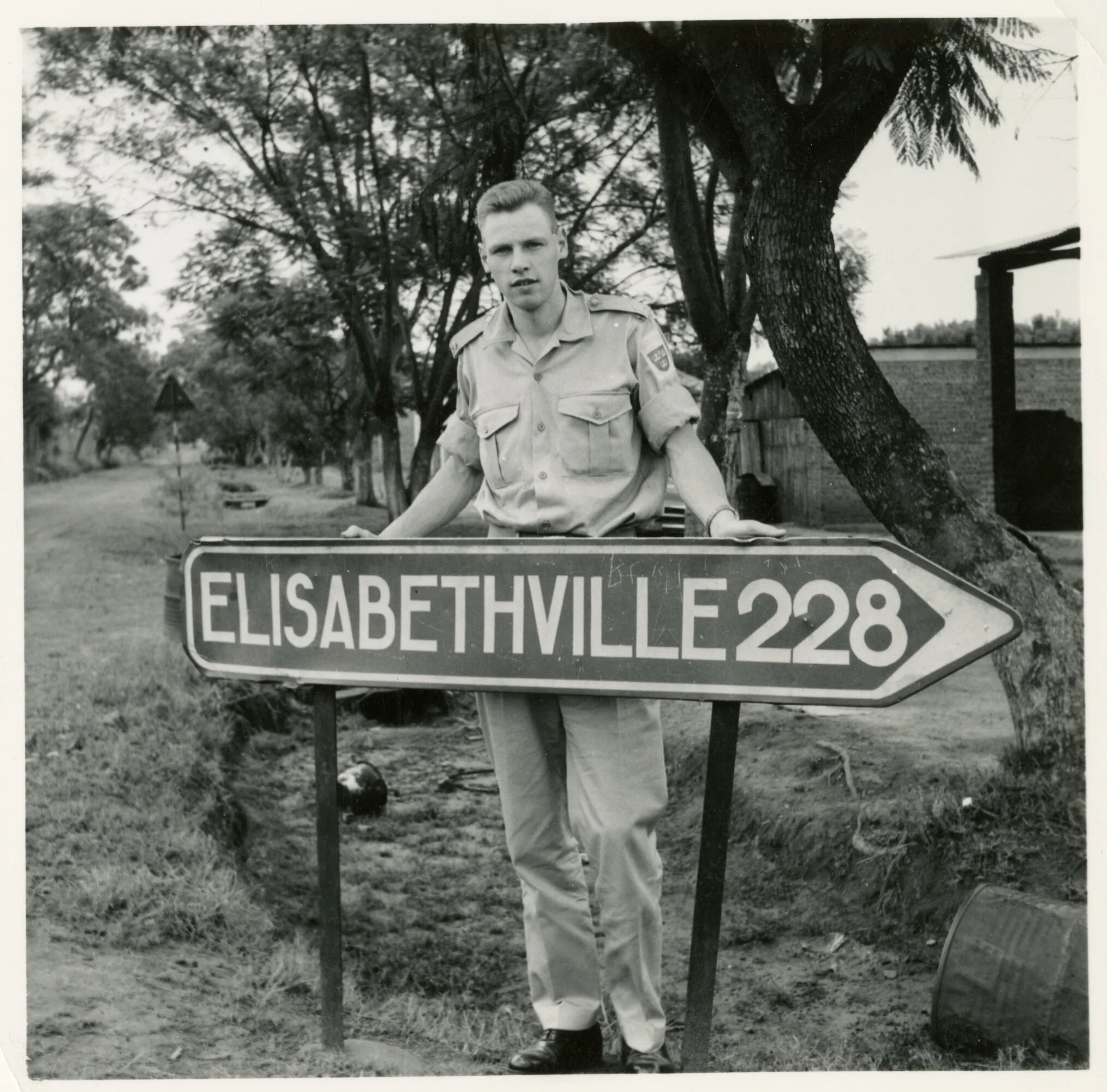
Rolf Larsén at the junction towards Élisabethville in Sakania. Photograph from Rolf Larsén’s archive at Fredsarkivet.
An archive can be described as an aid to memory, but it is a constructed aid, shaped by limitations, selections, and judgements. Within the archival profession, there is now a greater awareness that archives are neither value-neutral nor free from shortcomings. Nevertheless, the aim is, as far as possible, to maintain an objective approach to the material and to the ways in which it has been collected and preserved. The same applies to Fredsarkivet’s role as a custodian and provider of access to collections such as veterans’ archives. We strive to alter or process the material entrusted to us as little as possible, while remaining fully aware that, despite our efforts, not every perspective can be represented or every question that may arise in the future can be answered.
During 2019, Fredsarkivet digitised the archive of veteran Rolf Larsén, containing material from his service with Battalion 10 in the Congo in 1960–1961. Writing down one's memories is an essential part of coming to terms with what one has experienced. In the following account, we look back on the time in the Congo through the recollections written in 2005 by Rolf, who served in the 3rd Company, 3rd Platoon, 4th Squad.
Rolf’s son, Jan Larsén, has written two academic papers about the Congo. Both papers are available here to download as PDFs (click on the respective titles). The first is an undergraduate history paper (B-level), written during the spring semester of 1996 at the Department of History, Uppsala University: “Hjältarna som blev rövare. En studie av den svenska pressens olika framställningar av de svenska FN-soldaterna i Kongo 1961”. The second paper is entitled “En presentation av Kongokrisen. Bakgrund och förlopp fram till 1965” (dated 12 December 1996). Jan now works as a history teacher.
“Day by Day”, 1960 – With the UN in the Congo
As the 45th anniversary of our departure for the Congo mission of 1960–1961 approaches, my thoughts return to everything that happened during those hectic weeks before and after we learned that we—550 men out of approximately 5,000 applicants—had been selected to serve with UN Battalion 10 in the Congo.
Everything was a whirlwind of events. How much do we actually remember? What was the historical background to the conflict, how did it begin, and what happened while we found ourselves at the very centre of world events?
Personally, I felt that I needed to refresh my memory, so I read two annual chronicles from 1960 and 1961 (which I had bought at a flea market for 5 and 35 Swedish kronor, respectively).
I found them so interesting that I decided to write down selected passages, and here is the result.
Among other things, this account highlights the various developments, decisions, and events that ultimately proved decisive for us Swedish UN soldiers serving in the Congo.

Rolf Larsén with his parents and relatives at Arlanda Airport before departing for the Congo. Photo from Rolf Larsén’s collection at Fredsarkivet.
1960
Overall, the year was filled with crises and dramatic events. The upheavals in Africa reached a new peak: 16 newly independent African states emerged, and one of them, the Republic of the Congo (formerly the Belgian Congo), was shaken by conflicts that prompted a highly controversial United Nations intervention and caused serious international complications.
The Congo
The major international drama of 1960 gradually came to centre on the former Belgian Congo, drawing the great powers into the conflict and even calling the continued existence of the United Nations into question.
The difficulties encountered by the United Nations in the Congo must, to a large extent, be attributed to the failures and omissions of the former colonial power, although the rivalry between the great powers and the lack of unity among the independent African states must not be overlooked.
It all began with the Congo as a kind of private enterprise belonging to King Leopold II of Belgium, who was responsible for some of the most ruthless exploitation known in the history of imperialism. The Congo Free State, established in 1885, became one of the great scandals of the nineteenth century.
International public opinion turned against Leopold II, who was eager to shift responsibility elsewhere. The Belgian Parliament was sceptical and did not take over the Congo until 1908, the year of the king's death.
The Belgians nevertheless placed their trust in the men administering the colony. These administrators developed their own philosophy of colonial rule. They were to govern in order to serve, exercising authority with the benevolence of a father—but the father's authority was not to be questioned.
This paternalistic system did provide the Congolese with certain material benefits. At the same time, the Congo, and Katanga in particular, became a profitable field for investment. The mining company Union Minière became one of the world's legendary industrial corporations.

“Monument in the Congo commemorating Africans who died during the Second World War.” Photo from Rolf Larsén’s collection at Fredsarkivet.
The colonial government in the Congo maintained a special propaganda organisation known as Infocongo, which experts regarded as one of the most effective in the world. It concealed the true situation.
In early 1959, the Belgians' eyes were opened by the bloody uprising in Léopoldville. The Belgian commission of inquiry appointed after these disturbances had already identified two disastrous shortcomings of colonial rule.
Firstly, despite all assurances to the contrary, clear racial discrimination was practised in the Congo. Secondly, there had been a failure, on what would prove to be a catastrophic scale, to train leaders, administrators, teachers, doctors and technicians.
The resulting shortage became appalling after the Belgians' hasty withdrawal, which was completed in just eighteen months and ultimately became utterly chaotic.
The governors-general tended to encourage rather than counteract rivalries between tribes and individual leaders. Central authority was maintained with the help of the army, the Force Publique, whose officers were exclusively Belgian. Its discipline collapsed almost overnight when Belgian authority was removed.
The situation was made worse by the fact that Belgians in the Congo were acting against the government in Brussels.
Those with vested interests in the mineral-rich province of Katanga hoped, even at the last moment, to separate this wealthy province from the rest of the Congo, while in Léopoldville there was open intrigue against the elected Prime Minister, Patrice Lumumba.

Map of Africa. Political Divisions (L-45 P). Published by the General Staff’s Lithographic Institute, Stockholm, 1960. Photo: Bukowski Auktioner AB.
The newly elected parliament, which was intended to provide the young republic with its governmental authority, had the following distribution of seats in the legislative chamber:
Congolese National Movement (Lumumba faction) 35
National Progress Party (moderates) 22
National Solidarity Party of Upper Congo 13
Abako (Lower Congo) 12
CEREA Group (Kivu Province) 10
Congolese National Movement (Kalonji faction) 8
Balukabat (Baluba group) 7
Various smaller groups 22
Including the seats held by allied parties, Lumumba's faction controlled 40 seats in the chamber. Joseph Kasavubu became President, Patrice Lumumba Prime Minister, Antoine Gizenga Deputy Prime Minister, and Justin Bomboko Minister of Foreign Affairs. Kasavubu advocated a federal constitution, whereas Lumumba favoured a strong central government.
A conference in Brussels had established a timetable for the Congo's independence. The conference concluded in February. On 30 June, the Republic of the Congo was proclaimed. One week later, disturbances broke out in Coquilhatville, the army mutinied, and Belgian civilians were attacked.
As the chaos spread, Belgium ordered paratroopers into the Congo. On 10 July, Lumumba requested UN forces to expel the Belgians and restore order. The following day, the pro-Belgian Prime Minister of Katanga Province, Moise Tshombe, who was based in Élisabethville, proclaimed Katanga's secession from the Republic of the Congo and requested Belgian military assistance.
On 15 July, the first UN forces arrived in Léopoldville. On 9 August, reports emerged of another secessionist movement. Albert Kalonji, leader of the Baluba tribe, announced that he intended to establish a new state in South Kasai.
The Baluba were involved in a bloody tribal war with the Lulua, who received support from Lumumba, whose strongest political base was in Orientale Province, centred on Stanleyville.
On 5 September, Kasavubu, who drew his support from the tribes of Lower Congo, launched an attempt to remove Lumumba from office. The following day, the United Nations closed Léopoldville's radio station and blockaded the airfields, preventing Lumumba from mobilising his supporters.
A provisional government emerged one week later. On 14 September, Colonel Joseph Mobutu announced that he had seized power at the head of the army.
With Kasavubu's support, Mobutu appointed a government consisting of 15 young Congolese men of varying intellectual backgrounds. Mobutu's control over the disintegrating army remained uncertain, and the provisional government he established came under Belgian influence. Belgians had begun returning to the country in considerable numbers.
On 11 October, UN forces prevented Mobutu's troops from arresting Lumumba.
On 21 November, clashes occurred between UN soldiers and Congolese units when Mobutu attempted to expel Ghana's diplomatic representative. The United Nations initially opposed the expulsion but subsequently gave way. The Soviet and Czechoslovak diplomatic missions were also forced to leave.
On 22 November, Kasavubu was recognised by the UN General Assembly as the Congo's representative at the United Nations.
Following an attempted escape, Lumumba was captured on 1 December and arrested by Mobutu's troops, apparently under extremely brutal circumstances, according to a report by UN Secretary-General Hammarskjöld's Special Representative in the Congo, the Indian diplomat Rajeshwar Dayal.
Dayal also strongly criticised the harsh treatment Lumumba endured in his heavily guarded cell at the military camp in Thysville.
This triggered the most serious crisis to date surrounding the United Nations' policy in the Congo.
Whether free or imprisoned, Lumumba remained the central figure around whom everything in the Congo revolved.
During the summer, the Soviet Union had provided Lumumba with direct assistance outside UN channels and had hoped, with his support, to transform the Congo into an African satellite state.
Countries such as Ghana, Guinea, Mali, Morocco, the United Arab Republic, India, Indonesia and Yugoslavia regarded Lumumba as the true representative of Congolese nationalism.
In the West, Kasavubu had been supported in the hope that this would help counterbalance communism.
The United Nations' directives did not permit interference in the Congo's political conflicts. Such involvement, however, proved impossible to avoid, and as a result the United Nations was subjected to criticism that at times paralysed its ability to act.
The Congo Question at the United Nations
The “Operation Congo” launched by the United Nations in July rapidly expanded into the largest deployment of international military forces yet undertaken by the world organisation. The first units to arrive were hastily mobilised contingents, mainly from other African countries, but Sweden was also able to contribute troops at a very early stage by transferring its battalion stationed in the Gaza area to the Congo.
Other contingents subsequently arrived in succession, including several from Asia. By early October, the UN Command in the Congo, under the leadership of Swedish Major General Carl C:son von Horn, had a total of 18,000 men at its disposal. Eighteen countries were represented by military units, with Morocco, Tunisia, Ethiopia and Ghana providing the largest contingents.
The United Nations also organised administrative and technical assistance for the Congo. The Swedish official Sture Linnér was appointed head of these operations.
By the end of the year, the cost of the operation in the Congo had already reached 60 million dollars. The General Assembly decided that the financing should be handled through a special account, but that member states should contribute according to the same percentage scale used for the regular UN budget. In addition, the Congo would require assistance for economic development over the longer term.
These future problems, however, were overshadowed in 1960 by the immediate crisis in the Congo. The internal turmoil in the country was influenced and aggravated by foreign interference from various quarters. The difficulties facing the United Nations were increased by the Belgians' delaying tactics in withdrawing their military forces from the country and their encouragement of separatism in the wealthy mining province of Katanga. However, the greatest danger of international complications lay in attempts by the communist states to infiltrate the country.
The confusion was reflected in the decisions taken by the Security Council and the General Assembly, which failed to provide Secretary-General Hammarskjöld with fully adequate guidelines.
The United Nations had originally intervened at the request of the Republic of the Congo's own government under Patrice Lumumba. The Security Council's first resolution, adopted on 14 July, stated that UN forces were to provide whatever assistance might prove necessary until the Congo's own armed forces were, in the government's judgement, fully capable of carrying out their responsibilities.
A new resolution, adopted on 22 July, emphasised that the Security Council had recommended the Republic of the Congo for membership “as a single entity”, and called upon all states to refrain from actions that might undermine the Congo's territorial integrity and political independence.
The consequences of the sharp internal divisions in the Congo between the “centralist” Lumumba and forces favouring federalism, or even outright separatism, had not been foreseen.
President Joseph Kasavubu was among the federalists. The leading separatist was Katanga's leader, Moise Tshombe, although on a couple of occasions he made tentative approaches in Léopoldville concerning the possibility of a federation.
In a resolution adopted on 9 August, the Security Council authorised the UN Command to send troops into Katanga as well, where certain Belgian forces were still present. At the same time, the Council declared that the UN intervention must in no way “influence the outcome of any internal conflict”.
Indeed, it was repeatedly stated that the United Nations was politically neutral in the Congo. Fully upholding this principle, however, proved impossible because of the internal struggle for governmental power and the lack of authority among the rival factions.
On several occasions, Hammarskjöld found himself in situations where he either risked exceeding his authority or was unable to act with any real effectiveness. More often than not, he faced the latter dilemma.
While the complications still centred primarily on the withdrawal of Belgian troops and the Katanga question, Hammarskjöld enjoyed the support of the great majority of African and Asian nations at the United Nations.
During this period, Moscow, despite its threatening rhetoric, manoeuvred with a certain degree of caution, precisely out of consideration for these newly independent nations.
It was not until a Security Council meeting in September that the Soviet Union opposed the Afro-Asian countries by vetoing a compromise proposal submitted by Ceylon and Tunisia.
The Congo question was subsequently brought before an emergency special session of the General Assembly, where the Soviet delegation suffered a crushing defeat. By 70 votes to none, with 11 abstentions, the Assembly passed a vote of confidence in Hammarskjöld and authorised him to continue the operation in the Congo.
Following this setback, the Soviet Union launched an open attack on Hammarskjöld personally. Although the Soviets failed to bring him down, the continuing Congo crisis threatened to jeopardise the entire UN intervention.
The conflict increasingly centred on Lumumba. He had been overthrown in September after coming close to provoking a full-scale civil war. Nevertheless, Lumumba still had powerful supporters, not only in the Soviet Union but also among a number of African and Asian states.
In November, the General Assembly did grant a seat and voting rights to a Congolese delegation appointed by Lumumba's opponent, Kasavubu. Thereafter, however, divisions within the United Nations became increasingly severe.
Many countries reacted strongly when Kasavubu refused to admit a conciliation commission consisting of representatives from the non-European countries that had contributed troops to the Congo. This commission was closely associated with an advisory body established by Hammarskjöld, comprising representatives of all the countries that had placed troops at the United Nations' disposal.
Tensions increased still further in December when Lumumba was imprisoned by Colonel Joseph Mobutu, who, with the support of the army, had established a so-called provisional government in Léopoldville.
Lumumba had attempted to escape from his UN-guarded villa to join supporters in Stanleyville who were ready to take action.
Six countries decided to withdraw their troops from the UN force.
The Security Council was paralysed by further Soviet vetoes, and in the General Assembly, shortly before its adjournment until March 1961, a Western-backed resolution was defeated. This resolution would have given Hammarskjöld a much-needed renewed mandate for the operation in the Congo.
Although a Soviet-backed Afro-Asian resolution demanding Lumumba's release and the disarmament of Mobutu's troops was also defeated, the situation had become so critical that Hammarskjöld issued a warning: the position of the UN forces in the Congo could become completely untenable.

Rolf Larsén with local residents in Katanga, Congo. Photo from Rolf Larsén’s collection at Fredsarkivet.
1960 – “Day by Day”
4 January
UN Secretary-General Hammarskjöld, having visited Cameroon, arrives in Brazzaville in the Congo (formerly French Congo). He continues to the Belgian Congo and, during January, visits a number of African countries as well as Spain and Portugal. (See 28 July.)
20 January
A round-table conference on the future of the Belgian Congo begins in Brussels. The principal African participants are J. Kasavubu, P. Lumumba and A. Kalonji. On 27 January, an agreement is reached that the Belgian Congo will become independent on 30 June. (See 23 June and 6 July.)
23 June
Patrice Lumumba forms a government in the Republic of the Congo (formerly the Belgian Congo). His rival, Joseph Kasavubu, becomes President. (See 20 January and 30 June.)
30 June
King Baudouin of Belgium proclaims the Belgian Congo an independent republic in Léopoldville. (See 20 January, 23 June and 6 July.)
3 July
The autonomous African states of the Central African Republic, Congo, Chad and Gabon request and are granted independence within the French Community. The first three intend to form the Union of Central African Republics. (See 11 August.)
6 July
The army (Force Publique) of the Republic of the Congo (formerly the Belgian Congo) mutinies. Its Belgian commander, General E. Janssens, resigns. He is succeeded by an African former warrant officer, V. Lundula.
Serious disturbances break out and spread throughout the country. Acts of violence are committed against Europeans, who flee in their thousands. Belgium intervenes and sends military reinforcements to the Congo. (See 23 June, 30 June, 12 July and 15 July.)
11 July
The province of Katanga in the Congo is proclaimed an independent state, with M. Tshombe as head of government. (See 30 June, 6 July, 2 August, 8 August, 10 September and 17 October.)
12 July
The Congolese government requests assistance from the United Nations to restore order in the country.
Following consultations with nine African states, Secretary-General Hammarskjöld begins organising an international UN force under the command of the head of the UN Truce Supervision Organization in Palestine, Swedish Major General Carl C:son von Horn.
This is approved on 14 July by the Security Council, which also calls upon Belgium to withdraw its troops. (See 30 June, 6 July, 15 July, 20 July, 21 July, 28 July, 8 August, 21 August and 19 July.)
15 July
The first UN troops—from Ghana and Tunisia—arrive in the Congo. They are rapidly reinforced by additional contingents, including units from European and Asian countries, and gradually replace the Belgian troops. (See 12 July and 21 July.)
The Congolese Prime Minister, P. Lumumba, demands that Belgian troops leave the country immediately. He repeatedly reiterates this demand and threatens to request Soviet intervention. (See 12 July.)
19 July
At an extraordinary meeting of the Council of State, with Prince Wilhelm acting as Regent, a decision is made at the request of UN Secretary-General Hammarskjöld to transfer the Swedish UN Battalion (8) stationed in Gaza to the Congo for one month, under the command of Bernt Juhlin.
Practically the entire battalion has voluntarily undertaken the new assignment and subsequently agrees to remain in the Congo until 20 November, when their contracts expire.
Up to 20 light aircraft belonging to the Swedish Air Force may be placed at the disposal of the United Nations in the Congo. (See 30 July, 28 August, 23 September, 18 November, 12 July and 21 July.)
20 July
The UN Security Council meets in response to the further deterioration of the situation in the Congo.
The Council unanimously authorises Secretary-General Hammarskjöld to continue the intervention and calls upon Belgium to withdraw its troops from the Congo without delay. (See 6 July, 12 July, 8 August, 21 August, 8 September and 17 September.)

“View of Camp Suédois in Élisabethville. The gable end of our villa is visible on the right.” Photo from Rolf Larsén’s collection at Fredsarkivet.
21 July
The Swedish UN battalion from Gaza arrives in the Congo. (See 12 July, 15 July, 12 August and 19 July.)
(Among those serving in the battalion was Leif Sandqvist, who subsequently re-enlisted for service with Battalion 10, 3rd Company, 3rd Platoon, 4th Squad.)
24 July
Congolese Prime Minister P. Lumumba arrives in New York and holds discussions with Secretary-General Hammarskjöld. (See 23 June, 30 June, 12 July and 15 July.)
26 July
Swedish Associate Professor Sture Linnér is appointed head of the United Nations' civilian operations in the Congo. (See 12 July.)
28 July
UN Secretary-General Hammarskjöld arrives in the Congo. (See 4 January, 12 July, 24 July, 2 August, 8 August, 12 August, 13 August and 21 August.)
30 July
UN Secretary-General Hammarskjöld formally requests that the Swedish government provide a more permanent Swedish military contingent in the Congo. (See 19 July, 28 August, 23 September and 2 December.)
2 August
The UN Secretary-General announces over Congolese radio that UN forces will enter Katanga on 6 August.
However, this operation is cancelled on 5 August after UN representative R. Bunche receives a negative response from Katanga's Prime Minister Tshombe during a meeting with him in Élisabethville.
Hammarskjöld returns to New York. (See 6 July, 11 July, 12 July, 15 July, 28 July, 8 August, 12 August and 20 August.)
8 August
The UN Security Council meets at the request of Secretary-General Hammarskjöld, who declares that the situation in the Congo could endanger world peace.
On a proposal submitted by Ceylon and Tunisia, the Council adopts a resolution by nine votes to none, with France and Italy abstaining. The resolution calls upon Belgium to withdraw its troops from Katanga according to an accelerated timetable to be determined by Hammarskjöld.
The deployment of UN troops to Katanga is authorised.
The Soviet Union withdraws its demand that the UN Secretary-General ensure the removal of Belgian troops within three days.
9 August
Albert Kalonji proclaims part of the Congo's Kasai Province an independent state, known as the “Mining State”. (See 30 June, 6 July, 11 July and 25 August.)
11 August
Chad is proclaimed an independent republic within the French Community.
Its example is followed by the Central African Republic on 13 August, the Republic of the Congo (formerly French Congo) on 15 August, and Gabon on 17 August. (See 3 July.)
12 August
Dag Hammarskjöld arrives in Katanga accompanied by two Swedish UN companies.
President Tshombe accepts the Security Council's decision.
On 13 August, Hammarskjöld announces that the Belgian troops in Katanga are to be rapidly withdrawn to their bases. They will be replaced by various UN contingents.
The main body of the Swedish Congo Battalion is transferred to Katanga. (See 11 July, 12 July, 20 July, 2 August, 8 August, 21 August, 8 September and 17 September.)

“View of E-ville [Élisabethville] from the roof of Headquarters.” Photo from Rolf Larsén’s collection at Fredsarkivet.
13 August
Congolese Prime Minister Lumumba demands that all white troops leave the country. He declares that he has lost confidence in Dag Hammarskjöld. (See 23 June, 24 July, 28 July, 2 August and 12 August.)
20 August
Dag Hammarskjöld's Personal Representative in the Congo, Dr R. Bunche, is recalled and succeeded by the Indian diplomat Rajeshwar Dayal. (See 2 August.)
21 August
Dag Hammarskjöld defends his policy in the Congo before the Security Council against criticism from the Soviet Union and Congolese Prime Minister Lumumba. The Council adopts no new resolution. (See 12 July, 20 July, 8 August, 13 August, 8 September and 17 September.)
25 August
The Congolese government sends troops against the “Mining State” in Kasai. They temporarily occupy the capital, Bakwanga, and advance as far as the Katanga border, but encounter resistance. (See 11 July, 9 August, 12 August, 10 September and 17 October.)
28 August
The Swedish government has instructed the Supreme Commander of the Armed Forces to propose measures for training a permanent standby force for UN assignments. (See 19 July, 30 July, 23 September, 18 November, 2 December, 12 July and 21 July.)
31 August
Secretary-General Hammarskjöld has protested against Belgium's failure to withdraw all its troops from the Congo. (See 12 July, 20 July, 2 August, 8 August, 12 August, 21 August and 15 October.)
5 September
Congolese President Kasavubu removes Prime Minister Lumumba from power and instructs J. Ileo, President of the Senate, to form a new government. J. Bomboko also becomes Minister of Foreign Affairs in this government.
Lumumba refuses to comply and declares that Kasavubu can no longer be regarded as Head of State. Lumumba is placed under the surveillance and protection of a UN force. (See 23 June, 30 June, 6 July, 12 July, 7 September, 13 September and 7 November.)
6 September
The UN Command in the Congo temporarily closes the country's airfields and denies political leaders access to radio broadcasting. (See 5 September, 7 September and 13 September.)
7 September
The Congolese Parliament declares invalid the mutual dismissals issued by President Kasavubu and Prime Minister Lumumba. (See 5 September.)
8 September
In a report to the Security Council, Secretary-General Hammarskjöld requests expanded authority in the Congo.
In a thinly veiled warning to the Soviet Union, he urges that country not to intervene in the Congo behind the United Nations' back. The Soviet Union has, among other things, sent aircraft and trucks to the Congo, along with numerous technicians and advisers.
The Council meets on 8 September, during which the Secretary-General also sharply criticises Lumumba and declares that Kasavubu has the right to dismiss him.
The Council's meetings are adjourned several times. Neither of the rival Congolese representatives is permitted to participate in the proceedings.
A Soviet draft resolution submitted on 15 September condemns Hammarskjöld's activities and demands that he dismiss the UN Command in the Congo.
The United States proposes a vote of confidence in Hammarskjöld and a call for all states to refrain from direct intervention.
These points are incorporated into a “compromise proposal” submitted by Ceylon and Tunisia, which is defeated by a Soviet veto. (See 12 July, 20 July, 8 August, 21 August, 17 September, 23 September, 11 October, 19 October and 7 November.)

Larsén was treated for dysentery and a knee injury at the Italian UN hospital in Élisabethville. The tall man on the right of the photograph is none other than Italian Captain Giuseppe Cipolat, who treated several Swedish soldiers. Photo from Rolf Larsén’s collection at Fredsarkivet.
10 September
The Congolese military command orders a ceasefire throughout the country. A UN commission headed by Swedish Colonel S. M. Möllerswärd is dispatched to monitor the Katanga border. (See 12 August, 25 August and 17 October.)
13 September
The Commander-in-Chief of the Congolese Army, V. Lundula, is dismissed and succeeded by the Army Chief of Staff, Colonel J. Mobutu.
On 14 September, Mobutu stages a coup d'état and transfers the administration to a “College of Commissioners” headed by J. Bomboko.
On 15 September, the Soviet and Czechoslovak embassies are ordered to leave the country within 48 hours. (See 5 September, 3 November, 7 November, 28 November and 3 December.)
17 September
At the proposal of the United States, the UN General Assembly convenes in an emergency special session.
Secretary-General Hammarskjöld declares that he will resign if either he himself or the Soviet Union considers that his continued service is not in the best interests of the United Nations.
The Soviets launch further attacks, but on 19 September the General Assembly adopts an Afro-Asian draft resolution by 70 votes to none, with 11 abstentions (from the Eastern Bloc, France and the Union of South Africa).
The resolution authorises Hammarskjöld to continue the UN operation in the Congo and calls upon all states to refrain from direct intervention. (See 8 September, 20 September, 23 September, 3 October and 13 October.)
20 September
The UN General Assembly opens its regular session and elects the Irishman Henry Boland as its President.
On 21 September, fourteen new members are admitted: Cyprus and the African states of Cameroon, Togo, Malagasy (Madagascar), Somalia, Congo (formerly the Belgian Congo), Dahomey, Niger, Upper Volta, Ivory Coast, Chad, Congo (formerly French Congo), the Central African Republic and Gabon.
Senegal and Mali are admitted later.
22 September
President Eisenhower addresses the UN General Assembly. He warns against intervention by the great powers in the Congo and promises that the United States will support the country's economic reconstruction. (See 20 September.)
23 September
A new Swedish UN battalion, hastily assembled, begins departing in successive groups for Gaza to replace the battalion transferred to the Congo.
On 24 September, the Swedish government decides to recruit a replacement battalion for deployment to the Congo in November. (See 19 July, 30 July, 28 August, 18 August, 12 July and 21 July.)
(Battalion 10, in which we served with the 3rd Company, 3rd Platoon, 3rd–4th Squads.)
In a speech before the UN General Assembly, Khrushchev proposes abolishing the position of Secretary-General and replacing it with a triumvirate consisting of representatives from the Western Bloc, the Eastern Bloc and the neutral countries.
He also calls for the UN Headquarters to be moved out of the United States, demands the immediate abolition of all colonies, and proposes general disarmament in three stages.
3 October
Soviet Premier Khrushchev demands at the United Nations that Secretary-General Hammarskjöld resign.
Hammarskjöld responds that he intends to remain in office until the end of his term, namely 10 April 1963. (See 23 September.)

“Katangese soldiers.” Photo from Rolf Larsén’s collection at Fredsarkivet.
15 October
In a diplomatic note to Belgium, UN Secretary-General Hammarskjöld calls upon the country to withdraw its technicians from the Congo. The demand is repeated in a new note on 27 October. Belgium rejects the request. (See 31 August and 3 November.)
17 October
UN troops begin occupying rebel-ravaged areas in northern and central Katanga. (See 2 August, 8 August, 12 August, 10 September and 17 November.)
24 October
The United Nations celebrates its 15th anniversary.
3 November
Secretary-General Hammarskjöld presents a report from his Personal Representative in the Congo, R. Dayal. The report criticises Belgium and Colonel Mobutu's “regime”. (See 13 September, 15 October and 3 December.)
7 November
Congolese President Kasavubu arrives in New York. Despite opposition from certain African and Asian states and the Communist Bloc, Kasavubu's delegation is accredited to the United Nations on 22 November by 53 votes to 24, with 19 abstentions. (See 23 June, 30 June, 5 September, 7 September, 13 September, 17 November and 27 November.)
17 November
The UN General Assembly decides to send a mediation commission to the Congo, consisting of representatives from 15 African and Asian states, all members of Hammarskjöld's Advisory Committee on the Congo.
Congolese President Kasavubu opposes the decision, and the commission's departure is postponed on 22 November. (See 5 September, 7 September, 13 September, 7 November and 27 November.)
18 November
A Swedish UN battalion (Battalion 10) is transported to the Congo in successive groups to relieve the former Gaza Battalion. (See 19 July, 23 September, 12 July and 21 July.)
(Among its members were the subsequently famous and legendary “bush specialists” of the 3rd Company, 3rd Platoon, 3rd–4th Squads. See personnel details on the final page.)
Arrive at the camp in Élisabethville in the afternoon.
19 November
At dawn, the 3rd Company, 3rd Platoon, 3rd–4th Squads begin their month-long assignment in the town of Sakania, approximately 250 kilometres away, on the border between Katanga and Northern Rhodesia.
21 November
UN Secretary-General Hammarskjöld declares that the United Nations faces financial bankruptcy unless member states demonstrate a greater willingness to accept the financial consequences of the organisation's decisions.
25 November
A government delegation from Léopoldville, led by J. Ileo, holds negotiations in Katanga with President Tshombe concerning the Congo's internal problems. A round-table conference is planned. (See 11 July, 8 August, 12 August, 25 August, 10 September, 17 October, 7 November, 17 November, 27 November, 28 November and 5 December.)
27 November
President Kasavubu returns to the Congo from New York and meets Katanga's President Tshombe in Brazzaville on 28 November. (See 7 November, 25 November, 28 November and 3 December.)
28 November
Patrice Lumumba flees Léopoldville and is pursued by Colonel Mobutu's troops. He is captured in Kasai Province and detained in Thysville. (See 23 June, 5 September, 7 September, 13 September, 7 November, 27 November and 3 December.)
2 December
The Swedish Supreme Commander proposes establishing a permanent Swedish standby force of 1,450 men, capable of being deployed on UN service at six days' notice.
Rolf Larsén and several others volunteered for this rapid-response force but received no further information, so presumably the plan was never implemented. (See 30 July and 28 August.)
3 December
Colonel Mobutu announces that his so-called College of Commissioners in Léopoldville will be reorganised into a provisional government on 1 January 1961. (See 13 September, 7 November, 27 November and 28 November.)
The Soviet Union demands information from the United Nations concerning “Lumumba's legitimate government” in the Congo. (See 3 November, 7 November, 28 November and 7 December.)
5 December
Katanga's President Tshombe visits Brussels. (See 11 July, 8 August, 25 November and 27 November.)
6 December
Dag Hammarskjöld demands humane treatment for Lumumba, who is reported to have been assaulted by Mobutu's soldiers in the Congo. (See 28 November, 3 December and 7 December.)
7 December
The Security Council meets at the request of the Soviet Union. Hammarskjöld defends himself against renewed Soviet attacks.
On 14 December, the Soviet Union vetoes a Western proposal calling upon Hammarskjöld to continue the UN operation in the Congo.
The Western powers vote down a Soviet demand that the United Nations release Lumumba and disarm Mobutu's troops.
The Congo question is once again taken up by the General Assembly. (See 28 November, 3 December and 16 December.)
Yugoslavia and the United Arab Republic (UAR) decide to withdraw their troops from the UN forces in the Congo. Indonesia follows suit on 10 December, as do Morocco and Guinea on 12 December. (See 12 July.)
Congolese President Kasavubu declares a state of siege in Orientale Province, where supporters of Lumumba are attempting to seize power and threaten to kill Europeans unless Lumumba is released. (See 28 November, 6 December and 13 December.)
8 December
The Swedish Minister for Foreign Affairs declares that the government does not intend to withdraw the Swedish UN force from the Congo unless the situation changes radically. (See 7 December.)
11 December
The Commander-in-Chief of the UN forces in the Congo, C. C:son von Horn, is suffering from exhaustion and returns to Sweden for one month.
On 12 December, he is relieved of his command and resumes his position as head of the UN Truce Supervision Organization in Palestine.
The Irish Army Chief of Staff, Major General Seán McKeown, is appointed the new commander of the UN forces in the Congo. (See 12 July.)
13 December
The former Deputy Prime Minister of the Congo, A. Gizenga, claims to be the country's head of government, with Stanleyville as his capital. (See 5 September, 28 November and 7 December.)
16 December
The Soviet Union renews its demand in the General Assembly for an Afro-Asian commission to supervise UN representatives in the Congo.
The proposal is rejected, and on 20 December an Afro-Asian proposal calling for Lumumba's release and the disarmament of “all private armies” in the Congo is also defeated.
On the same day, the General Assembly rejects a Western-backed resolution calling upon Hammarskjöld to pursue the UN operation in the Congo with all possible determination. (See 7 December.)

“Christmas Eve. A little recreational target shooting at a termite mound.” From left to right: Leif Sandqvist, Lennart Jansson, Allan Anderberg and Bengt Bengtsson. Photo from Rolf Larsén’s collection at Fredsarkivet.

Western Radio Station, Christmas Eve 1960. Standing, from left to right: Leif Sandqvist, Allan Anderberg, Lennart Jansson and Olle Hellström. Seated, from left to right: Tord Nilsson, Bengt Bengtsson and Rolf Larsén. Photo from Rolf Larsén’s collection at Fredsarkivet.

“Please rinse!” There’s Johnnie Walker whisky in the pistol! In this photograph from Christmas Eve 1960, we see Bengt Bengtsson on the left and Rolf Larsén on the right. Photo from Rolf Larsén’s collection at Fredsarkivet.
21 December
The UN General Assembly adjourns until 7 March. Before adjourning, it decides that the costs of “Operation Congo” are to be assessed separately from the regular budget, but according to the same percentage rates. (See 12 July, 20 September and 16 December.)
Several days of strikes, demonstrations and riots break out in Belgium in protest against proposed legislation to increase taxes and reduce social benefits as a result of the economic losses in the Congo.
Riot police protect Parliament and government buildings, and troops are also deployed.
On 29 December, King Baudouin and Queen Fabiola fly home from Spain, where they have been staying since their wedding.
G. Eyskens' government is under severe pressure. (See 20 January, 30 June, 12 July and 15 December.)

Rolf Larsén during the extended patrol towards Dubie (a town in northeastern Katanga). Photo from Rolf Larsén’s collection at Fredsarkivet.
“Day by Day”, 1961 – With the UN in the Congo
Unrest in the Congo continued into the new year without any signs of subsiding, and Swedish UN soldiers were also involved in fierce firefights during January.
Swedish UN Soldiers Wounded in Firefights
The year began in the Congo with clashes between Mobutu's paratroopers and pro-Lumumba troops on the border between Kivu and the Belgian-administered trust territory of Ruanda-Urundi.
3 January
UN troops deployed to Kivu. Europeans arrested.
10 January
Two former ministers in Lumumba's government proclaim a new province in northern Katanga.
12 January
Mobutu declares the agreement of 17 October 1960 with the United Nations concerning the neutralisation of northern Katanga null and void. Three Swedish soldiers arrested by enraged pro-Lumumba troops.
13 January
Lumumba is released for a few hours and meets with Kasavubu and Mobutu. Fighting breaks out between pro-Lumumba troops and UN soldiers. The situation is explosive.
15 January
A Swedish UN force of 120 men engages in combat with Baluba warriors who attack a train convoy. Three Swedish soldiers are wounded.
17 January
120 Swedish UN soldiers take up defensive positions around a train convoy. Three attacks by 400 Baluba warriors are repelled.
Lumumba is transferred from his prison in Thysville to Katanga. Mutiny threatens Mobutu's army, while white residents flee Léopoldville in panic.

Photo from Rolf Larsén’s collection at Fredsarkivet.
18 January
Tshombe's troops in northern Katanga burn villages defended by pro-Lumumba soldiers.
19 January
Dag Hammarskjöld demands that Lumumba either be released or returned to Léopoldville and tried in a fair and public trial.

Burned village. Photo from Rolf Larsén’s collection at Fredsarkivet.
20 January
Reports of reprisals against Europeans in Stanleyville following Lumumba's transfer to Katanga. Twelve Belgians, including three women, are arrested and imprisoned. Terror in Stanleyville.
The Round Table Conference (Table Ronde Belgo-Congolaise) was a meeting held in two parts in Brussels in 1960 (20 January–20 February and 26 April–16 May), bringing together representatives of Congolese leaders on one side and Belgian political representatives and business leaders on the other.
The meetings resulted in the adoption of sixteen resolutions concerning the future of the Belgian Congo and its institutional reforms.
The popular and influential Congolese band Grand Kallé et L'African Jazz composed a song about this important conference: Table ronde (Click on the title to watch the video on YouTube.)
23 January
400 Europeans are evacuated from Kivu, including a group of Swedish missionaries who had been isolated.
24 January
Katangese aircraft carry out attacks against Baluba troops.
26 January
Hammarskjöld notes with concern the decisions by Indonesia, Morocco, Guinea and the United Arab Republic to withdraw their troops. According to Hammarskjöld, this serious weakening of the UN forces could compel him to submit a proposal to terminate the entire UN operation in the Congo.
February
“Prove That Lumumba Is Dead”
The announcement of Lumumba's death came as a shock to the entire world.
On 13 February, Katanga's Minister of the Interior, Munongo, announced that Lumumba's dead body had been identified in a village, where he had allegedly been massacred by the villagers.
On 10 February, it had been reported that he had escaped from his prison, a small farmhouse in northern Katanga.
Munongo refused to reveal the name of the village. Nor would he disclose who had found Lumumba, who had killed him, or who had buried him.
The reward of 8,000 dollars for the capture of the three prisoners would go to the village.
Munongo declared that he did not mourn Lumumba, whom he regarded as a danger to the Congo and, personally, as a power-hungry and hysterical adventurer.
He assumed that world opinion would claim that Lumumba's escape had been staged to provide an opportunity to murder him.
“Prove it,” he concluded his speech triumphantly.
The crisis was now complete.
Tshombe refused to provide the United Nations with any assistance in the search for the murderer, and Katanga mobilised in response to the UN Security Council's decision recommending that UN troops in the Congo be authorised to use force if necessary.
Kasavubu also reacted furiously to what he regarded as UN attempts to interfere with the Congo's freedom of action.
On 27 February, the whole of the Congo mobilised.
Throughout the country, particularly in Katanga, a ruthless manhunt continued until the end of the month against pro-Lumumba politicians and Baluba rebels, who were executed or deported.
The United Nations protested through Hammarskjöld, but without success.
The Soviet Union Demands Hammarskjöld's Resignation
Lumumba's death provoked an intense reaction at the United Nations, where the Soviet Union demanded on 14 February that Dag Hammarskjöld be removed from his position as UN Secretary-General.
A government declaration from Moscow stated that the Soviet Union would have no dealings whatsoever with Hammarskjöld and would no longer recognise him as a UN official.
The newly appointed US Ambassador to the United Nations, Adlai Stevenson, assured Hammarskjöld of American support.
The following day, Hammarskjöld declared in a speech that he had no intention of resigning as long as he retained the confidence of the other nations.
Violent Fights in the UN Public Galleries
An unprecedented disturbance broke out at the United Nations on 15 February when the Security Council began its debate on the Congo.
The chairman was forced to suspend the meeting for fifteen minutes so that the public galleries could be cleared.
Violent fights erupted in the galleries as security guards attempted to remove the troublemakers.
One woman fought with a shoe, while two others clung hysterically to a door, screaming.
Belgian Embassies Stormed
Violent demonstrations took place on 14 and 15 February outside Belgian diplomatic missions in various capitals, particularly Moscow, Belgrade and Cairo.
In Moscow, the number of demonstrators was estimated at 6,000.
African, Asian and Latin American students marched alongside Russian university students, schoolchildren and columns of factory workers carrying placards and banners.
In Cairo, the Belgian Embassy was set on fire.
While firefighters worked to extinguish the flames, demonstrators shouted insults against everything Belgian.
They also set fire to two cars within the embassy grounds.
March
Summit Conference
On 8 March, a summit conference began in Tananarive, Madagascar, bringing together leading Congolese political figures to discuss the country's future.
On 12 March, it was decided to establish a confederation of states with Kasavubu as its head.
At the same time, the participants demanded the repeal of the UN resolution of 21 February.
However, the conference did not achieve the success that had been hoped for, as Antoine Gizenga—the pro-Lumumba head of the Stanleyville government—refused to participate and fiercely opposed all attempts to “divide the Congo into miniature states”.
Bloodshed and Brutality in the Congo
Events in the Congo began with horrific bloodshed in Luluabourg, where enraged groups of soldiers rampaged through the African districts of the city.
It was an act of revenge against the civilian population, who had shot three soldiers dead and wounded three others.
On the same day, 1 March, Prime Minister Iléo demanded that the United Nations withdraw its troops from the airfield outside Léopoldville.
The fighting continued, and on 3 March serious clashes were reported between UN troops from Sudan and Congolese soldiers at the Banana naval base.
Tensions increased by the hour, and the hostile atmosphere towards the United Nations threatened to erupt into full-scale war.
Tshombe in Katanga furiously denounced the United Nations, which he believed was imposing a form of trusteeship over the Congo.
On 4 and 5 March, further fighting was reported between UN troops and Congolese soldiers belonging to the Léopoldville army in the port city of Matadi, which was completely cut off from the outside world.
On 7 March, the Kasavubu government announced a demand that all UN aircraft flying within the Congo should be inspected.
Hostility towards the United Nations was also expressed through loud demonstrations demanding the recall of Hammarskjöld's Special Representative, Rajeshwar Dayal, from the Congo.
Hostility towards Europeans continued.
On 12 March, ten Europeans, including three nuns, were taken to hospital in Léopoldville after being brutally beaten in Kivu Province, which was controlled by Lumumba supporters and where complete anarchy prevailed.
On 19 March, UN troops and soldiers from Gizenga's army began operations to clear out marauding bands described as fanatical savages, who were terrorising the white population in Kivu.
During March, the 3rd Company, 3rd Platoon carried out an extended patrol covering 2,000 kilometres through northern Katanga.
The patrol was completed without any major incidents, although on several occasions we came close to confrontations with Katangese gendarmes commanded by white mercenaries.

From the extended patrol towards Kishiale. Rolf Larsén at the machine gun on the lead jeep, 4th Squad. On the left, seen from behind, are medical officer Captain Bengt Vejde and Sergeant Bengt Rahm. The rear jeep belongs to the 2nd Squad. On the far right are Lennart Jansson and Olle Hellström. Photo from Rolf Larsén’s collection at Fredsarkivet.
April
Machetes Wielded Against Swedish UN Troops
While Lumumba and his death had dominated the month of March, April was dominated by the name Moïse Tshombe. He began the month with a speech in Elisabethville in which he virtually declared war on the United Nations. As a result of this speech, on 4 April, a shouting crowd marched towards the airfield in Elisabethville, which was guarded by Swedish troops. The UN flag was torn down by 4,000 furious demonstrators armed with machetes before UN troops were able to restore order.
On 8 April, UN troops took active military action for the first time to prevent civil war in northern Katanga.
The crisis approached its climax when Kasavubu, on behalf of the Congolese government, accepted the UN resolution of 21 February. Tshombe responded by walking out of the ongoing conference of Congolese leaders in Coquilhatville on 25 April.

Moïse Tshombe. Photograph from the Rolf Larsén Collection at Fredsarkivet

A crowd gathered outside the Post and Telegraph Office in central Elisabethville. This was the crowd that later marched towards the airfield. Photograph from the Rolf Larsén Collection at Fredsarkivet
Tshombe Arrested and Beaten up
On 26 April, Tshombe was arrested by armed soldiers of the Congolese central government's army, together with his Foreign Minister, Evariste Kimbe. Just as the two men arrived at the airport to return to Elisabethville, they were dragged from their car and beaten. Tshombe was placed in an old armchair, while members of his entourage were made to sit on the floor or on packing crates. All attempts to persuade Tshombe to return to the conference failed.
May
Dayal Dismissed – Kasavubu's Triumph
On 2 May, Katanga declared its willingness to negotiate with the United Nations. On 6 May, Foreign Minister Bomboko announced that Tshombe would be brought to trial on charges of high treason, the murder of Baluba tribespeople, and attempting to incite a revolt against the central government.
On 16 May, the UN suffered a setback when Gizenga rejected Kasavubu's decision to convene parliament in Léopoldville. Another setback followed on 23 May, when the Léopoldville government issued an ultimatum, threatening to suspend all cooperation if the Indian official Dayal – the UN's highest-ranking representative in the Congo – returned. On 5 May, Dayal was relieved of his duties by Hammarskjöld. On 27 May, the Irishman Conor Cruise O'Brien was appointed as Dayal's successor.
Tshombe's About-Face
The President of Katanga was released on 22 June and declared at a press conference in Léopoldville that same day that he had now agreed to cooperate with his brothers in the former Belgian Congo to create "a very great nation." However, by 28 June, he had already returned to his previous position of advocating an independent Katanga. "The government and I will never betray our cause," he said.
By this time, we were back home in Sweden after our perilous journey home. Starting in Elisabethville, we travelled via Kamina to Léopoldville, across the sandy expanses of the Sahara near Lake Chad, where we nearly crashed, with stopovers at the NATO bases at Wheelus near Tripoli in Libya and Châteauroux near Paris in France. We finally landed safely at Arlanda Airport.
How life unfolded in the Congo after our return home in June 1961, and up to the present day, is an entirely different story.
The wonderful camaraderie we share is something we all treasure, and it is always a pleasure to meet at our "refresher exercises," where we revisit and reflect upon our memories together. I hope this little memoir will bring back a few more memories.
Written in October 2005 by Private 2540 Rolf Larsén, 10th Congo Battalion, 3rd Company, 3rd Platoon, 4th Squad.

4th Squad advancing. Photograph taken by Gullberg, the official photographer of the 10th Battalion. From left to right: Leif Sandqvist, Tord Nilsson, Rolf Larsén at the machine gun, Bengt Bengtsson, unidentified, and Olle Hellström. In the cab: Lennart Jansson. Driver: Allan Anderberg. The 2nd Squad can be seen in the jeep at the rear.

4th Squad at Luano Airport, Elisabethville. From left to right: Rolf Larsén, Olle Hellström, Leif Sandqvist, Allan Anderberg, Tord Nilsson, William Engelbrektsson, Bengt Bengtsson, and Lennart Jansson. Photograph from the Rolf Larsén Collection at Fredsarkivet
“Who Was Who” Among the “Bush Specialists”
3rd Company:
Company Commander, Major 2415 Sven Berthelius, Malmö
3rd Platoon:
Platoon Commander, Lieutenant 2507 Torvald Fält, Taberg
Deputy Platoon Commander, Sergeant 2508 Bengt Rahm, Uddevalla
3rd Squad:
Squad Leader, Sergeant 2528 Lars Gunnarsson, Tenhult
Deputy Squad Leader, Corporal 2529 Åke Carlsson, Grytgöl
Rifleman, 2530 Sten Alm, Malmslätt
Machine Gunner, 2531 Lennart Staaf, Malmslätt (machine gun)
Rifleman, 2532 Herbert Hugosson, Höganäs
Rifleman, 2533 Bertil Svensson, Vittsjö
Rifleman, 2534 Kjell Strömberg, Nynäshamn
Rifleman, 2535 Bo Jansson, Ransäter
4th Squad:
Squad Leader, Sergeant 2536 Lennart Jansson, Malmslätt
Deputy Squad Leader, Corporal 2537 Leif Sandqvist, Jönköping
Rifleman, 2538 Olle Hellström, Kättinge
Rifleman, 2539 Bengt Bengtsson, Lund
Gunner, 2540 Rolf Larsén, Linköping (machine gun and submachine gun)
Rifleman, 2541 William Engelbrektsson, Uddevalla
Rifleman, 2542 Tord Nilsson, Mokorset
Rifleman, 2543 Allan Anderberg, Malmö

Rolf Larsén. Photograph from the Rolf Larsén Collection at Fredsarkivet
Quisque iaculis facilisis lacinia. Mauris euismod pellentesque tellus sit amet mollis.