

WITH THE COMBAT VEHICLE 90 IN WEST AFRICA
In February 2004, Sweden deployed a mechanised infantry company, together with supporting units, to the United Nations Mission in Liberia (UNMIL). This marked Sweden's first major contribution to a UN peacekeeping operation since the early 1990s.
Personnel for the mission were recruited primarily from Sweden's standing military units designated for international rapid deployment. The Swedish contingents were designated LA01–LA05 and, over a period of two and a half years, formed an important part of the joint Swedish-Irish UNMIL Quick Reaction Force (QRF), alongside Irish troops.
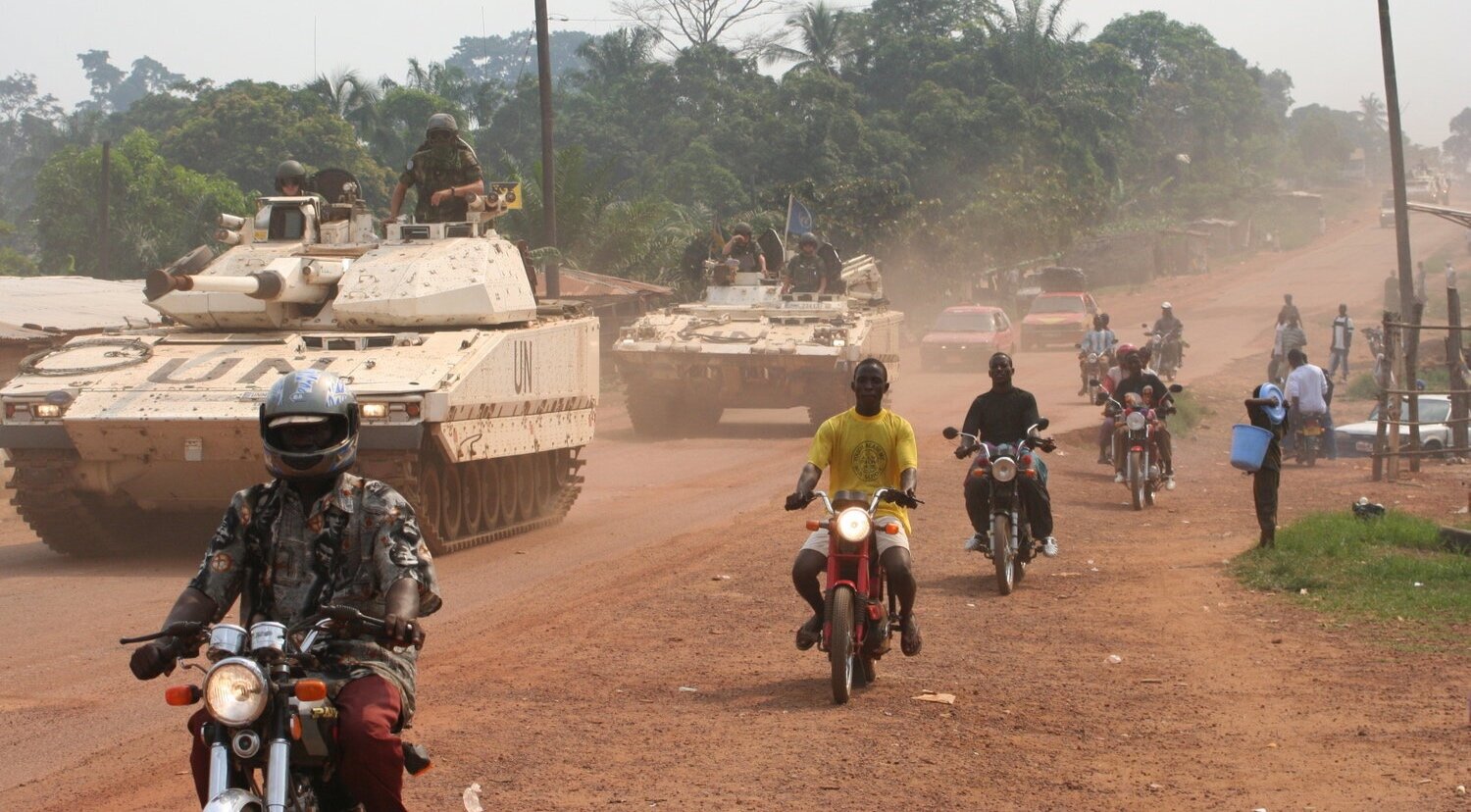
Swedish combat vehicles heading towards Ganta, Nimba County, Liberia. Photo: Mattias Wandler
The situation remained relatively calm throughout the deployment, and operations mainly consisted of so-called Long Range Patrols deep into the West African jungle. The greatest risks came from disease, the weather and the difficulties of travelling along the poor roads. The Swedish Combat Vehicle 90s, which had been fitted with additional armour and painted white before deployment, proved invaluable in negotiating the difficult terrain.
During the mission, one of the section commanders kept a diary, allowing us to follow the activities of one such Long Range Patrol. Although the mission in Liberia was relatively peaceful, there were still occasional incidents.
28 May – 8 June 2006: Long Range Patrol (LRP) – Operation White Light

Combat vehicles being unloaded. Photo: Mattias Wandler
Day 1, 28 May – March to Ganta
We departed Camp Clara at 0600, heading for Ganta. We travelled on a transporter, and I spent the first three hours in the driver's seat. It was nice to watch the scenery and enjoy the air conditioning. We arrived at our patrol base at 1600. It was then time to dig drainage ditches around the tents. We decided to sleep in Muzzidomes [a type of dome-shaped mosquito net] under a tarpaulin, as the weather was good and we would be staying here for a few days. It was really sunny and hot, and the heat hit us like a wall when we stepped out of the vehicle. We had spent practically the entire day inside that well-air-conditioned tin can. […]

UN soldiers sheltering from the sun. Photo: Mattias Wandler
Day 2, 29 May – Patrol in Ganta
Today we went out on patrol here in Ganta. At 0800, we headed into town, where people were already busy going about their daily lives. The platoon dismounted and patrolled on foot in sections. The temperature was pleasant and comfortable.
AS1 [the Platoon Commander] joined our section today, which was the first time he had done so. As usual, Andreas gathered a great deal of information in his role as MLRS [a system in which one soldier in each section receives special training in communicating with local people and gathering information]. He's good at it.
It was a successful patrol, and everyone was able to contribute a great deal to the patrol report. I shook hands with a man whose hands were covered in raw chicken. To be on the safe side regarding avian diseases, I burnt my gloves afterwards. Another man wanted to sell us some fish. It didn't look particularly appetising. He insisted it was fresh.
At 1200, the vehicles picked us up, and we returned to the patrol base for lunch. I also had some sweets and a soft drink. Very nice. I'm sitting under an umbrella at the moment to shelter from the sun.

Foot patrol at the market. Photo: Mattias Wandler

The rubber plantation in Salala, Bong County, Liberia. Photo: Mattias Wandler

Swedish UN soldier in Liberia. Photo: Mattias Wandler
Day 5, 1 June – Ganta
It's now 2137, and I'm lying in my Muzzidome [mosquito-net tent] at the patrol base. The rain is pattering against the tarpaulin, and our drainage ditches are filled to the brim with water. Just a little while ago, AH and I were standing looking out into the darkness on the other side of the road. Apparently, a woman had been thrown out by her husband, and she was crying and wailing loudly about it.
Today, we were accompanied on patrol by the Irish SMO (Senior Medical Officer). His name was Philip, and he was originally from Slovakia. He was a really nice fellow who had joined the Irish Army the previous year. We took things fairly easily on patrol and had several breaks. It was hot today, so they were necessary. It was a two-hour free patrol, during which we had access to neither a map nor GPS. It felt good and was enjoyable.
Just as we had returned to the patrol base and taken off our equipment, Andreas, Jonas and I heard a loud bang. It might have been about 200 metres away. "That was a gunshot," we concluded.
I immediately reported it to AS2 [the Deputy Platoon Commander], and within a minute we had permission to investigate. The five of us in the section set off along the path in the direction from which we had heard the shot. I ordered the men to carry their rifles across their chests, in case we needed to make our weapons visible.
We passed a house, moving around both sides of it. We continued along a path into the undergrowth and eventually emerged onto a rubber plantation. To our left, we caught sight of someone working. It was important not to lose observation of the other sectors as we moved quickly towards this person.
Suddenly, Johan spotted four people about 100 metres behind us, walking through the forest. They were carrying weapons, and we knew that some hunters in the area had AK-47s. We turned towards them and increased our pace. As we spread out into a line facing them, Andersson said something about an AK-47 slung across someone's back, and our attention became even more firmly focused on the group.
My pulse certainly quickened at that point. I shouted, "United Nations! Stop! Put down your weapons!" We were still perhaps 30 metres away from them, but they dropped their weapons immediately. One of them pulled out a machete that had been tucked into his belt. When we reached them, we could see that they were trembling with fear. On the ground lay only three SBWs [short-barrelled weapons], all hunting firearms. It turned out that they had shot a so-called groundhog, a type of marmot. They were still visibly shaken. I called AS2 over the radio, and he joined us. AS2 explained to the group that we were stationed just 200 metres away and that we would respond whenever shots were fired in our vicinity. He told them that, in future, they should hunt further away. […]
Quisque iaculis facilisis lacinia. Mauris euismod pellentesque tellus sit amet mollis.