
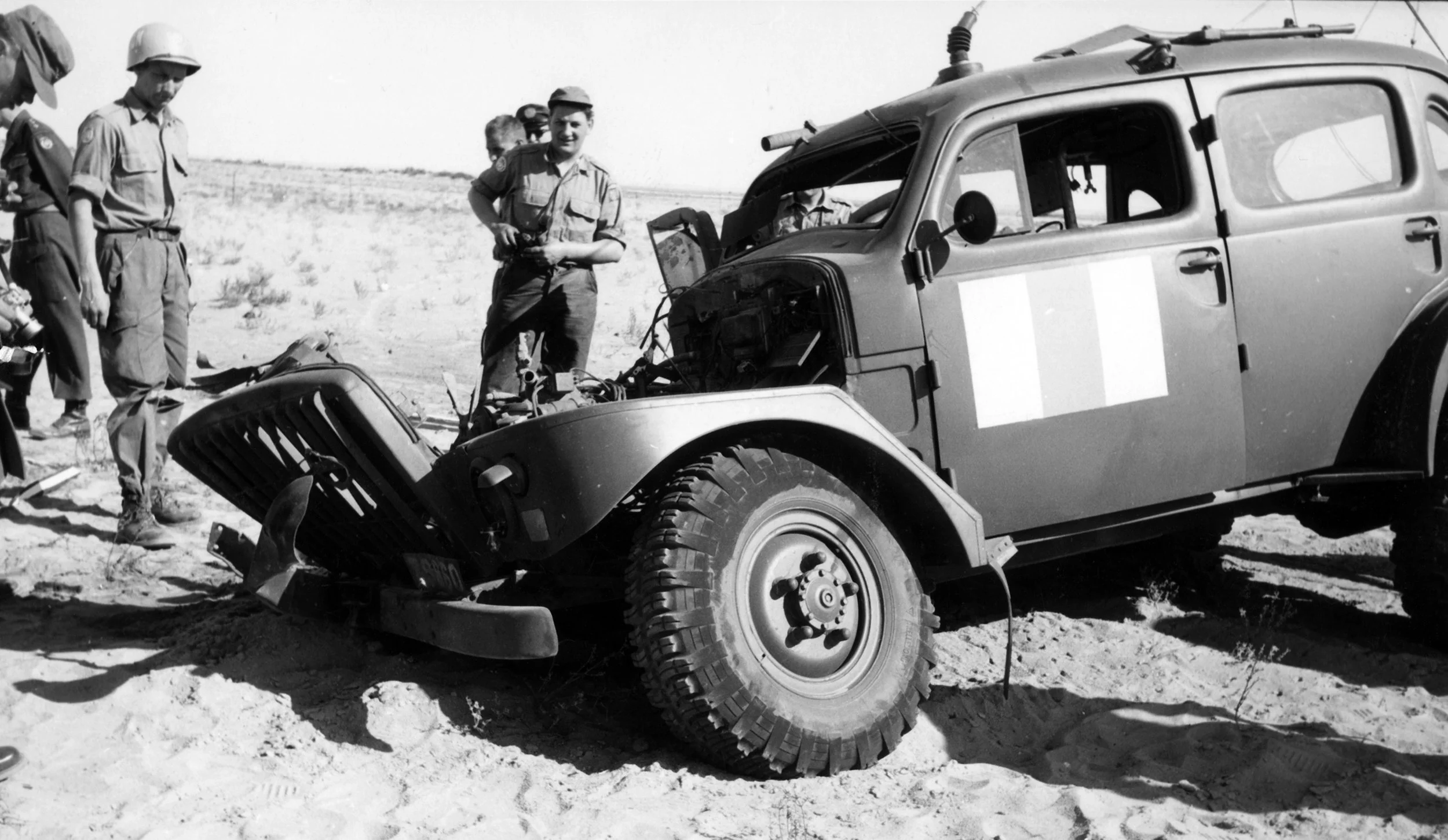
THE LANDMINE ACCIDENT
Kjell arrived in Abu Suweir, Egypt, on 3 December 1956, as part of a 330-strong Swedish contingent tasked with monitoring the ceasefire following the Suez Crisis. The contingent, which formed UNEF Battalion 01 (1G) and served from December 1956 to May 1957, faced considerable challenges and, as a result, learned many lessons at a high cost.
There was no experience from comparable missions to draw upon. The last peacekeeping mission of a similar nature in which Swedish troops had participated had taken place in Schleswig-Holstein in 1849–1850, more than a century earlier.
In many ways, Kjell and his comrades therefore paved the way for future peacekeeping missions through the experiences they gained during UNEF 01, also known as Battalion 1G.
One incident that left a particularly deep impression on Kjell was the landmine accident involving him and three of his comrades on 4 January 1957. In his diary entry for that day, Kjell writes in a matter-of-fact tone:
"Went out to El-Ballah to put up barbed-wire fencing around our future camp at Carnak Camp. During reconnaissance, we drove over an anti-tank mine. Corporal Enqvist lost part of his lower leg, and Magnesved suffered a chest injury. I got a piece of shrapnel in my forehead, nothing serious. The vehicle was reduced to a heap of scrap metal."
Kjell describes the incident in his written memoirs:
“On 4 January, a group of four of us were ordered to carry out reconnaissance for our future base at Carnac Camp. We used a "Sugga" (a Volvo military vehicle). During the reconnaissance, we drove over an anti-tank mine with the right front wheel. (A Czechoslovak plastic mine, Model 1954, containing 7 kg of TNT.)
The mine was located in a large minefield that none of us knew existed! It later turned out that we had driven a considerable distance into the minefield before hitting the mine.
Corporal Göte Enquist, who was sitting in the front passenger seat, was seriously injured. Uno Magnesved, who was driving, and I, who was sitting in the right rear seat, suffered minor injuries. The only one who escaped unhurt was Stig Brehmer. The heavy Volvo vehicle was thrown ten metres through the air, and when it landed, all the doors flew open and we were hurled out onto the desert sand.
We immediately realised that Göte was seriously injured — his entire right lower leg was gone. We also realised, of course, that we were in the middle of a minefield. But Göte urgently needed medical attention, and we agreed that Stig would stay with him after we had all helped apply a tight pressure bandage. Uno and I would go for help.
We will probably never forget that desperate run. Both of us were bleeding from wounds to our faces and chests. We ran, keeping a considerable distance between us and avoiding anything that looked unusual on the ground. We managed to get out of the minefield, which was marked by a fence on the far side. On the side where we had entered, however, the fence had been removed — stolen.
Our predicament had already been noticed from headquarters, so we encountered a DaNo ambulance (Danish-Norwegian) almost immediately. The ambulance crew were then able to follow our footprints back to the accident site and rescue Göte. Our injuries were treated in the ambulance, and we were later able to help maintain pressure on Göte's bandage throughout the journey to Port Said.
On 6 January, having been discharged from hospital, I helped with the mine clearance operation and the recovery of what remained of the "Sugga". It turned out that there were plenty of mines, including numerous booby traps involving anti-personnel mines.
One big surprise awaited us: the vehicle's radio was still working perfectly!
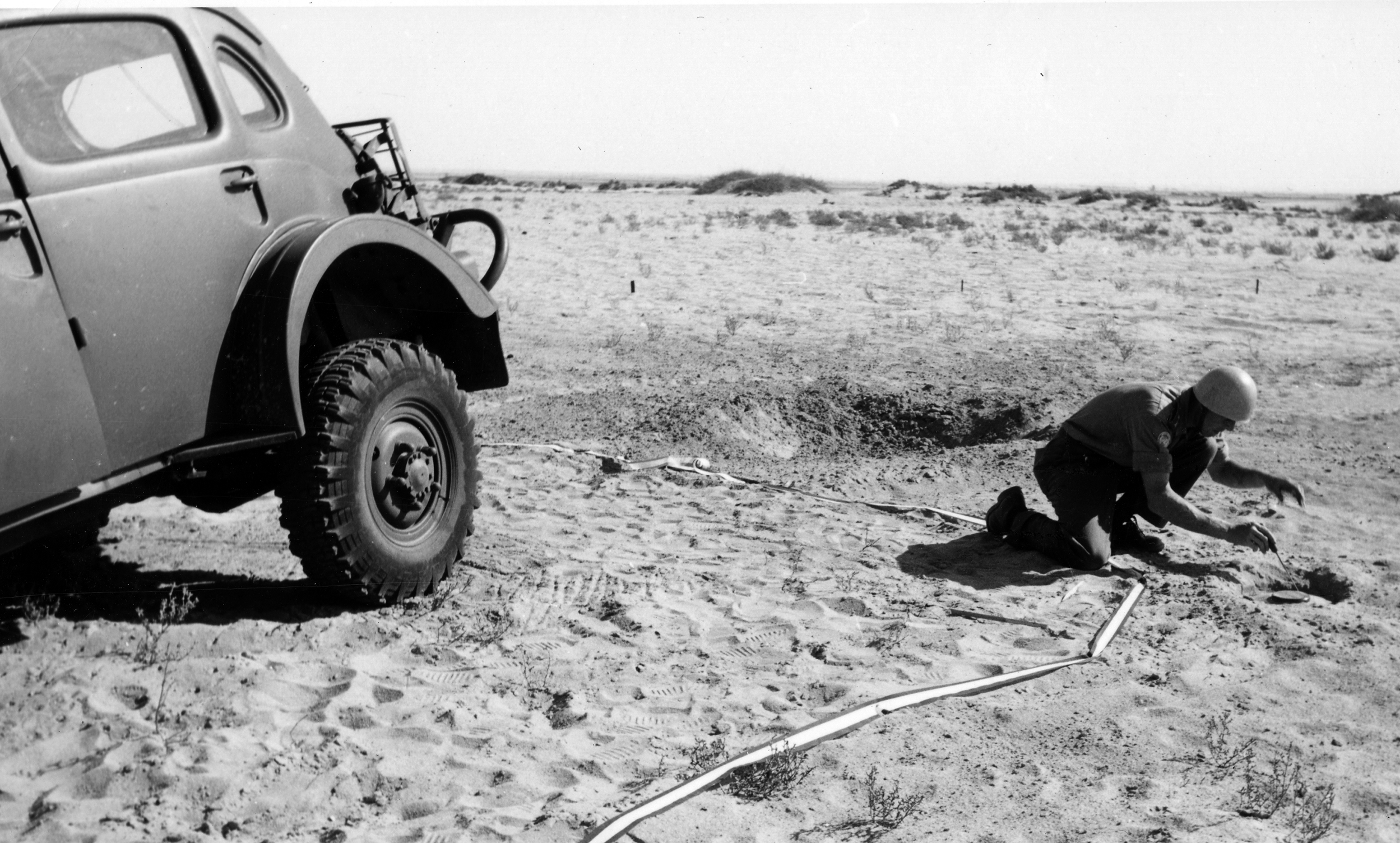

Göte later received a prosthetic leg, and we met again at the 40th anniversary reunion in Stockholm in 1996. We were all delighted to see that he had retained his good sense of humour. Nowadays, we meet several times a year at the Veterans' Club gatherings in Helsingborg. In February 1957, Stig Brehmer was awarded the ´Medal for Commendable Deeds´, Fifth Class. Sadly, Stig Brehmer is no longer with us. He passed away in 1990.”
Göte Enquist was finally awarded a medal by the Swedish Armed Forces in 2012 — 55 years later — in recognition of the lifelong injury he had sustained.

Photograph: Göte Enqvist (left) and Kjell Jonsson (right) reunite on Veterans Day, 29 May 2017, 60 years after the landmine accident.
Quisque iaculis facilisis lacinia. Mauris euismod pellentesque tellus sit amet mollis.