
IN THE MIDDLE OF THE SIX-DAY WAR

"In three assault columns, Israeli armoured forces broke through the Egyptian lines and advanced into Sinai. A fourth column entered the Gaza Strip and headed towards Gaza, where the Swedish UN peacekeepers had hastily dug themselves in on the beach. They were still awaiting evacuation when artillery shells began landing just a few dozen metres from their positions." — Lars Ericson Wolke, Populär Historia 8/2003.
On the beach in Gaza, infantry platoon commander Lars Bylander was with his comrades from Swedish UN Battalion 31 G when the artillery shells began to fall. What would later go down in history as the Six-Day War had just begun on 5 June 1967, and the Swedish UN troops suddenly found themselves quite literally in the middle of the war. Lars has written down his memories of those days, which you can read below.
By Lars Bylander
Battalion 31 G served in Gaza from April to June 1967. The first few months of the deployment were relatively uneventful. The battalion's task was to guard the so-called ADL line along the border with Israel, which was carried out through static and mobile patrols operating from a number of platoon outposts.
My platoon was responsible for guarding UNEF Headquarters in Gaza City, with one rifle squad on duty at a time. Part of my assignment was to establish contact with the local population. It was an enjoyable and rewarding task. I developed very good relationships with people from different walks of life and was treated with great kindness and generosity. I wanted to share my experiences with the platoon.
Another platoon commander and I planned and organised a study visit to Gaza, taking in several interesting sites, including the largest mosque in Gaza. Inside the mosque was a staircase leading up to a bricked-up doorway. Such a doorway can be found in every mosque. According to what we were told, if Muhammad returns, he will do so in a mosque, entering through this doorway.
Next to the mosque was a preschool. In preparation for our visit, the children had rehearsed a performance in which they walked around holding hands while singing a song. I asked an English-speaking member of staff what they were singing and was told: "We shall return, death to the Jews." No further comment necessary.
What had initially been an uneventful deployment gradually developed into an increasingly tense situation. A confrontation between Egyptian President Nasser and the Canadian Prime Minister led to the withdrawal of the Canadian battalion from Gaza. The entire force, 800 men and their equipment, was airlifted out by the American transport organisation MATS, the Military Air Transport System, in less than 48 hours.
Things were now coming to a head. Threatening statements were being made by all the states in the Middle East. Israel was mobilising. The PLO set fire to a large Israeli grain field. The PLA, the Palestinian Liberation Army, took up positions on David's Hill outside Gaza.
Our platoon outposts were withdrawn from the ADL line and redeployed to the battalion base at Hill 88.
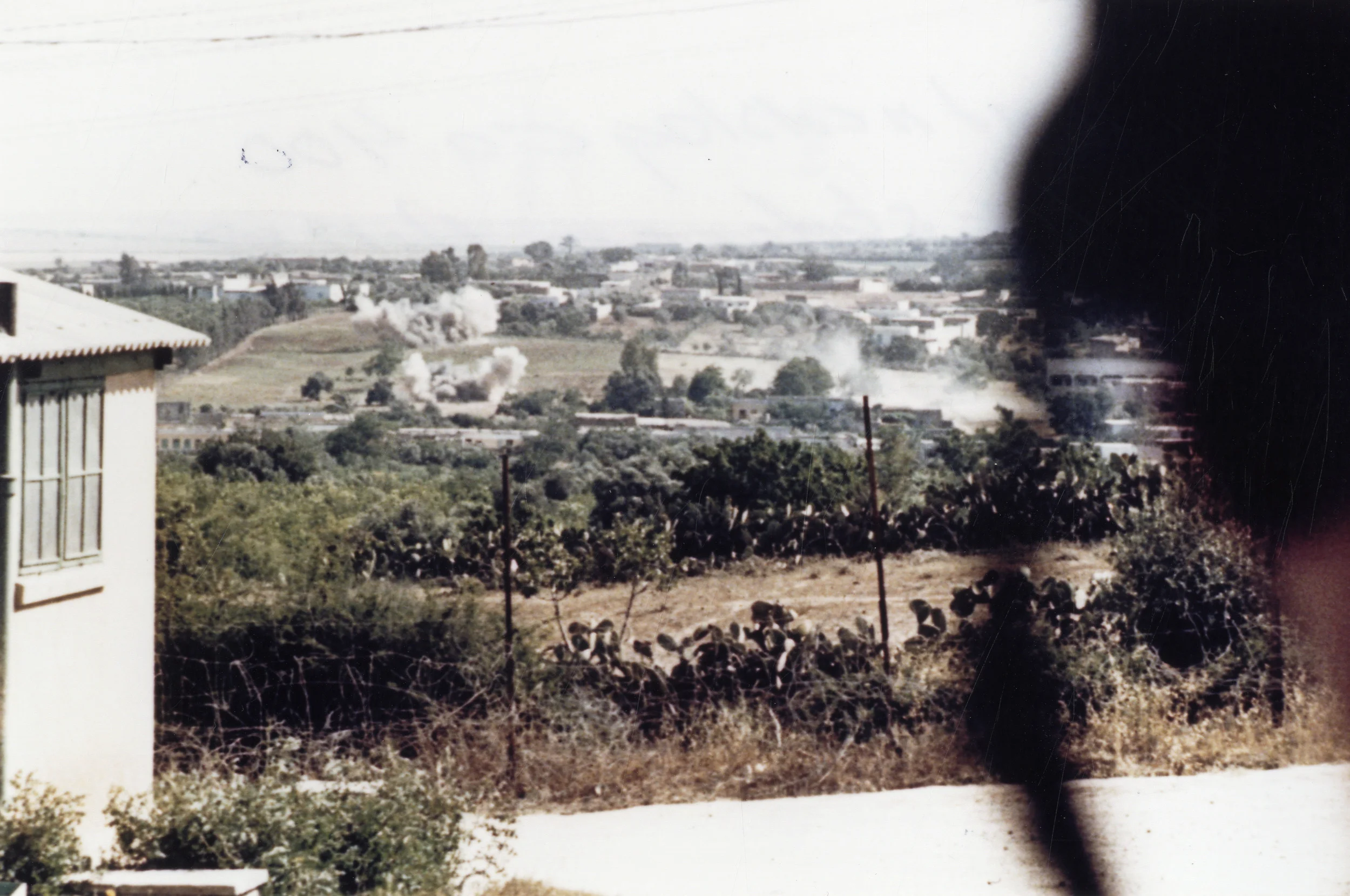
Artillery shell impact approximately 400 metres south of Hill 88.
In early June, Israel launched its attack on the neighbouring Arab states. Israel struck swiftly, fiercely and ruthlessly. The battalion left Hill 88 and redeployed to the beach in Gaza, where we dug ourselves in. Now we were at war. We were not involved in the fighting, but we found ourselves right in the middle of it.
Two Israeli Mirage fighter jets flew low over us and fired their automatic cannons into the sea, approximately 200 metres from our positions. We took this as a warning. Israel attacked an American signals intelligence ship. "Warning, stay out of this." Anything could happen. We prepared ourselves for combat, loading all our magazines.
I realised the importance of obtaining information and searched for it on my shortwave radio. I managed to pick up the BBC Middle East programme and Israeli Army Radio, fully aware that not everything I heard could necessarily be considered 100% reliable.
Evacuation of Hill 88.
We were dug in, divided into squads, so I gathered the squad leaders every two hours and whenever something dramatic happened. Israeli Army Radio broadcast short news flashes interspersed with morale-boosting music such as "Going Over Jordan" and "Havannah Gela Havanah Rannenha".
Israeli Army Radio reported major successes on all fronts. Israeli paratroopers had recaptured the Temple Mount in Jerusalem.
Israel was firing six guns from self-propelled howitzer batteries, with shells passing over and landing close to our positions. We kept our heads down in our foxholes. We became increasingly aware of the realities of war and combat. We were right in the middle of the fighting without actually taking part. We were neutral, but if we were attacked, we would defend ourselves. I instilled fighting spirit in the soldiers. Living so close to death certainly gives you an adrenaline rush. I felt no fear, but was more focused on commanding my men. I kept everyone constantly informed about the situation.
The outermost rifle squad came under fire. The squad leader requested permission to return fire. I informed the company commander and requested permission to return fire. The request was denied. Above our positions on the beach was a Palestinian anti-aircraft battery. It came under repeated attack from an Israeli Hawker Hunter aircraft. The anti-aircraft gunners were not shooting badly. Their tracer rounds passed close to the aircraft, both above and below it. Eventually, the anti-aircraft fire ceased — the battery had been knocked out.
As a former reconnaissance platoon commander, I was eager to gather information, so I climbed a ladder to look around. Suddenly, bullets began whistling through the air close to my head, striking the wall and sending clouds of cement dust flying. I quickly scrambled back down to ground level, shaken but not frightened.
6 June 1967, on the beach in Gaza.
Israeli Army Radio continued broadcasting rapid news flashes announcing that the war was over. Israel had been victorious on all fronts. An Israeli lieutenant said to me: "We stand with our backs to the Mediterranean. We must win every war we fight, otherwise Israel is lost." Perhaps this explains the Israelis' ruthless and uncompromising conduct of warfare.
The battalion broke camp and was transported to the port city of Ashdod, and from there by cargo ship to Famagusta in Cyprus, before finally flying home to Sweden.
Our mission has been criticised for having failed in its task. War had broken out. Professor Brink, an expert in international law, once said to me: "The Danish, Norwegian and Swedish battalions had a stabilising and war-deterring effect. War would have broken out much earlier if our battalions had not been there." The battalion did a good job. We did not lose a single man. However, a great deal of equipment was destroyed during the war. There was good leadership at every level, from the battalion commander down to the squad leaders. My own leadership was rated X99.
Lars Bylander
Infantry Platoon Commander
Headquarters/Support Company
UN Battalion 31 G
Quisque iaculis facilisis lacinia. Mauris euismod pellentesque tellus sit amet mollis.