
TOWARDS KILUBI
The following account comes from Sven Thufvesson, who served in the Congo (and partly in Gaza) with Battalions V G, VIII G/K, XVIII K, and XX K. The events described concern the unrest from the autumn of 1962 to the spring of 1963, and more specifically what happened after the attack on Kaminaville, when Sven was the squad commander of the armoured car Lulle-Belle.
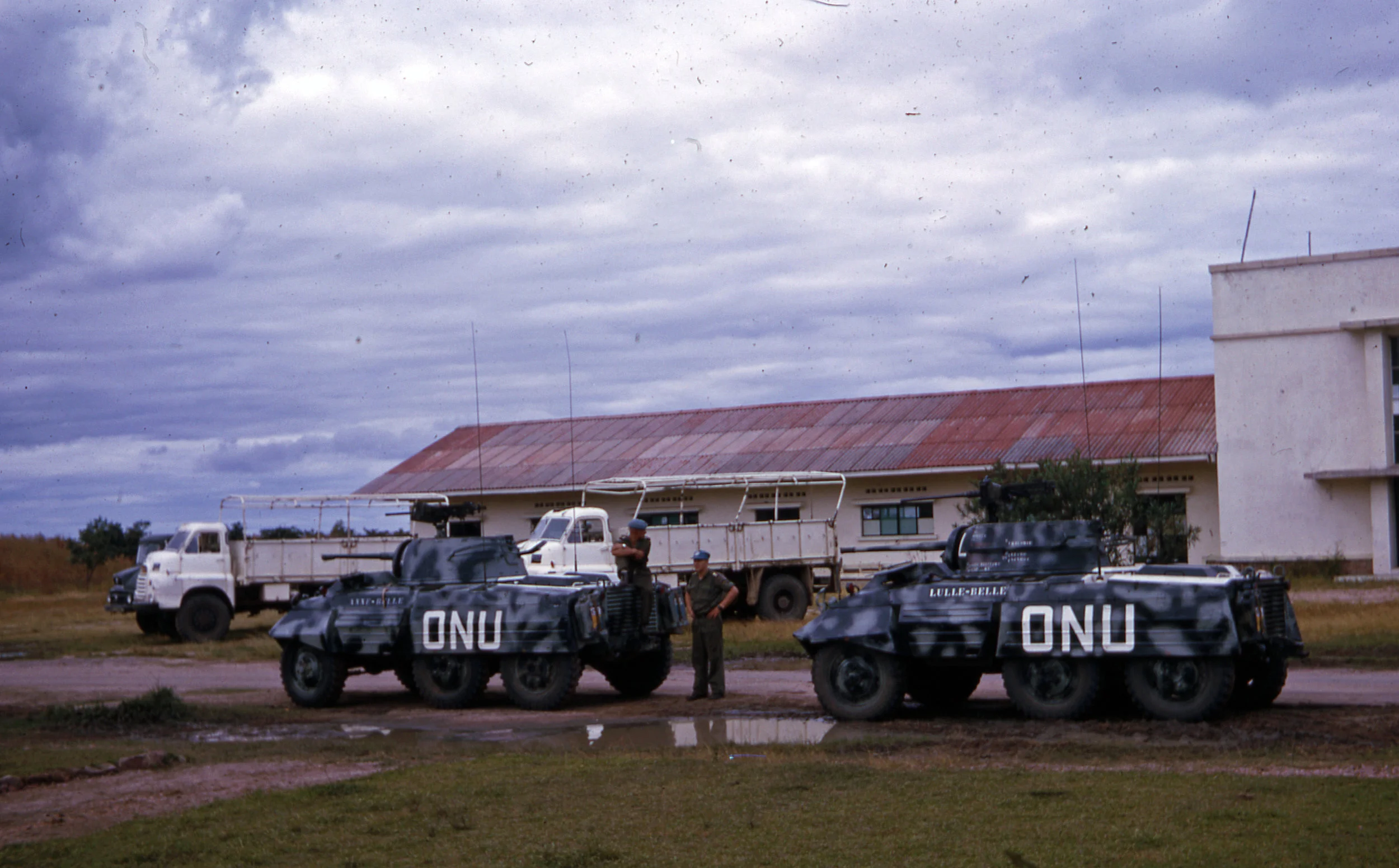
This armoured car was an M8 model that had been captured from the Katangese Gendarmerie. The Gendarmerie had used these armoured cars in combat against UN troops. Two armoured cars of this type were put out of action by Swedish troops during the attack on Kamina Base in September 1961. In the autumn of 1962, these two vehicles were restored to operational condition and used in combat against the Gendarmerie in December of the same year. During these engagements, two additional vehicles were discovered. All four became part of the Swedish Armoured Car Platoon, which was under the direct command of the Battalion Commander.
Lulle-Belle with her sister Nina-Belle. Photo: Bengt-Åke Svensson.
By Sven Thufvesson
In preparation for our assignment as the lead vehicle on the advance towards Kilubi, Lulle-Belle had been reinforced with a new fourth crew member. Bengt Herring, a veteran of the 12th Battalion, was a welcome addition to the team.
Relations between the captain, who was in command of the operation, and myself deteriorated right from the start. Would he be able to ensure our safety in combat using the two 37 mm guns? We had serious doubts, but we were obliged to obey orders. Herring and I were to stand exposed on the rear armour, operating the .50-calibre machine gun.
The easy days were over. Shortly before five o'clock one evening, we received orders to be ready for combat within an hour. Our objective was the Kilubi power station. Just give us a call and we'll be there!
Lulle-Belle was to lead the convoy. The captain had prepared the operation using aerial photographs and intended to direct the advance from my fighting position. I thought this was unnecessary, as there was an additional seat beside the driver.
Instead, Herring and I were assigned to operate the .50-calibre machine gun on the rear armour, while the captain would handle the 37 mm guns in combat.
I had prepared fresh ammunition belts with additional tracer rounds, as there was a possibility of fighting in darkness. Before moving to the .50-calibre machine gun, I showed the captain where the spare ammunition belts were stored inside the armoured car.

Just give us a call and we'll be there!
Eighty kilometres of poor roads lay ahead of us. We were supposed to reach Kilubi just at dawn, hoping to take the gendarmes by surprise.
During our first stop, the captain wanted to know how to operate the machine guns. I had assumed he was experienced with this type of weapon. After a brief explanation, everything was supposed to work out. I assured him that we would operate the .50-calibre machine gun over his head.
At times, the roads were heavily flooded. Looking back, it seemed as though we were travelling in a fast motorboat.
"Töreboda" had his hands full changing gears to make the best possible use of the engine's power. Sometimes he had to "crash-shift", that is, change gears without disengaging the clutch, to keep the "vessel" moving.


I wasn't scared “shitless” at the prospect of going into combat again, but my stomach began playing up during the night. In UN parlance, it was known as "axe stomach," but in ordinary civilian language, it was simply called a stomach bug.
I couldn't very well ask the captain to stop the convoy just so I could go to the "toilet." With a rope tied around my chest for support and my trousers pulled down, I backed across the rear armour while Herring gradually paid out the rope. At the very back, on the grille through which hot air escaped from the engine compartment, I squatted down and relieved myself. The warm air felt pleasant against my backside, and the lads in the vehicle behind us had a good laugh.
During a stop at around four o'clock, the captain asked whether he could crouch down on the floor of the armoured car if we came under fire. That would allow me to move back to my fighting position in the turret. It was probably the best solution for making full use of all the vehicle's weapons.
We reached our objective shortly before dawn. Bicycle-mounted infantry secured all the dam gates and prevented the explosive charges from being detonated. The mission was successful, and the vehicle convoy entered the power station compound.
We were assigned the task of clearing the accommodation area. I thought it was empty and deserted as I approached a building on foot to inspect it. Suddenly, an armed gendarme ran out, turned his back on me, and fled into the forest. I chose not to shoot, and my comrades in the turret could not open fire without risking hitting me. Not a single shot was fired at Kilubi, and the power station was saved.


Lulle-Belle was to serve as part of a mobile reserve force in the event of a counterattack. While reversing into our designated position, the accelerator cable came loose. Aldén went down to work on the pedals, while "Töreboda" attended to the carburettor. After a while, the problem was fixed.
Someone called to Aldén to test the accelerator. He did not answer. When we looked down at the floor, we found him fast asleep, using the brake and clutch pedals as a pillow. It was now seven o'clock in the morning. We had been on the move for more than 24 hours. We were offered some rest, but before we had even managed to fall asleep, new orders arrived: "Lulle-Belle is to return to base as soon as possible." Just give us a call and we'll be there!
Despite having been on duty for more than 24 hours without a break, and having had nothing to eat for the past 15 hours, we were ordered to return directly to Kamina Base. We had no map, so we followed the wheel tracks left during the night, hoping we were heading in the right direction.
It felt good to be heading back to base, where we would finally have a chance to rest and eat. We expected to arrive within four hours if we could maintain full speed in daylight. After approximately 40 kilometres, it happened. The clutch gave up.
We sprayed fire-extinguisher fluid into it and threw in gravel, but nothing helped. "Bella" stood motionless, her engine simply rumbling away. We were in an area where gendarmerie forces might very well still be operating. We tried calling for assistance over the radio, but nobody could hear us.
Aldén and Herring set off on foot towards the base. Armed with small arms and hand grenades, and carrying a little food and water, they began their journey. Forty kilometres on foot through enemy territory, hungry and exhausted. Would they make it?
Before they left, we held a council of war. Should all four of us remain and wait until dawn the following day, when the risk of an attack would be considerable, or should two men set out to find help? We made the right decision. We would never have survived a battle on our own.
"Töreboda" and I stayed with the armoured car. We laid dummy mines on the road in front of and behind the vehicle. We also scattered dry twigs across the road to serve as an improvised alarm system in the darkness. On both sides of the road were marshes full of frogs. They would serve as our watchdogs. If anyone attempted to cross the marshes, the frogs would fall silent.
We dug defensive positions in front of and behind the vehicle and rehearsed our procedures for fighting in darkness. If a vehicle approached, I would take up position in the foxhole while "Töreboda" manned the turret. If the approaching vehicle was hostile, I would duck down into the foxhole while "Töreboda" fired the machine guns over my head. From my position, I would throw hand grenades. Any enemy approaching us would certainly receive a warm welcome.
Before darkness fell, we took the opportunity to make some coffee. We were soon joined at our makeshift dining table by enormous ants. The only way to get rid of them was to scorch the ground with a blowtorch. (Perhaps that is where the expression "to put the blowtorch on someone" comes from?)
We made a bed on the rear armour using a tarpaulin and divided our rest into 30-minute shifts. On the right rear corner, we placed a tube of Swedish Christmas liver pâté. Whoever was on guard would walk a circuit around "Bella," squeeze a little pâté onto his thumb, put it in his mouth, and then make another circuit.
This was the only way we could keep ourselves awake while standing guard. After all, we were now into our second night without proper rest.
During the changing of the guard, we smoked. One man would climb down onto the floor of the vehicle while the other covered him with the tarpaulin so that no glowing cigarette could be seen.
Shortly after three o'clock, I spotted headlights on the road from Kamina Base. A vehicle was approaching us. I woke "Töreboda," who took his position in the turret, while I jumped down into the foxhole beside the dummy minefield. The vehicle stopped at the mines, and someone called out to us in an accent from the southern parts of Sweden.
Folke Norberg! You are our saviour! Thank you!
Aldén and Herring had managed to reach the base on foot in the darkness, only to be arrested by Ghanaian soldiers. Their story was not believed, and they were kept under arrest for much of the night. The claim that they had travelled such a long distance on foot in darkness was simply considered unbelievable. Eventually, the Swedish battalion was contacted, and a rescue party could be sent out.
Just imagine if I had slipped in the foxhole when the vehicle stopped. "Töreboda" might have interpreted my movement as an attempt to take cover and emptied two ammunition belts into our rescuers. It could have ended in a terrible tragedy.
We did not remove our dummy mines. As a result, the following morning, a truck belonging to the Ghanaian Battalion drove into a ditch when its driver spotted the "mines." An entire company deployed into combat positions throughout the area before the deception was discovered.
Since Aldén and Herring had been badly treated during the night, we felt that the Ghanaian Battalion had received a taste of its own medicine.
By the time we finally crawled into bed at the base, we had been on the go for almost 48 hours. We slept soundly for nearly the entire day before beginning repairs on "Bella." In Kaminaville, we had captured a considerable quantity of spare parts as war booty. Getting Lulle-Belle back on her feet again was therefore not particularly difficult. While working in the workshop, we probably did things that we would never have attempted under normal circumstances.
Many years later, Leif Aldén still insists that I once attempted to cut a petrol drum in half using an oxy-acetylene cutting torch. The drum had been filled with water to allow the petrol vapours to dissipate. Despite this precaution, an explosion occurred. Apparently, I escaped unharmed, although I have no recollection of the incident.
What I remember all too well, however, is how "Töreboda-Karlsson" decided to modify some cannon ammunition. Among the war booty we had captured were a number of high-explosive shells. The problem was that their casings had become rusty, and the sensible approach would perhaps have been to carefully remove the rust with sandpaper. "Töreboda" thought this procedure was far too slow. When I arrived at the workshop, all the mechanics had fled the premises. There stood "Töreboda," completely alone at a lathe, machining the projectiles. He had already managed to finish one of them when I stopped him.
Sometimes luck is on your side. We had only one lathe in the workshop!


By now, we mostly had regular "eight-to-five jobs," carrying out patrols to various villages. We were still searching for gendarmes and mercenaries.
The two armoured cars usually operated in pairs. The lead vehicle had its turret facing the six o'clock position, while the rear vehicle had its turret in the normal forward-facing position. In this way, we could defend each other in close combat by providing covering fire and clearing threats around one another.
One particular mission stands out in my memory. Folke Norberg and I were assigned to patrol a stretch of road and inspect two villages with our respective vehicles. At around noon, we went our separate ways, having agreed to rendezvous at approximately five o'clock. Lulle-Belle returned to the crossroads well ahead of time. We waited a long time for Norberg's vehicle, which finally arrived at dusk, around six o'clock. On the rear armour lay two long white boxes. They looked like coffins. What had happened?
"Well," Folke explained, "we reached the village beside the railway. A fully armed gendarme was standing guard outside a goods warehouse. I dismounted, maintaining a high state of alert, and approached the sentry.
I had equipped myself with a swagger stick, like those carried by all African officers. In my Scanian dialect, I ordered him to summon the rest of his unit. A commander and six men came running. They formed a neat line, and I inspected them. I fixed them with a steely gaze as I reprimanded them for unbuttoned buttons and poorly polished boots. I ordered them to 'ground arms' and, speaking in Swedish, informed them that the war was over. I paid them their wages out of my own pocket, removed their shoulder insignia, and disbanded the unit. We confiscated their weapons."
But what about the white boxes? "Well, we passed a ransacked mission station. The only things of value remaining were two large Swedish-made kerosene-powered refrigerators."
The motor transport officer, Captain Bertil Jernberg, accompanied us on one patrol. While we were taking a break near a village, we came under fire. Jernberg "took cover" behind the jeep's canvas hood, but I grabbed him and threw both him and myself into a ditch. I do not remember much about the incident, but Jernberg escaped unharmed. Later, he thanked me for saving his life and for "using force against a superior officer"!
Even the military chaplain had an unfortunate experience during one mission. On the return journey, he rode with us, sitting on the front armour and holding on to the cannon barrel with one hand. While travelling at high speed, I ordered the vehicle to stop beside an abandoned guard hut. The armoured car stopped, but the chaplain did not. He was thrown forward and landed on all fours on the ground.
"Hell, the padre's fallen off!" came a shout from the driver's position. The chaplain scrambled to his feet, covered in blood and mud, and rushed towards "Töreboda."
"I forgive you for driving like a reckless hot-rodder, but not for swearing in my presence," he declared, somewhat angrily. After a short while, however, the two became very good friends, and the incident was forgotten.
At the military camp in Kaminaville, we had taken possession of two armoured cars. These were to be restored to combat-ready condition and painted in the UN's colours. My gunner, Leif Aldén, had been promoted to sergeant and appointed commander of one of the vehicles. To obtain additional spare parts, several of us flew down to Elisabethville. There were damaged and shot-up vehicles there from which spare parts could be salvaged.
A Swedish sergeant was stationed in the town as a liaison officer. He lived in a villa where we were also accommodated. He had access to a heavy truck and knew that a disabled armoured car was standing near the Indian camp. We went out that evening to "check things out." The vehicle stood beside the access road leading to the Indian camp. We decided to collect it the following morning. With the help of the truck, it would be towed to the airfield, where workshop facilities were available for removing the components we needed.
We set off at dawn. Everything had been prepared for a quick operation. Attach the tow cable, put one man in the driver's seat, and off we go. But it did not work out. Suddenly, we were surrounded by fierce-looking Indian soldiers who, at bayonet point, forced us into a guardroom. And that was how, among others, a customs officer and a police officer — both from Sweden — found themselves under arrest for theft. The armoured car belonged to the Indians and was being kept as evidence of how skilled they were at destroying such vehicles.
The Indian commander was an understanding man. After we apologised for our actions, we became his guests. We were allowed to remove all the internal components from the armoured car. The Indians were only interested in keeping the wheels, turret, and bullet-riddled hull. For two days, we enjoyed their hospitality. We were frequently offered tea with goat's milk and plenty of sugar. It tasted excellent in the chilly, unpleasant weather. We were also treated to lunch on both days. Looking back, I suppose I can admit that we found the food so heavily spiced that we had some difficulty eating all the different dishes served. Fortunately, plenty of water was provided with the meals.
Quisque iaculis facilisis lacinia. Mauris euismod pellentesque tellus sit amet mollis.