

UN OBSERVER IN SYRIA AND LEBANON
In March 1984, Sixten Svensson travelled to Israel/Palestine to serve as a UN observer in Lebanon and Syria (the Golan Heights). He was stationed at various observation posts (OPs) until November 1984. In September 1984, his wife and three children joined him to live there, something that was, and still is, common among UN observers. The children attended school, and family life continued in this way until March 1985. Sixten later returned to serve with Battalion L98 in 1988–1989 and Battalion L118 in 1993–1994.
The diary entries below offer a brief glimpse into what it was like to work as a UN observer in Lebanon and Syria during the 1980s. His assignment appears to have been characterised by fairly ordinary everyday concerns, such as cooking, cleaning and homesickness.
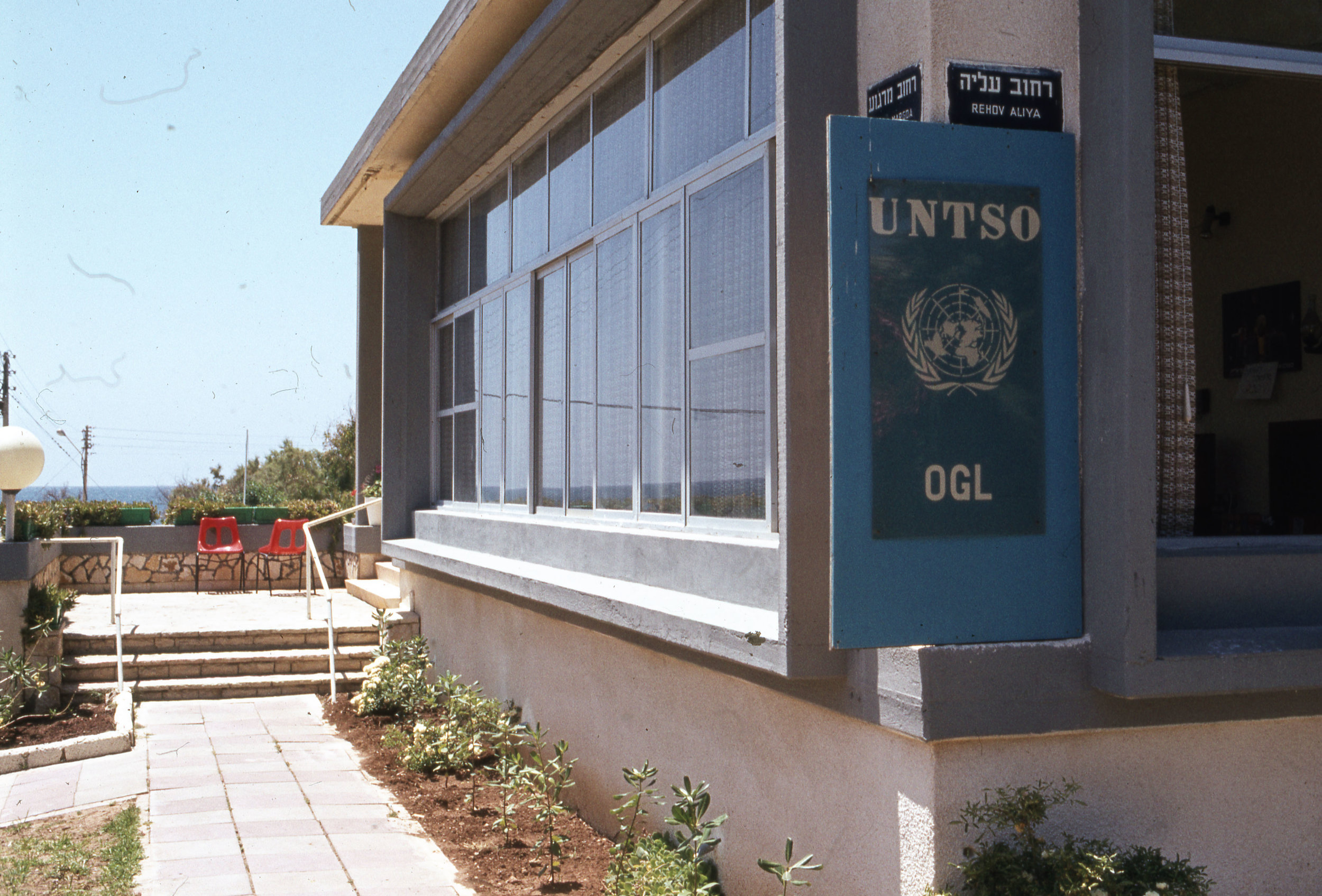
Wednesday, 11 April
OP day. The Chilean captain Morales, who is to be my senior officer at OP 72, collected me and my four pieces of luggage (OP box, cool box, blue naval kitbag and large suitcase), with my windproof jacket draped over my arm. I was picked up at 0730. First, a briefing at ISMAC House by the Deputy Commander of OGG-D. Then on to Ausbat, where we were briefed first by the Operations Commander and then by BUNMO. That is, the UNMO responsible for inspecting us and acting as the liaison between us and the battalion under whose operational command we work. In this case, Ausbat. I bought three rolls of film at Ausbat.
We arrived at OP 72 at approximately 1000. The departing team (Belgium and Australia) were in a hurry to leave. An OP usually consists of an enclosed compound designed to prevent both animals and people from entering. The enclosure is generally surrounded by a stone wall, 1½ to 2 metres high, and measures approximately 25–40 by 25–40 metres. Inside are the accommodation hut, shelter, evacuation vehicle, toilet, shower and main generator. There is also a fuel store and, of course, the observation platform. Here there are two observation positions. One is a small hut from which observations can be made while sheltered from the weather. The other is an open platform fitted with a very large pair of binoculars. The accommodation hut — the caravan — is approximately 10 metres long and 3 metres wide. It contains a room with two beds, a table and three chairs. There is a workbench with two radios and a kitchen worktop with a television receiving five channels. The kitchen area has a gas cooker and refrigerator. Heating is provided by a mazout heater (paraffin stove). Finally, there is a cupboard for equipment. There is also storage space in the kitchen units and two wardrobes for clothing. The shelter contains a radio, two helmets, two flak jackets and two blue covers to wear over the flak jackets (bulletproof vests). Sealed cupboards contain medical supplies and food. There is room for approximately four men. The washing-up and shower area is heated by a mazout heater. The toilet is a flush toilet. There is a water tank on the roof. Altogether, we have five water tanks. I assume that whatever is flushed away simply drains off somewhere. The OP is situated on high ground. The fuel store contains 200-litre drums of kerosene (paraffin), two drums of diesel oil (mazout) and one drum of petrol. There is also a small petrol-powered backup generator. The main generator is a PETTER-STAMFORD diesel.
The evacuation vehicle is an older Wagoneer. The vehicle has more or less reached the end of its useful life, but it is still perfectly adequate as an emergency vehicle. Duties are divided between the indoor and outdoor man. The indoor man is responsible for cooking, radio communications and cleaning the caravan for a 24-hour period. The outdoor man acts as observer, cleans the other facilities and carries out test runs of the generator and vehicle. The duties alternate daily. I started as the outdoor man and began by filling the water tanks from a water lorry operated by the Polish contingent. Afterwards, I received instruction in operating the generator, the mazout heater and the Aladdin lamp — that is, the PETROMAX LANTERN.
Lunch, prepared by the indoor man: soup and minced beef patties. I also took the vehicle out for a drive. Dinner was chicken with rice. Good Chilean red wine. I received a present: a small Chilean metal ashtray. Earlier, I had given him a cap tally bearing the inscription Royal Swedish Navy. To bed at 2330. My first OP day was FINALLY over.
Saturday, 14 April
Up at 0730. My senior officer is still asleep. I light our indoor mazout heater and the water heater. I take the binoculars out of the shelter and mount them on the observation platform. Breakfast, served by Pablo. Outdoor cleaning: the toilet, the urinal, and the washing and shower room. Cleaning largely consists of scrubbing the floors with Lysol. I try to follow the written instructions, so I give the toilet and urinal a thorough cleaning. I have also properly washed our five floor cloths. Pablo cleans the caravan by spreading Lysol over the floor, then using his foot to move the floor cloth around to wipe it up. According to Lars Ljung at the Training Centre in Jerusalem, we are supposed to scrub the floor in the usual way with detergent first, and then disinfect it with Lysol.
I am beginning to get used to the radio communications (in English) and can now follow them without difficulty. I have had another shower. I have also taken as many photographs of the OP as I dared, and a very few of the surrounding area. Photography is prohibited, but I would like to have some pictures to show back in Sweden. I certainly have no intention of deliberately photographing Syrian or Israeli secrets.
Pablo is a 30-year-old captain in the Chilean Air Force. He is a jet instructor at the Chilean Basic Flying School. He is married and has two young children. He is competent and teaches me a great deal. I am certainly fortunate to have him as my senior officer at my first OP. He spends a lot of time on outdoor duty, observing. He is also familiar with all the administrative paperwork, which suits me perfectly. This morning's radio news from Lebanon reported the casualties from the night in Beirut: six dead and approximately 40 injured. The other day, there was another Palestinian suicide terrorist attack in Israel.
Thursday, 19 April
To Lebanon on official duty with Paddy O’Brien. The road to the Syrian–Lebanese border is a motorway. It has painted road markings and is in very good condition. At the border, the effects of the war become apparent. The border station has been subjected to an air attack, I presume. Bombed-out buildings, shattered windows and burnt-out vehicles. From the border to Chtaura, both sides of the road are lined with shops. They sell almost everything: cameras, watches, video equipment, food and clothing. The shops range from simple shacks to more substantial buildings. The customers are mostly Syrians who come here to buy things that are unavailable in Syria. There is an enormous amount of rubbish everywhere.
Chtaura is Muslim and surrounded by Syrian troops. About ten kilometres from Chtaura lies Zahle, which is Christian and held by the Lebanese Army. Zahle is like a small French town. Modern shops, indeed some very modern ones, with a good selection of goods. For example, very beautiful clothes, including some from Spain. About a month ago, the town came under artillery fire. Several buildings have been damaged by shelling. Most of the shops have reopened. The goods in the shops are the very latest models. However, there is generally only one of each item, unlike in Sweden, where the same television, radio, video recorder and so on might be available in 10–20 examples. I bought food supplies for the OP. Exchanged dollars for Syrian pounds.
Back in Chtaura, I found a shop selling Lebanese postcards. Not postcards of Chtaura or Zahle, but still. I also saw Lebanese dolls. I must take the opportunity to buy some at some point. Paddy is looking for a video recorder, so we stop at several shops. Almost every time, a child immediately approaches us asking for baksheesh, or however it is spelt. Beggars, in other words. We never give them anything. It simply wouldn't work. We would never be left in peace. A very hot day. Certainly the hottest so far, at least when sitting in a car. To bed at 1900. Tired.


Tuesday, 15 May
OP day. Although I was the junior officer, I had collected the vehicle yesterday. At 0730, I picked up my senior officer, David Given, an Australian. We arrived at OP 57 at approximately 1000. This is a very quiet OP, the second southernmost on the Syrian side. There are minefields here, a Syrian military position and a fixed tank — that is, a Syrian tank dug into the ground so that only its turret protrudes. There is also a wreck left over from the 1973 war. A few kilometres from here lies "The Valley of Tears", where the Syrians lost more than 300 tanks and a number of men during a battle in 1973.
Inside the shelter, there is an inscription on the wall: "Example of a very long OP, from Oct 4th 73 to 19 Oct 73, Capt Schroll Nielsen DK, Capt Cloostermans B. LO Mansour Syr. War started at Oct 6th 73 1400 LT. And … the relief came at 0900 hrs 19 Oct 73 consisting of Maj Mallingcrodt NL, Capt Mountain CDN. LO Marout Syr. (Malli was bombed out of his flat in Damascus during air raid of 09 Oct 73 in which Dick Tjorswang N, his wife and youngest daughter were killed.) R.I.P. Cease fire commenced at 0500 hrs Wed 24 Oct 73."
During my test drive of the evacuation vehicle, a distance of 25 kilometres, I saw more remnants of the war here than anywhere else I have visited on the Golan Heights. Among other things, I saw two artillery guns, one of which was painted white and stood in front of the Finnish position 80. Given treated me to chicken, salad and homemade potato crisps. On one occasion, a UNMO attempted to visit our fixed tank. A sentry opened fire. A bullet hole in one of the radio masts remains as a reminder of that incident.
Sunday, 17 June
At least we have some violations here. Shepherds cross the Alpha Line and allow their animals to graze right up to the Israeli security fence. The Israelis behave very professionally. A road runs alongside the fence, which they constantly patrol by vehicle. A patrol car passes approximately every 15 minutes. They drive slowly and clearly keep a very close watch on the border. Our work is beginning to become monotonous. Unless we find things to occupy ourselves with, it could become really boring.
I try to read and improve my English. We are both having stomach problems. Hans and his family have been away on holiday and contracted some kind of stomach illness during their trip. I don't know whether my stomach trouble is a result of his illness, perhaps transmitted through food preparation and so on. An early night for both of us.
Sunday, 15 July
A quiet day. Hot. During the night, however, there was considerably more activity. Around midnight, the Israelis opened fire approximately three kilometres west of us, near the Alpha Line. There were about 15–20 bursts of automatic weapons fire, and they also used illuminating rounds. The flares set fire to the grass and bushes. Meanwhile, the Israelis brought up reinforcements in the form of vehicles, presumably carrying patrols. It appeared that they were searching along their security fence. At around 0130, the Israelis began firing artillery illumination rounds. Over the course of an hour, they fired 32 illuminating shells. These, in turn, set fire to the grass. It was all over by approximately 0300. All that remained for me was to complete a shooting report (SHOOTREP) and two situation reports (SITREPs).
Friday, 7 September
Up at 0500. OP day, heading for OP Khiam. At 0600, I was picked up at the Rec House for transport to OGL Headquarters in Lebanon. After a briefing on the organisation of OGL, I was taken on a training tour of the OPs, visiting OP Hind, Ras, MAR and Khiam. This time, Khiam was to become my own OP. The Dutch captain Joop Vangangel was already at the OP. Reliefs normally take place on Thursdays, but as I had my check-in yesterday, I began my duty today instead.
OP Khiam is situated in the so-called enclave, where the SLA (South Lebanon Army), under Brigadier General Lahad, operates. This is the area in which the well-known Major Haddad was active. Six kilometres from the OP lies Château Beaufort, the famous fortress that was held by the PLO and captured by the Israelis after heavy fighting. Beaufort is clearly visible through our powerful 12 cm binoculars. It is badly damaged in places, but larger than I had imagined. On the other side lies Israel and, somewhat further away, Syria. In good weather, it should be possible to see my first OP in Syria, OP 71, approximately 15 kilometres away. I began as the indoor man. Here, the duties differ from what I am used to. Each man prepares his own breakfast and lunch. The indoor man is responsible for all tasks not connected with observation, such as refuelling the generator, burning rubbish and so on.
There is more violence in the OGL area than I have encountered so far. Israel has occupied southern Lebanon. A form of Lebanese resistance movement exists, which means that attacks on Israeli patrols occur almost every day, resulting in Israeli casualties, both dead and wounded. So far, 85–86 UN vehicles have been hijacked. The most recent incident occurred in February. For this reason, all OGL vehicles report their positions by radio at designated checkpoints (see the list of reporting points below). These are situated only a few kilometres apart. If a vehicle travelling through the area fails to report within 30 minutes, the movement control station at OP LAB attempts to contact it by radio. (OP LAB can be found on the map above, almost on the coast, south-east of Naqoura.) If there is no response from the vehicle, it is assumed to have been hijacked. Everyone travelling in this area must carry a flak jacket and helmet, meaning that they must have them in the vehicle. I prepared my potato gratin and, needless to say, it was very much appreciated. To bed at approximately 2400.
Wednesday, 10 October – Malaria Day
I got up at 0745, well rested after a good night's sleep. Freddie Swords, the senior officer at HIN, picked up Marki at 0900 for a mobile patrol. Alone again. During the morning, there was one overflight. This OP is connected to the Lebanese electricity grid. This means that we receive approximately 175 volts instead of 220. As usual, we also have a main generator and a backup generator. Two neighbouring families have been connected to the generator. According to what I have heard, it was a Swedish UNMO who arranged this. This has become a (small!?) problem. The neighbours come over in the afternoon when they want to watch television ("Start the generator"). They complain in the evening if the observers switch off the generator too early. They ask for water from the water lorry and want petrol. There have also been occasions when they have brought meat that they want stored in the OP's refrigerator. It has now been decided that, from 15 October, all such arrangements with the neighbouring families are to cease.
It may not sound as though the neighbours' needs and demands are particularly great. But they are gradually increasing. At present, it feels as though the observers are constantly bending over backwards to accommodate the neighbours. Perhaps not all of them? Half of them, at least. It is unpleasant to work under such conditions. Of course, one feels sorry for the local population. The problems faced by our neighbours are shared by the entire population of Lebanon.
Yesterday, I received a letter from Bengt Hoppe and another from Mats Hallsund in Damascus. Bengt enclosed the Baghdad observers' service insignia, which he had promised to send me. I also received a letter from my father, who was very pleased with the knife I had sent him as a birthday present.
Sunday, 14 October
A lie-in. I was woken at 0930 by Peter, who told me that our field binoculars had been stolen from the second floor of the OP. How the thief managed it is a mystery. But this is not the first time something has disappeared. For this reason, barbed wire has been installed along the two external access routes to the second floor. Either the thief managed to climb past the barbed wire or used a ladder (although the latter seems rather unlikely). Two windows on the second floor could be opened from the outside. It is, of course, an unfortunate way for us to end our time at the OP. We have reported the incident to the neighbouring woman who speaks English. She said she would inform the village Mufti.


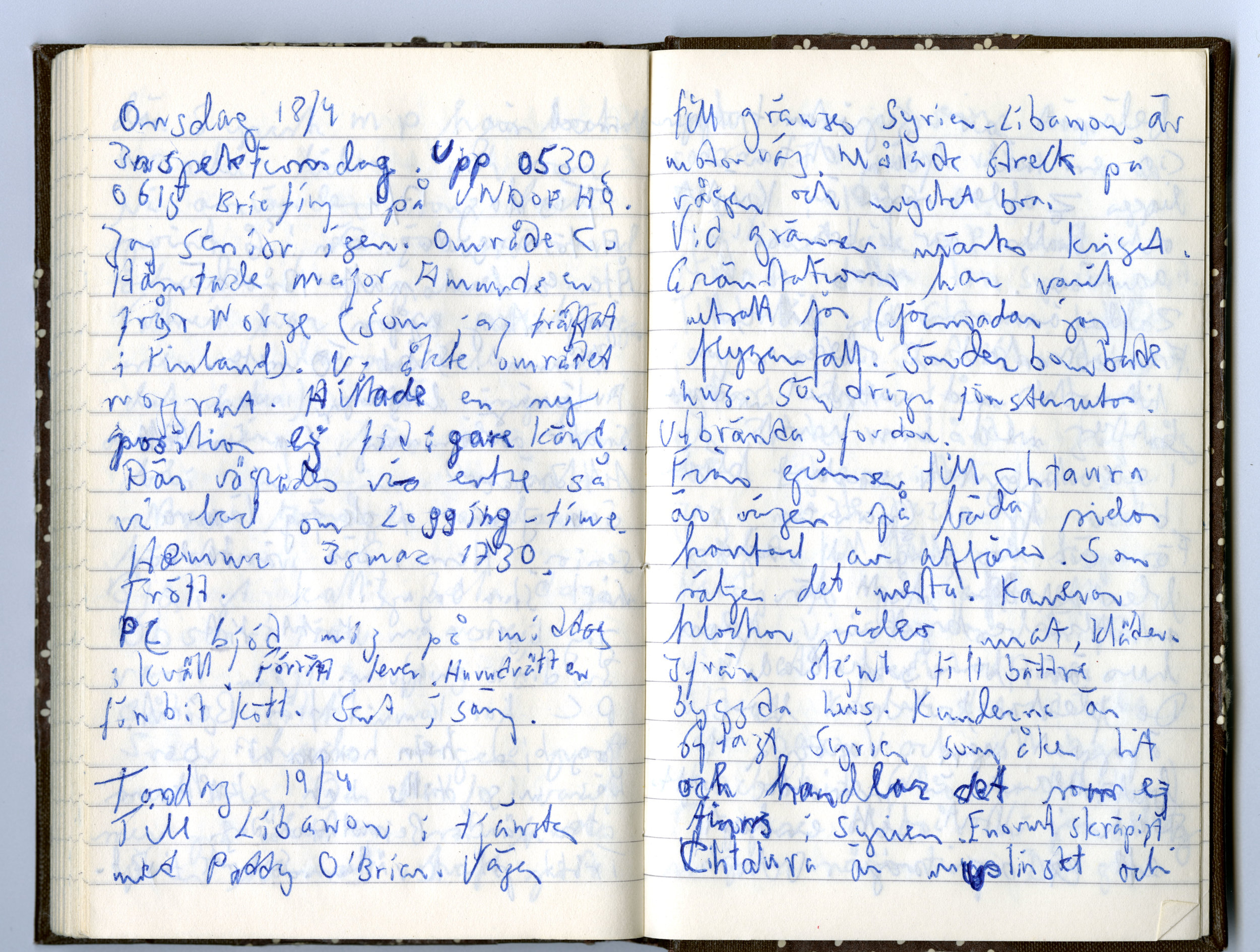


Quisque iaculis facilisis lacinia. Mauris euismod pellentesque tellus sit amet mollis.