
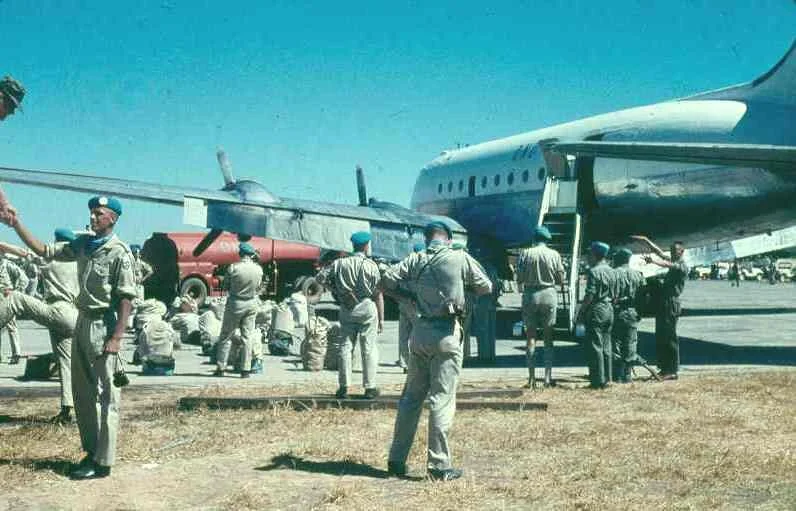
A TURBULENT AND PERILOUS JOURNEY HOME FROM THE CONGO
10th Battalion

"Were these to be the final moments of our lives? Would it all end here, in a sand dune in the Sahara? Who would ever find us? Afterwards, some said they had seen their entire lives flash before their eyes like a film at that very moment."
Former UN soldier 2540 Rolf Larsén, of the 3rd Company, recounts what happened in June 1961 during the journey home aboard an American military transport aircraft, returning from the turmoil of war in Katanga Province in the former Belgian Congo. The aircraft nearly crashed when it encountered a whirlwind, causing it to plunge uncontrollably towards the ground in the Sahara Desert near Lake Chad.

Rolf Larsén 1961
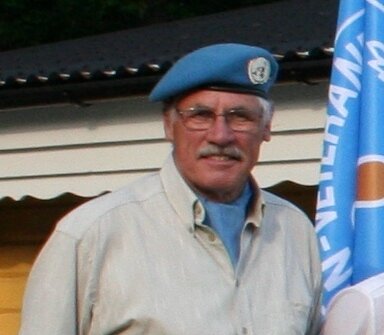
Rolf Larsén
I had served as a machine gunner and marksman in the first directly recruited Congo Battalion, the 10th Battalion, since 14 November 1960, with the 3rd Company, 3rd Platoon. We were now on our way home to be demobilised at the I 10 Regiment in Strängnäs.
On our outward journey, on Friday, 18 November 1960, we had flown as the first contingent of 165 men aboard one of the Belgian airline Sabena's "giant aircraft," a Boeing 707, a four-engined jet airliner.
It had been just like a charter flight. Most of the men had never flown before. I myself had previously flown in a Tiger Moth, an Alouette helicopter, and a TP 83 Pembroke.

Boeing 707
We celebrated the 21st birthday of one of the elegant flight attendants. After refuelling in Brussels, we continued towards the breakaway province of Katanga in the former Belgian Congo.
After an 11-hour flight, including the refuelling stop, we landed at Luano Airport in Elisabethville, now known as Lubumbashi.

The flight attendants on the outward journey. The one on the left was celebrating her 21st birthday.
We began our journey home on Wednesday, 7 June 1961, when we loaded our equipment and boarded a Douglas DC-4, a four-engined propeller aircraft, at Luano Airport in Elisabethville. Our first destination was Kamina Base, approximately 600 kilometres away by air.

Loading the Douglas DC-4.
At Kamina Base, we had quite a long wait before the aircraft carrying members of the relieving 12th Battalion from Sweden arrived. We had time for a chat with the "Albyl boys" and were able to brief them on the situation and answer all their questions. I met a friend from back home who shouted after me, "Send us some herring and crispbread for Christmas!" And that is exactly what I did.
We were now to continue our journey aboard an American military transport aircraft, a Douglas C-124 Globemaster, serial number 30046, a four-engined propeller-driven aircraft. It was time for the 76 of us, most of whom came from the 3rd Platoons of the 1st and 3rd Companies, to march into the Globemaster's enormous "pelican's mouth." We felt as though we were entering a great assembly hall, with a ceiling six metres high.

Douglas C-124 Globemaster, with Rolf Larsén and Tord Nilsson standing in front of the aircraft. The Globemaster was nicknamed "Old Shaky" because of its noisy and vibration-prone characteristics.
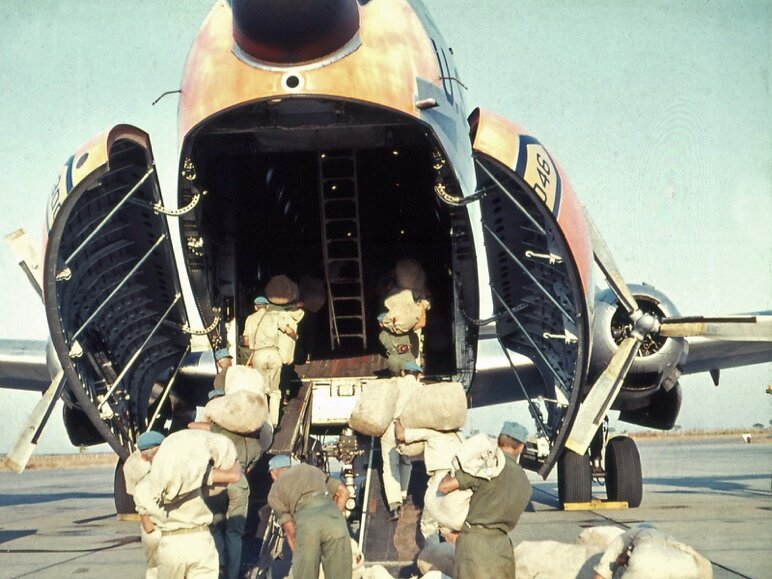
Rolf Larsén, at the front on the left, boarding the aircraft with his kit bag. The stairs leading up to the cockpit can be seen in the background.
Suitcases and kit bags, along with souvenirs such as bows, spears, and elephant tusks, were placed in the middle of the "assembly hall," and most of the items were secured with straps.
Our journey then continued towards Léopoldville (now Kinshasa), where we landed at N'Djili Airport at around 8 p.m. We were served a meal at an Indian UN camp and spent the night in a wine warehouse belonging to the Martini company, located close to the airport.

From left to right: Kaj Möller from Malmö, Åke Carlsson from Grytgöl, Sten Alm from Malmslätt, and Bo Jansson from Ransäter.

Martini's wine warehouse in Léopoldville.
After a draughty and windy night, we set off early in the morning for the airport, where the aircraft was waiting, fully refuelled and carrying more than enough fuel for the journey.
We stood in formation in our uniforms, ready to make our formal report before departure. It turned out that the new NATO aircrew were from Brazil and were dressed as though they were heading off on a holiday to Hawaii, wearing colourful floral shirts. What our platoon commander thought of this, I have no idea!
Each man had now been given a boxed meal containing provisions, including roast beef with some kind of remoulade sauce, which we were supposed to eat during the flight, a little more than halfway through the journey.

The lower deck with part of the cargo. The meal boxes and rubbish bins can be seen along the bottom of the photograph.
We now had approximately 4,200 kilometres ahead of us, a six- to seven-hour flight northwards across the countries of Africa, over the Sahara, past Lake Chad, and onwards towards Libya and the American NATO airbase at Wheelus, outside Tripoli.
We passed the time playing cards and chatting about our "adventures" during the seven months we had spent in Katanga.
I found myself thinking, among other things, about what it would be like in a few days to "put on my Air Force uniform and report for duty" as an additional aircraft technician at F 11 in Nyköping, before later beginning a one-year training course as an electrical technician at FCS, the Swedish Air Force Central Schools, in Västerås.
Little did I know then that I would become a resident of Västerås and remain associated with F 1 for almost the rest of my life. I had applied for the position while serving in the Congo. My far-sighted father, Alf, had sent me the advertisement in which the Swedish Air Force was recruiting additional technicians. Applicants who passed examinations in subjects including mathematics, physics, and chemistry would be accepted for training.
There was also a certain sadness in the air. Here we were, a close-knit group of comrades who had endured so many hardships and life-threatening situations together, knowing that upon our return home we would all go our separate ways.
A pleasant diversion was the opportunity to visit the cockpit. We could climb a four-metre-high ladder, where the pilot and navigator explained the flight plan, the various instruments, the radar display, and the radio communications. Navigation was carried out using maps and a compass. Radio navigation beacons were conspicuous by their absence. Our maximum flying altitude was just over 3,000 metres, since the aircraft had no pressurised cabin. So far, everything had gone well.
After approximately three and a half hours of flying, we were approaching Lake Chad. The pilots could now see several storms on the radar, and the most worrying one was quite close. The pilots began discussing whether they should attempt to fly around the typhoon-like whirlwind that was moving towards the aircraft, or whether we could pass between and through the whirlwinds without difficulty. Their decision would depend on the movement of the storms and the aircraft's speed and course. We were warned and began fastening our safety harnesses.
Suddenly, the storm was upon us. The whirlwinds merged into one enormous vortex. We were now on the edge of the storm, entirely at the mercy of Aeolus, the ruler of the winds. It began with severe turbulence, lifting us several decimetres out of our seats. For a few minutes, things calmed down enough for most of us to fasten our harnesses. Tommy Nilsson from Malmö had been urinating at the "toilet," which consisted of two barrels secured behind a dividing tarpaulin on the lower deck. He just managed to climb the ladder back to his seat beside Kaj Möller, who was also from Malmö.
Suddenly, we were floating in the air, about a metre above our seats, only to be slammed violently back onto the floor. Before we had time to react, we were thrown upwards again. This time, we floated weightlessly, desperately trying to grab hold of something before the aircraft plunged several hundred metres once more. This happened repeatedly. Lennart Staaf from Malmslätt had been sleeping on the floor and woke up floating through the air among luggage flying in every direction. The enormous Globemaster was being tossed uncontrollably around by the whirlwind like a feather. We experienced terrifying sensations of falling, lost our breath, and felt as though our stomachs were being forced up into our heads. Everyone was absolutely terrified, and some shouted, "Bloody hell, we're going to crash!"
At that moment, Kaj Möller was thrown into the air. In his desperate attempt to grab hold of something, he managed to seize Tommy's trousers by the fly. There was a loud ripping sound as Tommy's trousers tore open all the way down to his calf. Kaj was hurled against the ceiling, striking one leg against a beam with such force that the tendon connected to his big toe was severed near his shin. At the same time, I was thrown against the ceiling and pinned there as though caught in a vice, with my back pressed against the padding. I could not move. I was learning, in the most dramatic way imaginable, about the effects of G-forces. There was now a five-metre drop to the lower deck and a three-metre drop to the upper deck where we had been sitting.
We were now inside the whirlwind. The Globemaster had rolled onto its side, and we were falling freely at approximately 1,800 metres per minute, with one wing pointing vertically towards the ground. The engines were racing at extremely high revolutions. There was no air resistance for the propellers to work against. In the middle of all this, one of the engines failed and stopped. We now had only three engines.
Were these the final moments of our lives? Would it all end here, in a sand dune in the Sahara? Who would ever find us? Afterwards, some said they had seen their entire lives flash before their eyes like a film at that very moment.
Thoughts raced through our minds as we desperately tried to hold on to anything we could to avoid being thrown around. Olle Hellström from Häradshammar managed to grab hold of something and hung on tightly. It was the emergency exit handle. After a while, he realised, to his relief, that the door had not opened. Now came the next violent battering. The Globemaster began climbing at approximately 4,000 feet per minute. Kaj and I were lucky. We landed on the floor of the upper deck rather than falling all the way to the lower deck. Our deputy platoon commander, Sergeant Bengt Rahm from Uddevalla, badly injured his back after striking a seat. Tord Nilsson from Västerås hit his head against a beam, suffering a deep cut and a concussion as a lasting reminder of the experience. Arne Rolf from Norra Vram had a jeep fuel can land on his big toe, tearing off the toenail and filling his boot with blood.
Within a matter of a few tens of seconds, the aircraft had dropped 1,000 metres, descending to an altitude of just 400–500 metres.
Any equipment that had not been properly secured was hurled through the air. One of our suitcases, reinforced with steel corners, flew upwards and punched a triangular hole through the ceiling padding and metal panelling, exposing the outside air. It then crashed back onto the floor and burst open after travelling a total distance of 12 metres up and down. The crew members responsible for loading the equipment had their seats on the lower deck near the toilet. They received an unexpected and distinctly unpleasant shower of the contents of the latrine. A rubbish bin broke loose and flew around the cabin before landing in one of the crew's upper bunks at the rear of the aircraft. All loose equipment was flying about, and many of the men had their cameras and souvenirs smashed to pieces.
Our meal boxes went flying. Roast beef was scattered here and there, while bottles of beer and Coca-Cola floated weightlessly through the air. From one opened bottle, the contents slowly poured out into the air like a thick, viscous liquid. Several men vomited. Our platoon commander, Lieutenant Torvald Fält from Taberg, had no sick bag but solved the problem discreetly by "returning" his breakfast to the meal box he had stored beneath his seat.
How we eventually escaped from the whirlwind remains unclear. According to the pilot and navigator, we were thrown out of it after passing through its centre during our rapid descent. The entire ordeal was over after approximately 20 minutes. The pilots later told us that there had been absolutely nothing they could do. The aircraft had been impossible to control, no matter how hard they tried or how they pulled on the controls. They considered it almost beyond belief that we had not crashed. We still had approximately three hours of flying ahead of us before reaching Tripoli.

The NATO airbase at Wheelus in Tripoli.
After approximately three hours of flying, we landed at the NATO airbase, Wheelus, in Tripoli. When the ground crew entered through the aircraft's open "pelican's mouth," they recoiled at the stench inside. We were welcomed like war heroes, with a military band and a large reception ceremony. Not everyone was able to take part. Kaj was taken to hospital, where he underwent surgery, received stitches, and had his leg placed in a plaster cast. Bengt Rahm had to be helped off the aircraft and taken to hospital, where doctors discovered that several of his vertebrae had been deformed. Bengt was given a supportive back brace and a bag of painkillers. Tord Nilsson received stitches and was diagnosed with a concussion. Several others required medical treatment for minor injuries. Tommy Nilsson had to have his trousers repaired.
The battered aircraft was immediately taken into a maintenance hangar, where the damaged engine was repaired. An inspection of the wings was also carried out, revealing that they had sustained damage due to excessive structural loads. Nevertheless, the aircraft had survived remarkably well. The hole in the ceiling, measuring several decimetres across, was temporarily patched with riveted metal. Following the inspection, the aircraft was considered fit to continue flying. There was no replacement Globemaster available at the base. The nearest aircraft of that type was in Pisa, Italy. It was therefore decided that we would continue to the NATO base at Châteauroux in France, where we would transfer to another Globemaster.
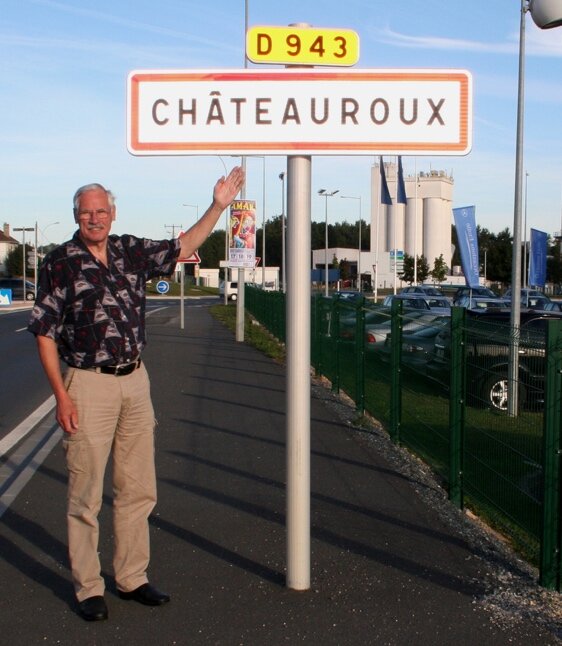
Rolf Larsén revisiting Châteauroux, France, nearly 50 years later.
While waiting for the aircraft to be repaired, we enjoyed two much-needed days of rest, including a tour of the base and refreshing swims in the Mediterranean at the base's private beach.
The base was like a self-contained community, with everyone living and working within its grounds. There was even a large shopping centre offering goods at low prices. Everyone shopped using the base's own currency; no other money was accepted.
Flying activity at the base was incredibly intense. Canberra light bombers and F-86 Sabre fighter jets were constantly taking off and landing in formations of four and six on the two intersecting runways.


NATO banknotes, used as currency at the airbases.
Now, on the fourth day, we continued our journey towards Châteauroux, approximately 200 kilometres south of Paris, France. We arrived late in the afternoon, just as dusk was falling and darkness was setting in. It was pouring with rain. Here, too, we were welcomed with a military band and a parade. In the middle of the ceremony, Olle Hellström suddenly collapsed. He had become seriously ill with a stomach infection following a late-night visit to the Indian camp's kitchen in Léopoldville. Olle and Bengt Bengtsson from Lund had stolen some food, and a couple of days later their misdeed caught up with them. Olle was taken to the base hospital and had to remain there when the rest of us set off for Sweden and Arlanda Airport the following day. He stayed under observation for a week before being allowed to return home. He had to arrange his journey back himself!
Olle had no money for a ticket, so he hitchhiked to Paris, where the Swedish Embassy provided him with a train ticket back to Sweden and Malmö. From there, he boarded a train towards Strängnäs. As the train passed through Nyköping, Olle looked out towards the running track at the sports ground. There was someone he recognised, running and training. It was me! Olle got off the train at the central station and made his way to the sports ground. We had a joyful reunion over a meal in town. I had already been working at F 11 for almost a week.
The rest of us had arrived at Arlanda on Sunday, 11 June, somewhat battered and bruised and a full day behind schedule. We had originally been due to arrive on Saturday, when our worried families had been waiting for us at the airport, only to have to return home again. We were then formally discharged from our UN service at I 10 in Strängnäs, before going our separate ways and returning home to "everyday life".
Our outward journey had taken just 11 hours. Our eventful return journey took four days — four days we would never forget.
Written in April 2011 by former UN soldier No. 2540, Rolf Larsén. Photographs from the Larsén Archive.
Film footage from the return journey is also available from the personal films of veterans Rolf Larsén and Tommy Nilsson. Produced by Tommy Nilsson.
Watch the film by clicking on the title (YouTube, opens in a new window): C124 Old Shaky 30046 from Katanga to Sweden June 7th-10th.
Footnote 1. Captain Torsten Holmqvist from Kristianstad, a member of the battalion staff and commander of the returning detachment from the first directly recruited Congo Battalion, received a certificate issued by the aircraft's pilot. The certificate confirmed that during the 20 minutes the storm lasted, the pilot's instruments had at times recorded the aircraft descending at a rate of 6,000 feet (1,800 metres) per minute and climbing at 4,000 feet (1,200 metres) per minute. The crew were astonished that the aircraft and its wings had withstood the ordeal and stated that they had had no control over the aircraft.
Footnote 2. Among the passengers returning home was 72-year-old Sigfrid Orre, a former big-game hunter who had shot, among other animals, seven lions. He was also a mining administrator and a reserve officer formerly attached to I 4 in Linköping, which he had left in 1916. Orre had spent 45 years in the Congo, lived in Elisabethville, and spoke several languages fluently, including Swahili. When asked how he was feeling and whether he had been frightened during his dramatic first-ever flight, he did not think there was anything particularly remarkable about the way we had been tossed around. "Well, I've seen how birds fly," came his perfectly calm reply. Orre had been sitting on the lower deck, securely strapped into his seat throughout the entire ordeal.

Sigfrid Orre and Captain Holmqvist supervise the loading of the aircraft at N'Djili Airport in Léopoldville.
Footnote 3. Following the military coup in 1969, when Muammar Gaddafi, then aged 27, overthrew King Idris I, the United States' and Britain's military bases in Libya were closed.
Some Final Personal Comments
When Kaj Möller returned home to Malmö, he was examined by medical students. He had been advised in Tripoli not to continue flying, but had chosen to accompany the others. His leg had been stitched just above the ankle in Tripoli. The medical students concluded, "Good work in Tripoli." Kaj required six months of convalescence.
Bengt Rahm, who had injured his back, suffered severe pain and had to be helped off the aircraft in Tripoli. He was X-rayed at the base medical centre and told that three of his spinal discs looked like "flattened slices of tomato"! This was perhaps something of an exaggeration, but he suffered from back problems for the rest of his life. Bengt was given a cardboard back brace for support and a bag of painkillers.
Several of the men belonged to the 1st Company, 3rd Platoon, including Ulf Fransson from Gävle. He had been sitting on the lower deck. After being lifted out of his seat, he fell onto his suitcase and smashed a bottle of fine cognac! He saw someone, either Orre or the chaplain, trying to kick away several overturned rubbish bins that were rolling towards them. He noticed that the ladder leading to the cockpit had disappeared! It had come loose and become lodged against the ceiling! He also saw Folke Lundqvist from Vaxholm fall and injure himself. Someone from the crew opened a hatch and took out medical supplies.
Kjell Eriksson from Kövra was thrown half a metre into the air, managed to grab his safety belt, and fastened himself in. All the air was forced out of his lungs. The aircraft creaked and groaned. Someone cut themselves on a broken bottle. He saw a rubbish bin standing upside down, completely emptied of its contents!
Gustav Eriksson from Gällö, Sven West from Vaplan, and Fritz Wänseth from Krokom were also sitting on the lower deck.
Approximately 14 days after returning home, Kjell Eriksson and Fritz Wänseth both fell ill with dysentery and were admitted to the infectious diseases hospital in Östersund, where they shared a room. Kjell Eriksson later became a police officer and attended a motorcycle training course in Strängnäs. During the course, he rented a room from the former battalion commander, Anders Kjellgren, whose wife let out rooms. The house had large rooms, including a spacious reception room. Mrs Kjellgren invited him for coffee and princess cake at a small table with two chairs in one corner. During their conversation, he mentioned that he had served with the 10th Battalion. The atmosphere was rather stiff and formal. Kjellgren himself was nowhere to be seen.
Quisque iaculis facilisis lacinia. Mauris euismod pellentesque tellus sit amet mollis.