
UNREST IN LÉOPOLDVILLE, 1960
Engineer Per-Arne Andén was a member of the Swedish technical contingent sent to the Congo by the United Nations in August 1960 to help maintain the country's infrastructure during the ongoing conflict. The contingent initially consisted of 30 civilian engineers who were assigned to various projects, including the power station at Kilubi and a drainage project outside Léopoldville, now Kinshasa. Per-Arne was in charge of the drainage project.
In late November 1960, unrest broke out in Léopoldville when soldiers of the Congolese army, the Armée Nationale Congolaise (ANC), attempted to arrest the Ghanaian diplomat Nathaniel Welbeck, who had been declared persona non grata by the Congolese government a month earlier.
Welbeck refused to leave his post at the Ghanaian Embassy in Léopoldville, where he was protected by Tunisian UN troops. On 21 November, the embassy was surrounded by ANC soldiers, who confronted the Tunisian troops stationed there. Colonel N’Kokolo of the ANC demanded that Welbeck be handed over, but the Tunisians refused.
"The final spark that triggered the fighting was a rumour that a Ghanaian colonel at the embassy had shot the Congolese colonel in the head during an argument. As the rumour of the killing spread, increasing numbers of ANC soldiers began roaming uncontrollably through the city, searching for UN personnel."
— Per-Arne
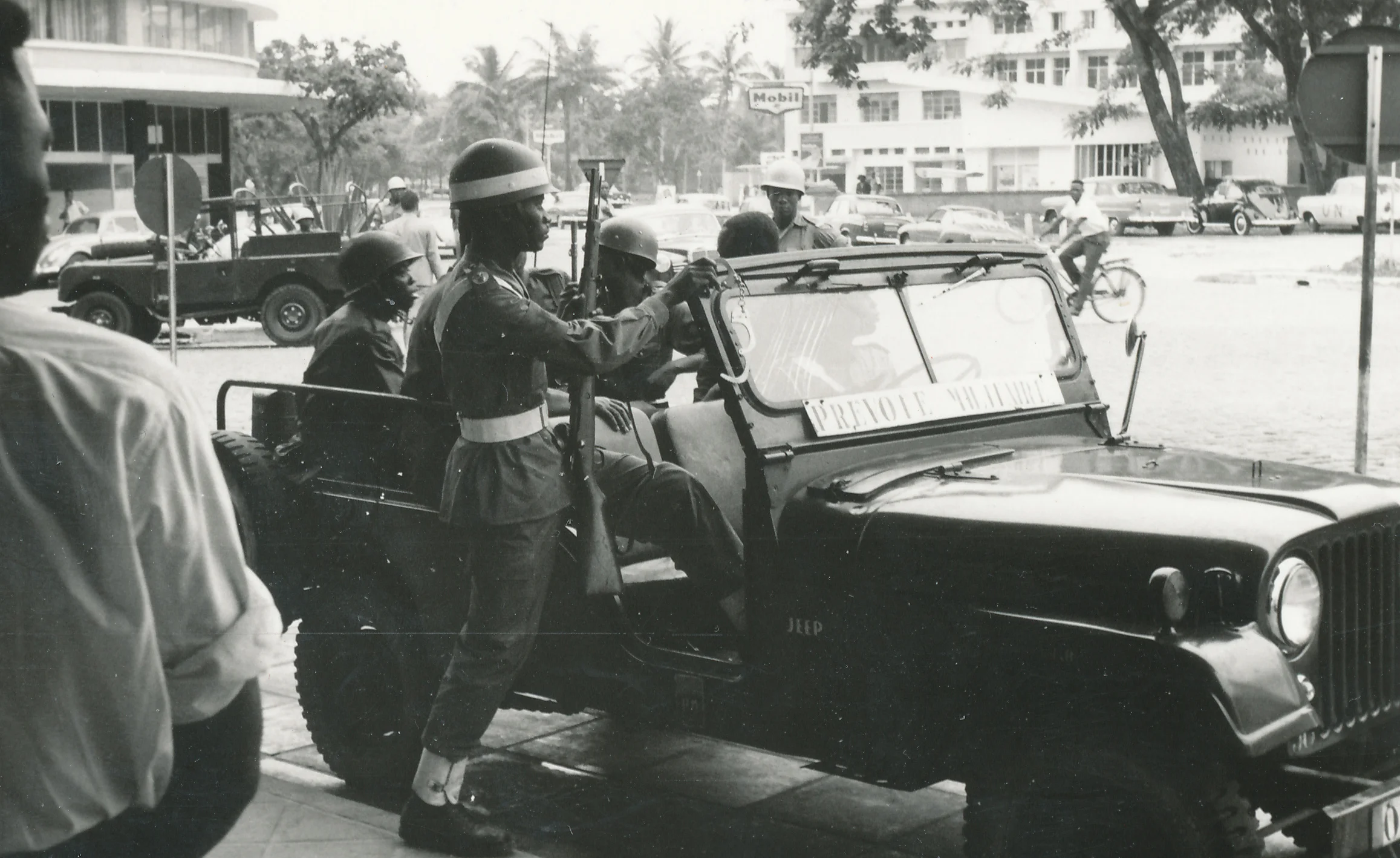
Soldiers of the Armée Nationale Congolaise (ANC) in Léopoldville, 1960.
At this point, Per-Arne and his colleague, the interpreter Leon Lidvall, were visiting two Swiss doctors working for the UN in the city. They heard gunfire in the distance and decided to try to return to their own accommodation.They had not travelled far before they were stopped at a roadblock by Congolese soldiers, who dragged them out of their car, beat them with rifle butts, and took them to a private house, where they were held captive.
A total of 32 captured UN personnel — 30 men and two women — were confined in a room measuring just eight square metres. After being threatened with execution throughout the night, they were taken outside the following morning. There, they were lined up in two rows, with 16 people in each row. Per-Arne was placed in the rear row. In front of them stood a group of ANC soldiers, preparing to shoot them.
"It is incredible how quickly your whole life flashes before your eyes when you realise you are about to be shot. I notice a concrete-lined ditch running behind me. I think to myself that as soon as they start shooting, I will throw myself backwards into the ditch. They are just about to open fire when a Congolese officer comes running towards us and stops the execution." — Per-Arne
On the morning following their arrest, Per-Arne and Leon were released from captivity. Two days later, Per-Arne returned to the site of the drainage project outside the city. The situation was still tense, and he had to pass through three military checkpoints on his way to work. To get through the roadblocks, he bribed some of the soldiers with cigarettes.
"I cannot say that the incident has troubled me later in life. The only thing I can recall is an occasion a few months afterwards when, one night, I suddenly threw myself out of bed and dived onto the floor. When my wife asked what on earth I was doing, I replied that I had dreamt I was about to be shot. But that is the only time I have experienced a frightening memory of the Congo." — Per-Arne
Quisque iaculis facilisis lacinia. Mauris euismod pellentesque tellus sit amet mollis.