
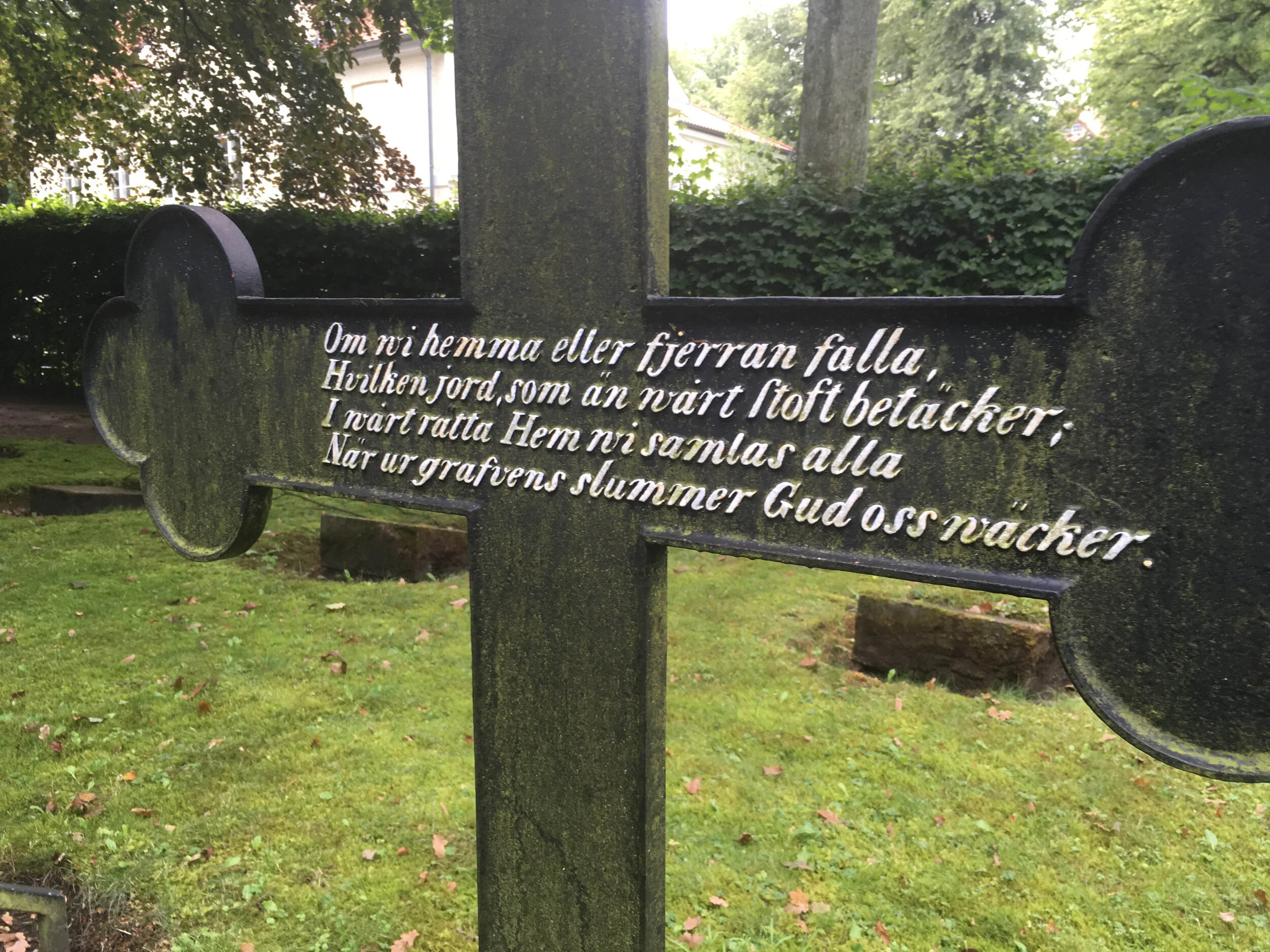
OTTO JOHAN RINGHEIM IN SCHLESWIG, 1849–1850
“Om vi hemma eller fjärran falla,
Hvilken jord, som än wårt stoft betäcker;
I wårt rätta Hem wi samlas alla
När ur grafvens slummer Gud oss wäcker”
(“Whether at home or far away we fall,
Whatever soil may cover our remains;
In our true Home we shall be gathered all,
When God awakens us from the slumber of the grave.”)
From a Swedish grave cross at Alter Friedhof (Old Cemetery) in Flensburg, where an unknown number of soldiers from the First Life Grenadier Regiment are buried.

OTTO JOHAN RINGHEIM 1813-1898
Sweden’s first official international peacekeeping mission took place in connection with the Saar plebiscite in January 1935. However, Swedish troops had previously participated in the so-called Åland Detachment in 1918–1919 and monitored the armistice in Schleswig in 1849–1850. This article tells the story of Otto Johan Ringheim, who served with the joint Swedish-Norwegian peacekeeping forces in Schleswig, the first of their kind. The deployed force comprised a total of 3,850 men.
Who was this Ringheim, who lived from 1813 to 1898 and was the son of Captain Simon Peter Ringheim (1774–1843) and Carolina Charlotta Volin (1780–1863)? Sweden’s first veteran of an overseas peacekeeping mission? Well, perhaps that is not quite the right description, but he was among the earliest known to us, and one who also left behind a written account of his experiences. The Swedish Peace Archives has digitised the majority of Ringheim’s archival material, which is now carefully preserved at the Regional Museum in Kristianstad. Here, we present a small selection of this fascinating material.
The Swedish Military Memorials Association (SvMM) carries out important work aimed at preserving existing Swedish military memorials in cooperation with local organisations and authorities.According to its statutes, the Association’s mission is to: “— identify, catalogue and cooperate with the legal owners of military memorials and, in collaboration with them, monitor and support their care and preservation. The Association shall also maintain a publicly accessible register of the memorials concerned in an appropriate manner.”
The Swedish Military Memorials Association (SvMM) has summarised the background to, and the course of events during, the Schleswig-Holstein War of 1848–1851 as follows:
The borderlands between Denmark and Germany had long been home to a mixed Danish and German population. Throughout history, the region, comprising the duchies of Schleswig and Holstein, had been ruled at various times by Danish, German and Swedish rulers, although Schleswig had generally been more Danish in character and Holstein more German. German nationalists wanted to incorporate Schleswig, which had a substantial German-speaking population, into the German Confederation, of which Holstein was already a member. Danish nationalists, meanwhile, wanted to establish closer ties between Schleswig and Denmark.
During the revolutionary year of 1848, German nationalists therefore proclaimed a provisional Schleswig-Holstein government in Kiel in March. Denmark decided to suppress the uprising by military force in order to restore Schleswig-Holstein to the Danish Crown. On 8 April 1848, the Danish army defeated the insurgents at Bov, north of Flensburg, and subsequently occupied Schleswig. Shortly afterwards, however, a German army of 19,000 men arrived to reinforce the insurgents.
Following an attack on 23 April 1848, the 10,000 Danish troops were forced to abandon the Dannevirke fortifications during the Battle of Schleswig. The Danes retreated to the island of Als. Over the following month, the German army occupied the whole of Schleswig and southern Jutland, while the Danish navy imposed a blockade on German ports and intercepted German merchant vessels. On 28 May 1848, the Danes launched an attack from their bridgehead at Alssund and captured the Dybbøl Heights. They subsequently repelled an attack by the combined German forces on 5 June. An armistice was concluded in Malmö on 26 August 1848. However, violations of its terms occurred, and the agreement therefore resulted in only a temporary suspension of hostilities.
Following Danish dissatisfaction with German violations of the armistice terms, war broke out again on 3 April 1849. On 7 May, a German army of 40,000 men advanced into Jutland, forcing the main Danish army to retreat to the fortress of Fredericia, which was subsequently surrounded. After Fredericia had been under siege for two months, a Danish force of 19,000 men, secretly assembled from Funen, Als and Helgenæs, launched a surprise attack on 6 July. The Danes succeeded in capturing all the German redoubts, seizing 31 cannons and taking 2,000 prisoners of war.
A new armistice was concluded on 10 July 1849. Under its terms, northern Schleswig, as far south as Flensburg, was occupied by 4,000 Swedish-Norwegian troops, who served as a buffer force between the Danes and the Germans. Following lengthy negotiations, a peace treaty was signed between Denmark and Prussia in Berlin on 2 July 1850. However, none of the issues underlying the conflict had been resolved, and fighting therefore broke out again just a few weeks after the treaty was signed. The fighting of 1850 began on 24 July with a battle at Helligbæk. The following day, 25 July, the Battle of Isted took place, becoming the bloodiest engagement of the war. The Danish army, numbering 39,000 men, forced the Schleswig-Holstein army to retreat to Rendsburg and occupied the Dannevirke fortifications. The Schleswig-Holstein forces launched two major attacks against the Danish positions, both of which failed. The war was subsequently brought to an end through pressure exerted on the opposing sides by other countries.
The Swedish-Norwegian force stationed in northern Schleswig under the armistice of 1849 was not the only Swedish-Norwegian involvement in this war. During the 1830s and 1840s, Scandinavism had spread throughout Denmark, Norway and Sweden, initially among university students. The Danish position on the Schleswig-Holstein question had also gained support among Scandinavists in Sweden and Norway. Consequently, when war broke out, a number of Swedes and Norwegians volunteered to fight. In 1848 and 1849, these volunteers numbered 243 Swedes and 114 Norwegians, who served in various Danish units and participated in several of the war’s battles. Among the volunteers were also 24 Norwegian and at least 60 Swedish officers, as well as a number of non-commissioned officers and enlisted soldiers. Although the Swedish-Norwegian volunteers were relatively few in number, they appear to have been greatly appreciated by the Danes. After the war, more than 44,000 people signed an address expressing their gratitude to the volunteers. Denmark also received a degree of official Swedish support during the war, when a reserve force of 5,000 men was stationed on the island of Funen in 1848. These troops did not take part in the fighting and were withdrawn following the armistice of 1848.
Lieutenant Otto Johan Ringheim recounts his experiences in a narrative written in verse. His account could be said to begin with a farewell to his fiancée: “I kissed my beloved’s forehead, tenderly, against her heaving breast, and bade her farewell. And now, onward along my path; it does not become a warrior to linger. Love, you must not now make a slave of the soldier.” (E. Dahlberg, Skåne och regementet: en bok om Skånes land och folk och om Kungl. Norra skånska infanteriregementet för dess soldater. Kristianstad, 1936.) Ringheim describes his personal experiences and memories both in his diary-almanac and in the letters he wrote to his fiancée Margarete and his future mother-in-law.
Other examples of microhistorical accounts from European theatres of war include Peter Hagendorf’s account of the Thirty Years’ War. Hagendorf served as a mercenary during the conflict, and through his Ein Söldnerleben im Dreissigjährigen Krieg (published in Swedish in 2006 under the title Sedan stack vi staden i brand), we gain access to the only known substantial eyewitness account of everyday life during the Thirty Years’ War written by an ordinary foot soldier. Another well-known work is Karolinska krigares dagböcker jämte andra samtida skrifter (Diaries of Carolinian Soldiers and Other Contemporary Writings), published in twelve volumes between 1901 and 1918 and edited by August Quennerstedt. This extensive collection is an important historical source for the European theatres of war in which Swedish troops participated during the early eighteenth century.
A figure more closely comparable to Ringheim, however, is Carl Magnus Hultin, who published his book En gammal knekts minnen (Memoirs of an Old Soldier) in 1872. The text was first published as a serial in Ny illustrerad tidning and, according to the book’s dedication, was written at the suggestion of Emil Key, a landowner and politician and the father of the renowned author Ellen Key. The book provides a highly entertaining account of the war of 1808–1809 and the campaigns in Germany and Norway under Karl Johan, later King Charles XIV John. Hultin, who came from Vimmerby, initially served as an ensign in the Östergötland Landwehr and subsequently in the Jönköping Regiment, taking part in both the war of 1808–1809 and the campaigns of 1813–1814. He retired from military service in 1842, having attained the position of company commander.
What makes Ringheim’s account particularly valuable to us, however, is that it describes a peacekeeping mission. From late August 1849 until early July 1850, a field battalion of the Norra skånska regementet formed part of the Swedish force in Schleswig, before being relieved by a battalion from the Södra skånska regementet.
Further down this page are several examples from the correspondence between Ringheim and his fiancée, as well as extracts from Ringheim’s diary-almanac.
Die Provinz Schleswig-Holstein (The Province of Schleswig-Holstein). Map from Bibliothek allgemeinen und praktischen Wissens für Militäranwärter, Volume I, 1905 / Deutsches Verlaghaus Bong & Co., Berlin.
Although the map dates from a later period than the mission in Schleswig in 1849–1850, it nevertheless shows the most important locations, including Kiel in the centre of the map, Schleswig to the north-west, and Flensburg and Apenrade further north.
Otto Johan Ringheim: “Pages from My Diary, During My Service with the Northern Scanian Field Battalion of the Occupation Corps in Northern Schleswig.” The diary comprises just over 140 pages.
Captain Otto Johan Ringheim. Photograph: C. M. Tullberg’s Photographic Studio, Malmö.
Note the carelessly applied Dymo label bearing Ringheim’s name, which was added at a much later date. The label was attached before the archival material was transferred to the Regional Museum in Kristianstad, where it is preserved today.
Letter to his fiancée Margarete, dated 23 August 1849 in Sønderborg:
“On the 21st, Josephina’s Day, the frigate entered Sønderborg harbour without a single one of our men having suffered even an hour of seasickness, and dropped anchor amid the cheers of thousands of officers and volunteers from the Danish army. Almost the entire Danish Guard had gathered at the harbour, and when the steamship arrived, greeted by the band playing Den tappre Landssoldat (The Brave Soldier), you may well believe that a cheer rang out to welcome us such as I shall never forget.”
Otto Johan Ringheim wrote numerous letters to his fiancée Margarete during his stay in Schleswig: “…for you may believe me when I say that my dearest moments are those I spend writing home to you…”
From a letter dated 23 March 1850, Flensburg.
On the left-hand page of the letter, halfway down: “On the 17th [of March], we came close to suffering a grievous loss. First, a fine young man from the Life Company, Vice-Corporal Schildt, died of fever…”
On the right-hand page of the letter, the second line contains the following words about Schildt: “…on the 19th [of March], Schildt was buried with great ceremony in the beautiful cemetery. Shortly after the coffin had been lowered into the grave, the soldier’s landlady, a German woman, came forward and planted a beautiful Swedish flag, which looked particularly splendid alongside the many hundreds of others.”
Final page of the letter to his fiancée Margarete, dated 23 March 1850.
The final resting place of Vice-Corporal Pehr Schildt in the Old Cemetery (Alter Friedhof) in Flensburg: “An Honourable Soldier, a Loyal Friend, Loved and Mourned by His Comrades.”
The cemetery is reserved for war graves from the conflicts between Denmark and the states of the German Confederation in 1848–1850 and 1864.
Photograph taken in summer 2019 by Johan Landgren.
Lieutenant Ringheim’s almanac from 1850 contains daily entries documenting his stay in Schleswig. Before the archival material was transferred to the Regional Museum in Kristianstad, it was held in the archives of the Officers’ Corps of the Royal Northern Scanian Infantry Regiment. Rather insensitively, the archive stamp was placed directly across the centre of the title page, obscuring part of its illustration.
From Ringheim’s almanac, March 1850. The entry for 19 March records that Private Schildt was buried on that day.
“But I shall cherish the memory of you forever!”
Ringheim’s tribute to the Danish Lieutenant J. W. T. von Götzsche, who was killed in action in Schleswig.
“The ill-fated war in Schleswig, which robbed me of so many friends…”
Ringheim’s tribute to his fellow military cadet, von Götzsche.
“…at Leijonhufvud’s grave in Ulkebøl churchyard in Schleswig… taken by Otto Ringheim.” A memento (referred to as “the branch” in the diary below) that Ringheim had somehow obtained from Leijonhufvud’s grave in Schleswig.
The Swedish volunteer, First Lieutenant Baron Knut Otto Eric Leijonhufvud, was killed in action at the Battle of Dybbøl on 5 June 1848. His body lay in St Marie’s Church in Sønderborg, alongside those of other fallen officers, until he was buried in Ulkebøl churchyard on 8 June of the same year.
Altogether, several hundred Swedes and Norwegians served as volunteers in the Danish forces during the Schleswig-Holstein War, which lasted from March 1848 to January 1851.
From Ringheim’s diary: “At Leijonhufvud’s grave.” On the right-hand page, the line reads: “Nor the ‘branch’ which I now behold!”
The reverse side of the piece of cardboard bearing the memento from Leijonhufvud’s grave. Depiction of Augustenborg Palace on the island of Als in Schleswig. The palace has been owned by the Danish state since 1921. Ulkebøl churchyard is situated not far from the palace. Drawing by Ringheim.

Captain Otto Johan Ringheim wearing the Royal Order of the Sword on his chest. He was awarded the insignia of Knight of the Order in 1867. Photograph: Blekinge County Museum (Blm 2036).
From Otto Johan Ringheim’s diary. On 19 June 1850, General Malmborg bade farewell to the battalion. Ringheim’s poetic rendering of Malmborg’s speech ends with the words: “Farewell, comrades! Each and every officer! Perhaps we shall never meet again!”
Quisque iaculis facilisis lacinia. Mauris euismod pellentesque tellus sit amet mollis.