

THE FIELD HOSPITAL COMPANY IN LEBANON, 1984–1985
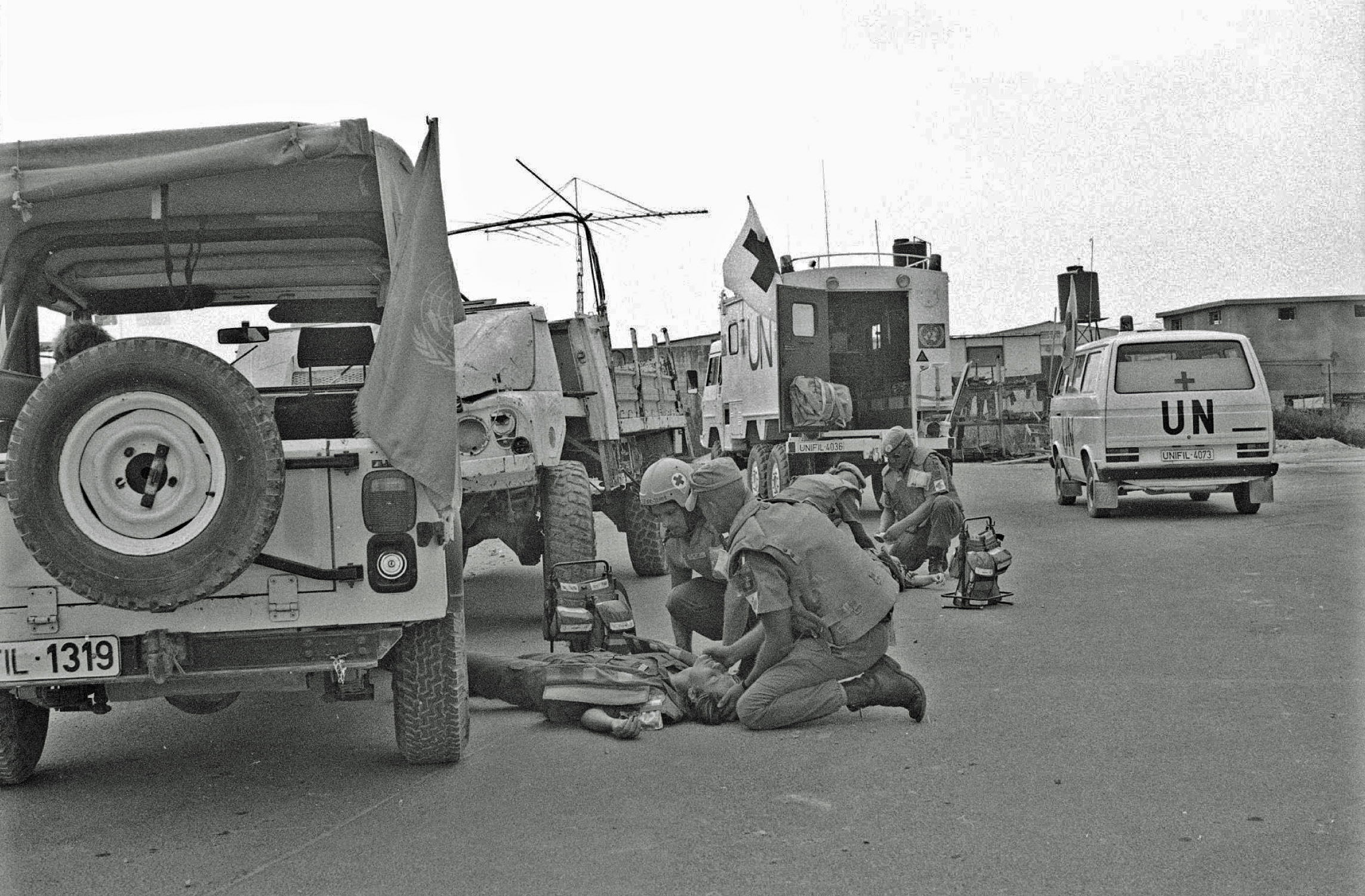
During the early and mid-1970s, Lebanon experienced political instability, which led to a civil war lasting from April 1975 to October 1976. Unrest continued after the war, and Lebanese groups also began attacking targets in Israel. This prompted Israel to occupy territory in southern Lebanon in 1978.
In March of that year, the United Nations established UNIFIL (United Nations Interim Force in Lebanon) to confirm Israel's withdrawal from Lebanon, restore peace and security, and assist the Lebanese government in re-establishing effective control over the southern part of the country.
Sweden contributed a company-sized force as early as 1978 and also staffed UNIFIL's hospital between 1980 and 1992. Sten Helleng served with Battalion L08, which staffed the hospital from February to August 1984.
By Sten Helleng
Shortly before Midsummer 1984, I received a telephone call from Hans-Olof Hellström at the UN Section of the Swedish Army Staff. He asked whether I could travel to Lebanon in a couple of weeks to serve with the Swedish Hospital Company. My answer was, of course, “Yes.” There followed a hectic period of medical examinations, vaccinations and a great deal of paperwork.
I was to serve with the Hospital Company. The hospital was designed to cope with a mass-casualty situation and therefore, under the prevailing circumstances, had considerable spare capacity. This meant that it could also receive members of the local population seeking various forms of medical treatment. Women also came there to give birth. It became apparent that news of this Swedish goodwill spread throughout the surrounding villages, and consequently we Swedes always received an exceptionally warm and enthusiastic welcome whenever we travelled around the area.
Once all the preparations were complete, I reported to the Swedish Armed Forces UN Training School in Södertälje to collect my equipment. I was informed that I would serve as the camp maintenance officer, responsible for the routine maintenance of electrical installations, carpentry, plumbing and sanitation. On the morning of 2 July, I was transported from my home to Arlanda Airport, where the temperature was just +6°C and everything was enveloped in drizzle. There I met a colleague, the hospital engineer, who was also travelling as replacement personnel. The first leg of our journey in a Hercules transport aircraft ended at Larnaca Airport in Cyprus. This alone was an adventure, as I had never previously travelled further south than Copenhagen.
After dinner at Camp Victoria, we were accommodated at the Sun Hotel. It was now evening, and we decided to take a look around the town. A broad stone staircase led down from the hotel entrance to the pavement. As we were almost at the bottom, a young woman approached us and asked, “Do you need love anybody?” Neither of us did, but that was my first encounter with the local population of Cyprus.
After a substantial breakfast, we continued our flight to Ben Gurion Airport in Tel Aviv. From there, we were transported to the border crossing at Rosh HaNikra for passport control, and then onwards to Camp Silvia in Naqoura. We were welcomed to the strains of Carolus Rex by off-duty personnel from Hospital Company L08, who were assembled under the command of Lieutenant Colonel Ulf Ingelsson. It was rather uncomfortable stepping out onto the tarmac wearing Swedish Army uniform m/59 in a temperature of approximately +50°C. A week later, I was confined to bed suffering from dehydration. Fortunately, it did not take me long to learn the importance of maintaining a proper fluid balance. Between my arrival and the middle of October, there were only two nights when I slept under anything more than a sheet.
The next few days were spent attending various briefings. First, I was introduced to the maintenance group, who were to become my colleagues. Afterwards, I accompanied Captain Lennart Wenner around the camp, meeting as many people as possible. A visit to Headquarters, where I learnt where to order supplies and equipment, was preceded by a trip to Nahariya in northern Israel.
On 21 July, a traumatic incident occurred. Following an announcement over the loudspeakers, a soldier from the French Battalion was brought in, having been fatally shot. He had been shot by a fellow soldier during weapons maintenance. It was tragic to see this young man lying dead. He had been born in 1963, the same year as my youngest son. I was deeply affected, particularly as it was the first time I had ever seen a dead person.
One of the women working in the pharmacy was called Maj Karlsson, as stated on her name badge. One day, she and I, together with a few others, were crossing the border into Israel. A guard was sitting there recording Blue Card numbers. When it was Maj's turn, he looked up and said, “Aha! Major! Not bad.”
L08 was a so-called “summer company”, serving from mid-February to mid-August. At the beginning of August, the L08 personnel began winding down their activities and preparing for their relief by L09. As this did not affect me, I was granted a week's leave. On Monday morning, I decided to make my way to Gaza, a place I had heard so much about. After being transported to the border, I managed to get a lift with two French soldiers who were travelling to Haifa on a shopping trip. They dropped me on the outskirts of the city, near the railway. There was a newspaper kiosk there, and I asked the proprietor how I could continue to Gaza. He spoke no English, and I spoke no Hebrew. A young woman standing beside the kiosk overheard my question. She pointed towards a bus stop on the other side of the railway and said, “Take the bus to Tel Aviv Central Station. There you can find other buses, which will take you to Gaza.” Naturally, I was grateful for this information and followed her instructions.
The bus terminated in an old, run-down neighbourhood where, among others, a few Arab men were sitting and chatting. I asked them how I could continue to Gaza and was told that the bus service had been discontinued. So much for my trip to the Gaza Strip, I thought. A taxi driver overheard the conversation and offered to drive me to Gaza for 50 dollars. “No, thank you,” I said. “Not at that price.” “But it's cheap,” he replied. “That may be,” I said, “but you're not getting that much from me.” “Where are you coming from? Irish?” he asked. “No,” I replied. “Sweden.” “Sweden,” he said, his face lighting up. “Then it's no problem for you.”
He invited me into his taxi and drove me to a sherut station in Jaffa. (A sherut is an eight-seater shared taxi that departs when all the seats are occupied.) There, he exchanged a few brief words with the driver. I took my seat and was driven to the entrance of the Gaza Beach Club for two dollars. It certainly paid to be Swedish.
A Danish major was in charge of this small UN-owned guesthouse, and I was given a very warm welcome. I stayed until Wednesday, when the major was due to travel to Netanya to replenish his beer supplies at the Maccabee Brewery, which was an impressive establishment.
The major returned, while I stayed in the town centre. There, I soon found Motti and his UN Bar. It was dinnertime, so I ordered a pepper steak and a good red wine. Unfortunately, the steak turned out not to be of the highest quality, and I developed an upset stomach. I spent the following day sitting in the shade, drinking water and making frequent visits to the toilet. I wanted to return to camp but did not dare travel by public transport. During the afternoon, a UN-marked jeep arrived carrying two Norwegian lads who worked for Field Service and were now on their way to Naqoura. It was a very welcome encounter. I explained my condition and was given a lift back to camp.
At our camp, we employed a local Lebanese man named Mustafa. He was a very cheerful and witty fellow whose job was to look after the outdoor cleaning and general upkeep. Every morning, as he passed my accommodation hut on his way to work, he would call out cheerfully, “Hello, chief! How are you?” I would always reply, “I'm fine,” whereupon he would say, “Very good!” and continue happily on his way.
On this particular Friday morning, following my trip to Israel, I was sitting outside the hut feeling absolutely dreadful. Along came Mustafa, who called out in his usual cheerful manner, “Hello, chief! How are you?” “I feel bad,” I replied. Whereupon Mustafa exclaimed brightly, “Very good!” and happily continued on his way to his daily duties.
Before long, L09 arrived under the command of Lieutenant Colonel Stefan Lindroth.
He had originally trained as a military officer and had subsequently studied medicine. For this particular assignment, it was an ideal combination.
My new colleagues also arrived. They were young men with considerable professional expertise, and they soon settled into their respective roles.
One particularly memorable episode occurred when the permanent radio station was to receive a new 10-metre radio mast. The mast had been delivered and assembled and was ready to be erected. Its lowest section — the anchor-bolt assembly — had to be buried and secured in concrete. This required a substantial excavation. I contacted the French engineer platoon to request assistance with the digging. Nothing happened, despite repeated reminders. The excavator failed to appear, so I went to the Chief Engineer at Headquarters and asked for explosives. That brought the excavator. We then needed approximately two cubic metres of concrete. Israel normally supplied the concrete, but would not deliver quantities smaller than four cubic metres. There was nothing for it but to get the team together and mix the concrete ourselves. With the small concrete mixer available to us, the work took almost an entire day.
Then the mast had to be erected. I was asked how I intended to solve the problem. As we were stationed next to the Italian helicopter platoon, I came up with the idea of trying to erect the mast using a helicopter. I approached the unit commander. He thought the idea was fine and worth trying. The following day, a lifting sling was attached to the top of the mast. The helicopter hooked onto it and, thanks to the Italian pilot's flying skills, lifted the mast into position. The task was accomplished, and the company celebrated with champagne.
One day in mid-October, an announcement came over the loudspeakers requesting people with A-positive blood. As I had been a regular blood donor for many years, I volunteered to give blood. A short while later, an ambulance arrived carrying a French soldier who had been playing with his loaded weapon and had accidentally shot himself. The bullet had entered just below his left nipple and exited through his shoulder. I asked whether I could observe the operation, and the thoracic surgeon, Michael Heine, gave his permission. The soldier's left arm was secured to a support, and the surgeon made an incision along his left side. The lung was so badly damaged that it had to be removed. I could then see the steady beating of his heart. The surgeon pointed out the path the bullet had taken. On the surface of the heart, there was a mark as thin as a human hair, showing just how close the bullet had come — only millimetres from causing his death. He recovered, and life returned to normal.
Before long, it was time to celebrate Christmas. There was plenty of bustling about, cleaning and preparing everything in the traditional Swedish manner. The women decorated the camp with garlands and other Christmas ornaments, while another group decorated the Christmas tree. Then it was time for the traditional Christmas swim. After taking a dip in the Mediterranean, we were awarded the so-called “Polar Bear Certificate” (Isbjörnsdiplomet).
Commanding Officer Stefan played Father Christmas and handed out a bath towel to everyone. The dining hall had everything one could wish for in a traditional Swedish Christmas dinner. Later that evening, there was dancing around the Christmas tree in the officers' mess. Our colleague Steven, who was of Native American descent, wanted to demonstrate a traditional Native American rain dance. We stood in a tight circle around the Christmas tree, with our arms around one another's backs, while Steven stepped into the middle and performed the dance. It created an extraordinarily moving atmosphere that touched us all.
A few days later, I met Steven and told him how wonderful it had been to experience his rain dance. "Yes," Steven replied, "but I must have done something wrong, because it's been raining in Cyprus for two days."
Plans for the New Year's celebrations were now beginning to take shape. The dining hall was rearranged and transformed into a restaurant called "Silvana". We booked our tables using the field telephone. Some of our comrades became waiters and waitresses, while others organised a New Year's revue.
Then came the moment to welcome in the New Year, 1985. I was the bell-ringer and had been entrusted with that responsibility. Everyone had gathered in the darkness on the so-called tennis court. When the final stroke from the bell tower had faded away, the floodlights were switched on. Cries of "Happy New Year!" and "Cheers!" echoed across the entire court. Suddenly, we heard bagpipes coming from our Irish neighbours. A group of them came over to our camp and played Amazing Grace. What an incredibly moving moment!
In February, it was time for rotation. L09 had completed its mission, and we were to be relieved. We were now going home and would be going our separate ways. Many experienced the sadness of separation, and there were tearful farewells.
I had experienced the greatest adventure of my life and was now returning home to the safety and security of Sweden. During my time there, I had seen and experienced another part of our world, and had met and worked alongside people from 13 other nations. I was leaving behind many newfound Lebanese friends. Hopefully, I had made some small contribution towards bringing them the peace they so richly deserve.
Quisque iaculis facilisis lacinia. Mauris euismod pellentesque tellus sit amet mollis.