
THEFT AND DISCIPLINE – MAINTAINING ORDER IN THE FIELD

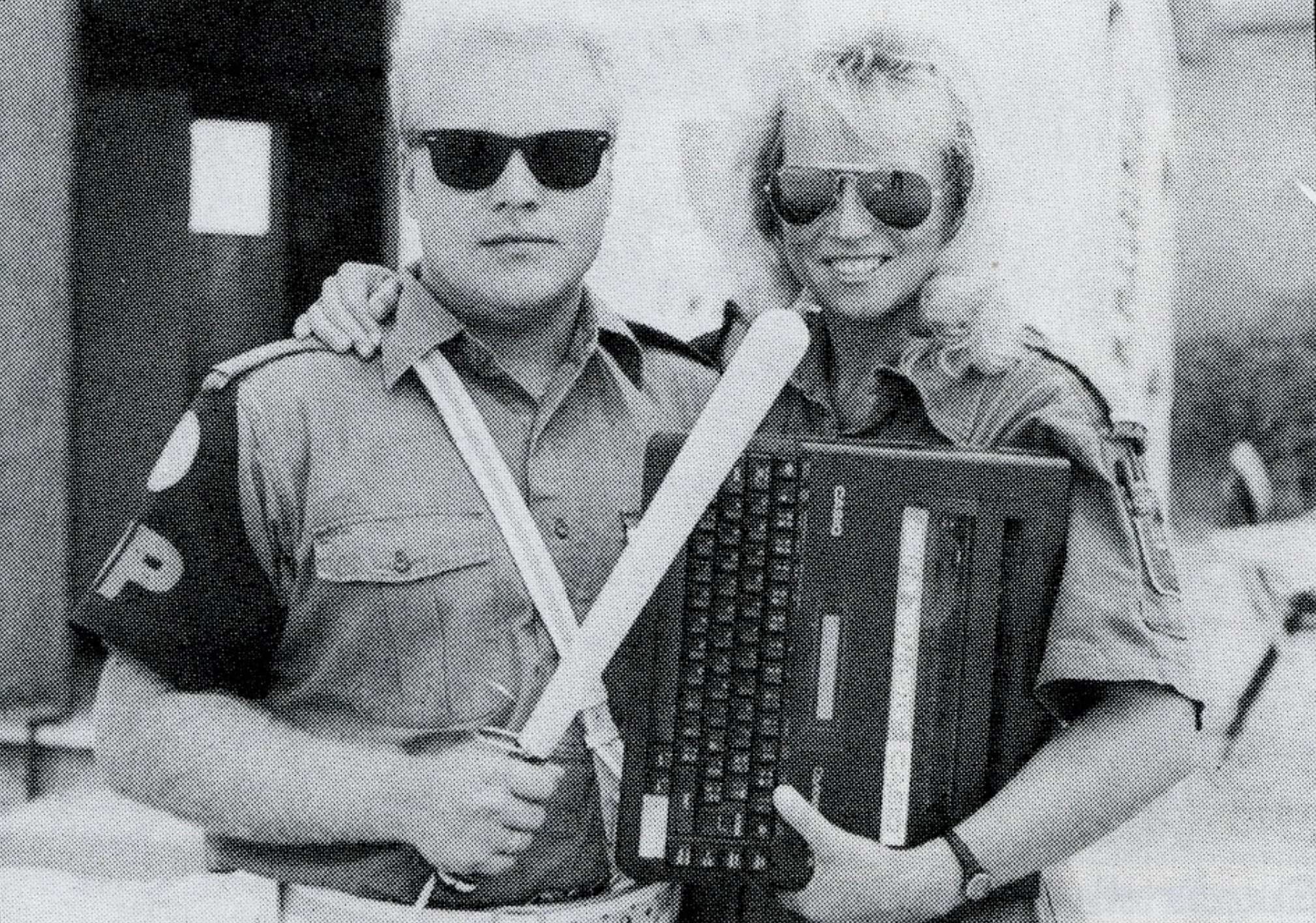
Pens and swords have their place – but the military police have batons and typewriters. Photo: L104 Commemorative Book
An international peacekeeping operation, such as the one in Lebanon during the 1980s, is a large organisation involving several thousand personnel. The Swedish Hospital Company, which was later expanded into a full logistics battalion, consisted of hundreds of individuals who had to live and work together for a limited period within a confined area, often under demanding conditions and while carrying out dangerous duties.
Making such an organisation function effectively requires everything from its own shop and medical services to cleaning schedules. It also requires discipline and order in the legal sense, and therefore some form of law enforcement authority to resolve disputes and, when necessary, impose disciplinary penalties.
The Swedish contingent had a guard platoon responsible for maintaining security and order, as well as a smaller military police presence. The military police investigated incidents in coordination with the unit's legal officer and the wider UNIFIL organisation.
The unit was expected to maintain discipline and order and had the legal authority to impose certain penalties. Fines and/or deductions from pay were common disciplinary measures, but in serious cases, the individual concerned could be sent home and the case referred to a public prosecutor.
However, the vast majority of cases dealt with were relatively minor and concerned everyday matters, with negligence being the most common offence of which an individual soldier might be suspected.
In one case, the Swedish contingent was the victim of theft when a protective vest was stolen from a vehicle after a car door had been left open. The case was closed without further action.
Personnel frequently had their belongings stolen. This most often happened while they were on leave, but thefts were not entirely uncommon while they were on duty either. However, the UN force was there first and foremost to help the Lebanese people. The legal officer (the unit's military legal adviser) and the military police could also be called upon to assist local residents who had experienced problems involving serving UN soldiers.
The case described below is just one small example of the many different problems that had to be dealt with by the unit's legal officer or military police. During each six-month deployment, a battalion would typically handle between 60 and 80 disciplinary cases.
As mentioned earlier, most of these involved relatively minor matters, with traffic accidents being particularly common, while others required extensive investigations and considerable effort to resolve.

Quisque iaculis facilisis lacinia. Mauris euismod pellentesque tellus sit amet mollis.