
THE JOURNALIST OUT IN THE FIELD
During the fighting in the Congo in September 1961, journalists accompanied Swedish UN soldiers on the front line and reported events back to Swedish radio and the press. The Swedish Peace Archives holds accounts describing how journalists risked their lives to conduct interviews and film in the midst of the fighting.
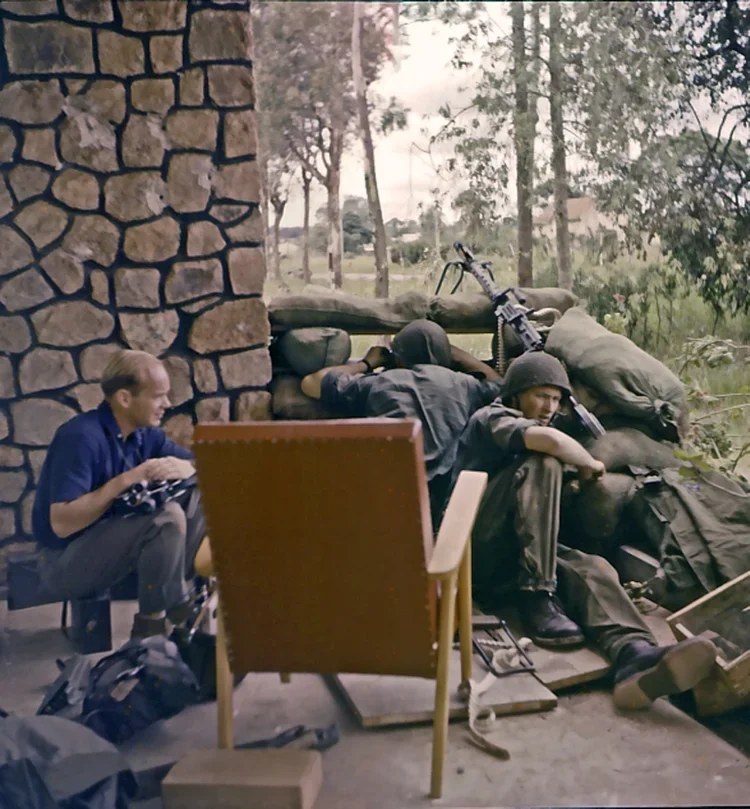
The accompanying photograph shows an American newsreel cameraman who accompanied the Swedish troops during the fighting in December later that same year.
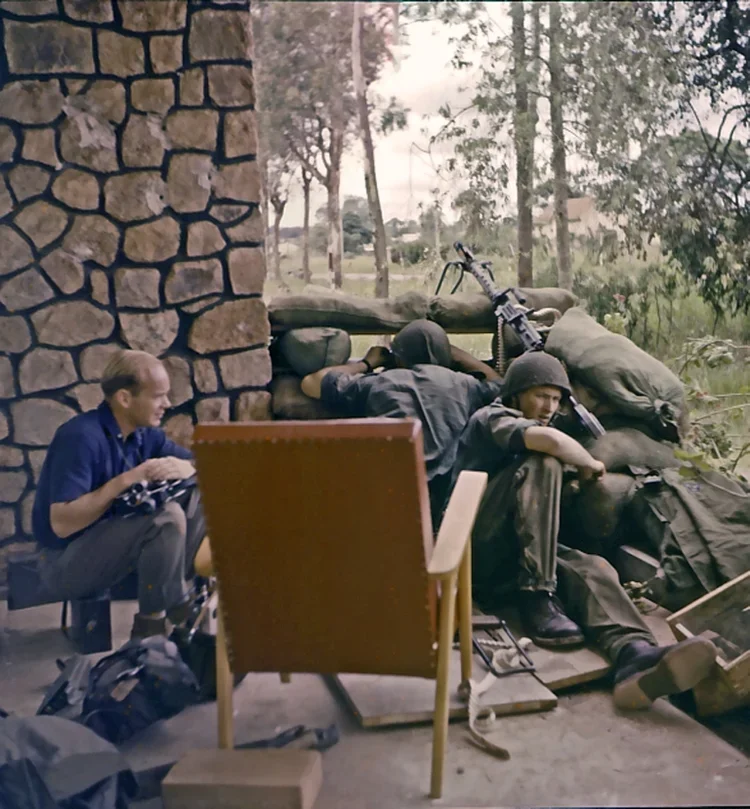
Forward position on Kasenga Road leading into the city. An American newsreel cameraman can be seen on the left. Photograph: T. Dahlén.
Bo L. Andersson writes in his diary:
“14 December 1961
As we make our way through wooded terrain towards our position at the petrol station, we come under fire, but fortunately the shots are too high. Bullets whistle over our heads through the treetops. We have two American newsreel cameramen with us, and one of them puts down his camera and makes the sign of the cross. He then picks up his camera and continues with us.
We are filmed while digging our defensive positions. All the time, bullets are whistling through the air. 4347 strikes a hand grenade with his pickaxe. For some reason, it has ended up in our defensive pit.
The Irish arrive in the afternoon and carry out reconnaissance in an armoured car. They then reverse about 50 metres and open fire over the heads of the two sections positioned on the other side of the road. All hell breaks loose!”
(Read Bo L. Andersson’s full account of the fighting in December 1961 by clicking here)
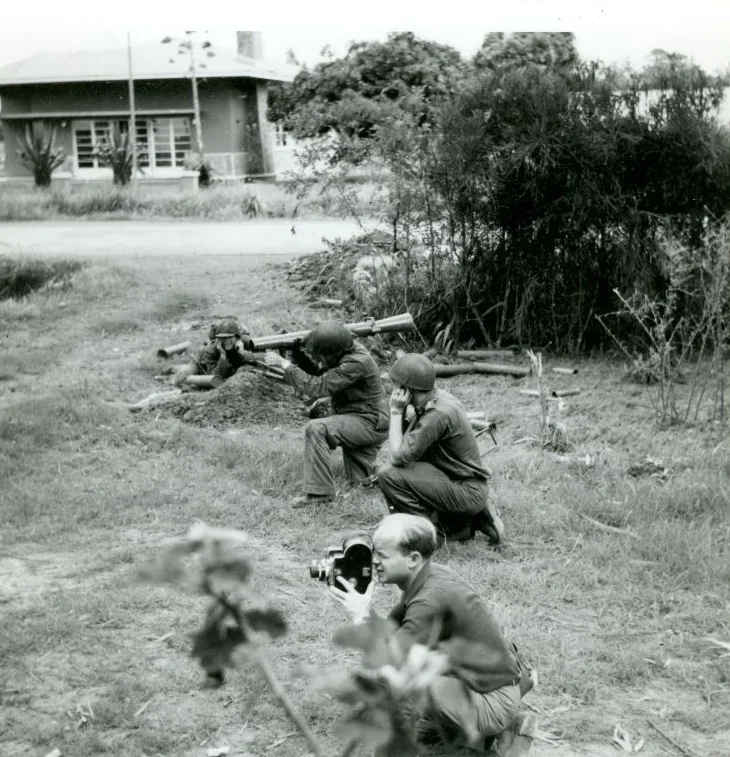
“We have two American newsreel cameramen with us, and one of them puts down his camera and makes the sign of the cross. He then picks up his camera and continues with us.” Photographer: Unknown
Sadly, the American newsreel cameraman pictured was killed in action a few months later.
Relations between the Swedish UN force and journalists were generally good. However, documents held by The Swedish Peace Archives clearly show that, during particularly stressful situations, both sides could develop tunnel vision, with established procedures suddenly being disregarded. Following the fighting in September 1961, the battalion commander was highly critical of Swedish journalists. His main concerns were their naivety and lack of critical scrutiny of sources.
Below is an extract from Battalion Commander Jonas Waern’s monthly report for September 1961.
“Operating from a base in Ndola, Rhodesia, the world's press was fed specially tailored stories aimed at individual national contingents. The Indians were accused of unprecedented brutality. The Irish were accused of surrendering in protest against the brutal conduct of the fighting. The Swedes were subjected to rumours of having been ‘terrified after witnessing the brutality of the other countries’, and it was repeatedly claimed that Swedish soldiers had deserted.
These rumours were often repeated without reservation in the Swedish press, with a demoralising effect on the troops.
This is a serious problem that deserves our full attention so that we may be better prepared for an adversary's psychological warfare in the future. It does little credit to Swedish radio and the press that they should fall so uncritically into such obvious traps. By accepting and repeating these claims, Swedish radio and the press were serving the interests of Katanga, Rhodesia and South Africa.”
UN soldier Lars Frost wrote in a letter to his mother on 8 October 1961:
“If any newspaper reporter comes round, all you need to tell them is that I am safe and well and getting along reasonably well. What I have been through is not something to be shared with the general public. It's bloody awful enough as it is without some newspaper making use of it. The public wouldn't understand anyway, and they're better off not knowing.”
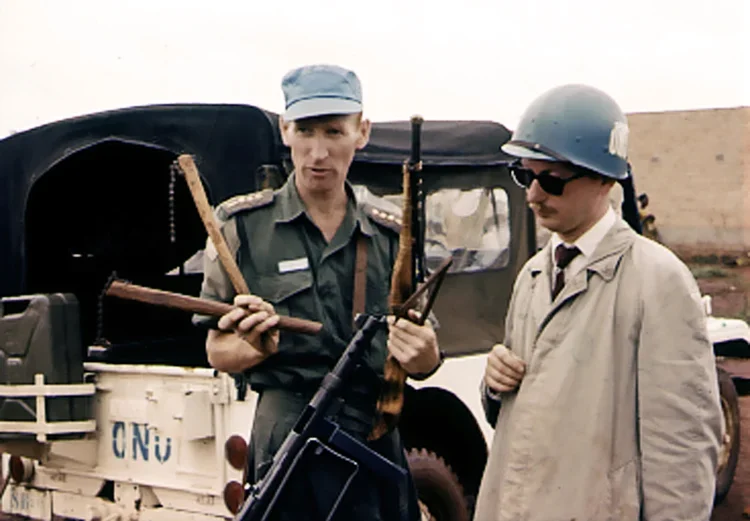
T. Dahlén and Svenska Dagbladet reporter von Friesen following a raid on the refugee camp in Elisabethville in the autumn of 1961.
Quisque iaculis facilisis lacinia. Mauris euismod pellentesque tellus sit amet mollis.