

North American P-51 Mustang
TIEFFLIEGER – THE LOW-FLYING THREAT
During the Second World War, Sweden was officially neutral. However, particularly during the final stages of the war, a number of Swedish relief operations were launched. The best-known of these was undoubtedly the White Buses operation, which is frequently mentioned when discussing Sweden’s humanitarian efforts during the war. Another, less well-known initiative was the Swedish Prisoner-of-War Relief Organisation.
Below are a number of eyewitness accounts from the two operations, all describing the same type of incident. These events took place in April 1945 and involved what the Germans called Tiefflieger, literally meaning “low-flying aircraft”. These Tiefflieger were Allied aircraft flying at low altitude and carrying out so-called “strafing runs”. Their objective was to open fire on German convoys travelling along the roads. However, during the confusion and chaos of the final stages of the war, these pilots often chose to shoot first rather than risk allowing a potential enemy target to escape. As a result, civilian relief workers and their vehicles also came under fire, leaving many civilians seriously injured or dead.
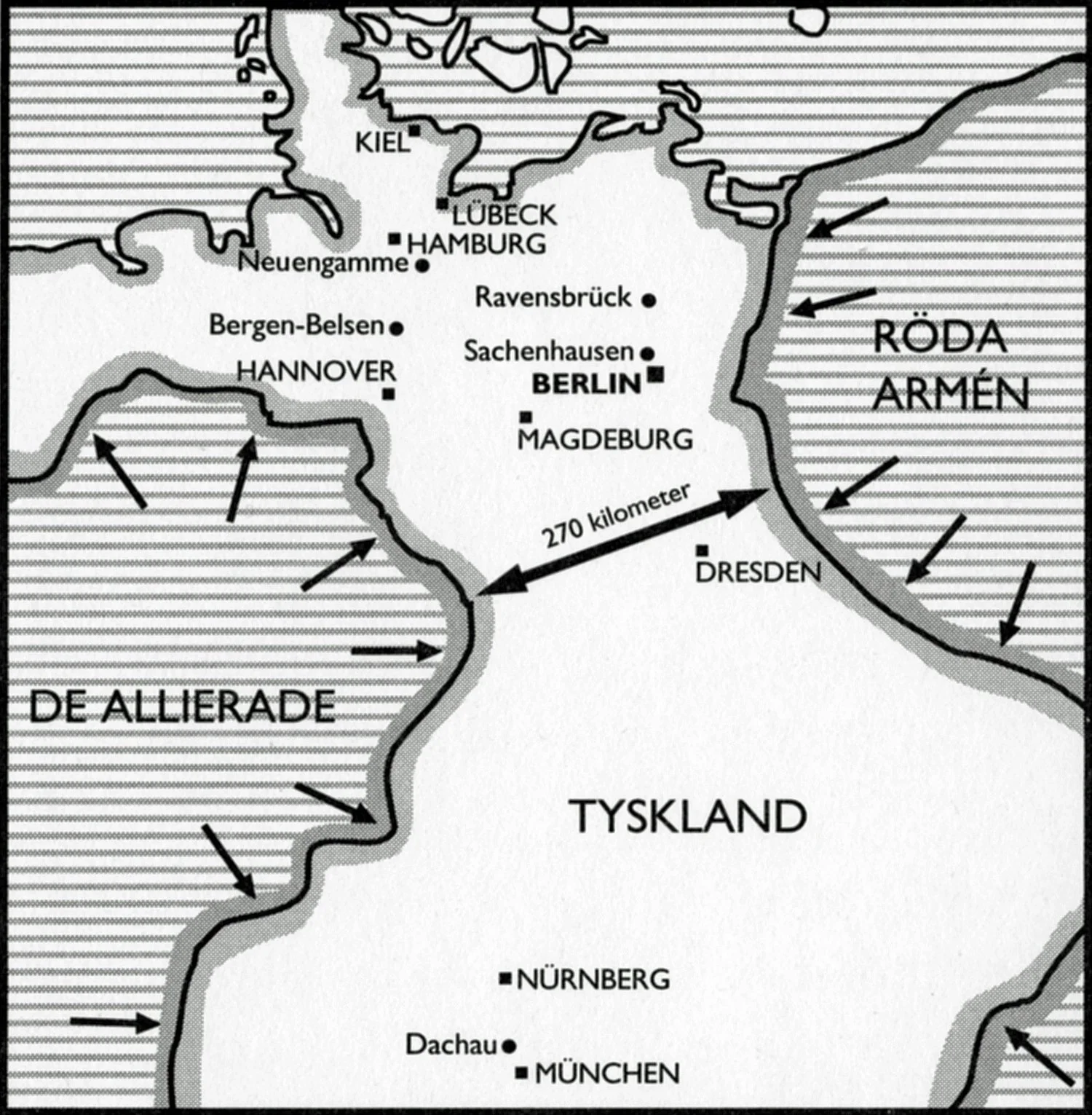
Map taken from Lieutenant Hallquist’s Diary.
This was towards the end of the war, as the Allies advanced from the west and Soviet forces approached from the east. It was therefore a particularly hectic and urgent time for both the White Buses operation and the Swedish Prisoner-of-War Relief Organisation. The White Buses travelled back and forth across Germany between the two advancing fronts, while the staff of the Swedish Prisoner-of-War Relief Organisation were forced to flee in great haste from their headquarters in Sagan (now Żagań in Poland) to Lübeck.
As the German state apparatus and infrastructure increasingly disintegrated, it became more and more difficult for these relief organisations to move around the country.

Photograph from Lieutenant Hallquist’s Diary, showing some of the White Buses stopped for a break along the road.
The first eyewitness account comes from 24-year-old Lieutenant Gösta Hallquist. Gösta was from Ystad and was one of those who travelled to Germany to serve as a driver for the White Buses. He did so for two reasons. First and foremost, it was a matter of duty: “In those days, when a superior officer asked you to do something, you said yes.” However, his decision was also strongly influenced by the romantic difficulties he was experiencing: “Besides, I was engaged to one girl and in love with another, Karin. Somehow, I thought this assignment would also solve my romantic dilemma.”
He left for Germany on 9 March 1945, and some of his characteristically vivid descriptions, which can be found in the book Lieutenant Hallquist’s Diary (written together with Anita Nilsson), read as follows:
Gösta Hallquist, photograph from Lieutenant Hallquist’s Diary.
24 April
I get up at 5 a.m. Wake everyone. The driver of lorry 104 is missing. I take his vehicle, and Erik Ringman drives on his own. Dr Arnoldsson has gone on ahead with one of the German escorts from the Gestapo.
We push on at 90–100 km/h. Time is short. At 9 a.m. I am due to meet some fifteen vehicles from the International Red Cross, which I am to take command of.
The drivers of these Swiss vehicles are former prisoners of war from Canada and the United States who have been released to work for the Red Cross.
With my lorry at the head and Erik Ringman at the wheel, the convoy makes its way towards Ravensbrück.
Thousands of women are lined up along the road outside the camp when we arrive. They are overjoyed, talking and laughing, but many have clearly been standing here for a long time and, unable to remain on their feet, have collapsed. We are told they have spent the entire night outside the camp waiting to be rescued.
A Danish ambulance convoy has arrived before us, but the Swedish buses have not yet returned from their journey to Denmark.
There is a desperate struggle, with pushing and jostling, as the women try to climb aboard.
Everyone wants to leave immediately! We load as many women as we possibly can onto the back of each lorry. They stand tightly packed together, yet they seem to think this is a wonderful way to travel.
As soon as we have finished loading, we set off. It is difficult to say how many women travelled in my convoy of lorries, but there must have been several hundred spread across sixteen vehicles.
We stop from time to time for obvious reasons, as the women need to relieve themselves. We also offer them something to eat and drink. They are immensely grateful.
These women want to give me the whole world and suggest that the youngest and prettiest among them, a Dutch girl, should sit up front between Ringman and me.
We drive west and north-west to make progress as quickly as possible, but when darkness falls, I dare not risk the women's lives by continuing.
Low-flying aircraft appear from time to time and may open fire with a burst of machine-gun fire at anything moving along the road.
Besides, I have never met these drivers before. I therefore have no idea how well they can manage driving in the dark along a road partly blocked by wrecked vehicles, horses, carts, military vehicles and refugees. Nor do I know how they will manage to weave between the bomb craters in the road in the darkness.
We therefore take shelter beside the road for a few hours during the night. I can hear the women walking about, singing, laughing and talking in all their different languages. That they still have the strength after everything they have been through! It is as though all their pent-up vitality is bursting forth, now that they are on their way to freedom after so long in captivity.
From time to time, aircraft fly overhead. Fighting is taking place not far from us, both in the air and on the ground, from the west and from the east.

Photograph from Lieutenant Hallquist’s Diary, showing some of the women who travelled aboard the White Buses.
25 April
We continue at 5 a.m. The journey towards Denmark goes on. We stop occasionally for short breaks.
It is a bright, sunny day, with clear skies, making it easy for pilots flying at high altitude to spot our convoy.
We are an easy target. On a day like this, we could do with Sven Nilsson riding ahead on his motorcycle to warn us of approaching aircraft.
By now, the situation in the air is so chaotic that the usual warnings of impending air attacks no longer work.
But my vehicle is painted white and clearly marked with red crosses on both sides and on the roof. In addition, the Swedish flag has been painted on the radiator as an extra guardian angel.
The backs of the lorries are covered with green tarpaulins to protect the women from the cold and draughts during the journey. The sky is completely blue and clear.
After that, all I remember is that we stopped around midday to give the women something to eat and drink.
I also remember that we got back into the vehicles to set off again after a stop, probably after that meal break.
Then I have no idea what happened. It is as though I suddenly regain consciousness and see Erik Ringman slumped over the steering wheel. I think he has dozed off from exhaustion, so I give him a nudge and say:
“Ringman, come on, let's get going!”
He does not move. He just remains slumped over the steering wheel, showing no sign of life. Something terrible must have happened, I think. I look down at my legs, drenched in my own blood. I grab the door handle, open the door, take a few steps out onto the road and collapse.
What Gösta had experienced was an attack by a Tiefflieger, a low-flying Allied aircraft, which had riddled his vehicle with gunfire. He survived by the narrowest of margins, having sustained severe injuries, particularly to his head.
Gösta later recalled that he owed his survival entirely to the Swedish doctor Hans Arnoldsson, who persuaded a German neurosurgeon named Zehrer to operate on him.
Dr Hans Arnoldsson also wrote about his experiences with the White Buses and his time in war-torn Europe in his book Natt och Dimma (Night and Fog).
He described the attack on Gösta’s convoy as follows:
Hans Arnoldsson, foto: http://charlottefreme.blogspot.com/p/om-mig.html
“On the morning of the 24th, Mussy Junior, Franz Göring and I set off once again for Ravensbrück, accompanied by Lieutenant Hallquist, who was later to take command of the twelve Red Cross lorries that had also been dispatched towards the camp.
When we returned to Ravensbrück (after certain complications and conflicting orders from the Germans), we discovered that Suhren (the camp commandant) had taken our words quite literally. Eight hundred women, mostly French, Dutch and Belgian, were lined up along the road and greeted our arrival with tremendous cheers. Their joy at having escaped from the camp was unmistakable. There was such excitement and commotion, such laughter and conversation, that it is impossible to describe.
Hallquist's convoy then left Ravensbrück on a journey that, for many, would prove to be their last. The convoy consisted of a Swedish lorry, with Ringman at the wheel and Hallquist beside him, together with vehicles belonging to the International Red Cross, driven by Canadians. These drivers were former prisoners of war whom de Blonay had managed to secure the release of from German camps so that they could work for the Red Cross.
The roads were dangerous. The German lines had virtually collapsed, and at any moment we might encounter Allied armoured spearheads advancing with lightning speed from the west. At night, the slightest glimmer of light was enough to attract fire from the ever-watchful Tiefflieger, the low-flying aircraft that continuously patrolled the main roads. Hallquist did not wish to expose his passengers to the dangers of travelling at night under these conditions and therefore halted in a forest. On my return journey, I visited them there, and the mood among the women was still as cheerful as could possibly be imagined.
The following day, disaster struck. Because of congestion on the roads, the convoy had split into two groups, one travelling via Wismar and the other via Schwerin. At approximately 2 p.m., the latter group came under fire about fifteen kilometres west of Schwerin. The driver Ringman, a Canadian driver and five women were killed instantly. Sixteen people, including Lieutenant Hallquist, were seriously wounded. At the same time, the other group came under fire near Wismar, where four people were killed and ten sustained serious injuries.
What we had so often feared, but which Providence had thus far spared us, had finally happened. It seemed doubly bitter that this should befall our comrades just as they were about to complete their mission, and those under our protection just as they stood on the threshold of freedom. It was a day of mourning for the detachment.
As soon as I learned what had happened, I travelled with Paul de Blonay to the scene of the attack, where we administered first aid to the wounded and transported them to hospital in Schwerin. During the attack, the women had shown remarkable self-control and presence of mind. Now they sat silently in the forest, contemplating the fate that had robbed their companions of their lives at the very moment when life had been given back to them. Lieutenant Hallquist lay in a ditch, almost completely naked, having been robbed by passing refugees who believed him to be dead. His diary was found beside him.”
Another account of this incident comes from Maj-Lis Lüning/von Eickstedt-Peterswaldt. She was also known as the “Angel of Lübeck” and worked for the Church of Sweden in Lübeck, where she collaborated with Hans Arnoldsson.
Her own life story is fascinating, as the direction her life had taken before the war suggested a very different future. However, that is a story in its own right and can be explored in the exhibition Möten med Folke Bernadotte (Encounters with Folke Bernadotte) on the Fredshistoria.se website.
In her book Bro över mörka vatten (Bridge over Dark Waters), she writes:
Maj-Lis Lüning, foto: Svensk film
“The front lines were now very close. The only question was: would the Russians or the British win the race to capture the city? Low-flying aircraft were active every day, almost without interruption. One day, we were to experience their devastating effects first-hand.
The officers, Dr Arnoldsson, Pastor Hellquist, Monsieur de Blonay and I were all sitting in the office holding a meeting when the door was suddenly flung open. An American soldier, a driver with the International Red Cross, staggered in and reported that Lieutenant Hallquist’s convoy from Ravensbrück had come under fire just outside Schwerin. Low-flying aircraft had launched a surprise attack, killing several people. The Swedish driver had been shot dead and the officer seriously wounded.
The driver himself was wounded, and his eyes were filled with anger. How could anyone attack Red Cross vehicles?! But it was not entirely surprising that the Red Cross markings were no longer being respected. The Germans had also begun painting their vehicles white and displaying red crosses on them. It was even said that they were using these markings to transport troops. Yes, it was a terrible blow to suffer such a loss just as our mission in Germany was nearing completion.
That day, moreover, was a truly ill-fated one. At the very same hour, another convoy operating under the Danish Red Cross was attacked and fired upon. And as if that were not enough – it was as though all the forces of evil had conspired against us! – yet another convoy came under fire near Wismar. In a single day, the transport units had suffered approximately forty-five casualties: fifteen dead and thirty-five to forty wounded.
Attacks on the convoys continued over the following couple of days. It was becoming increasingly clear that only a very short time remained before the whole war would be over. That evening, the dead and wounded were brought to Lübeck. The wounded were accommodated in the church, where Dr Arnoldsson cared for them. Yes, those final days were a terrible strain on the nerves!
One Swede dead… Who? Lieutenant Hallquist seriously wounded. I knew him very well. Whenever he had a few hours to spare between transports, he had often helped us with our work. And above all, he came from the same part of Sweden as I did – he was a Scanian! One fortunate circumstance amid the tragedy was that the attack had taken place near Schwerin, where several distinguished brain specialists had been evacuated. Despite everything, we can be thankful that there were not even greater losses during this critical period, for everyone within Germany’s borders was in constant danger of losing their life.”
The final eyewitness account comes from Gösta Lundin, a teacher at a co-educational secondary school, who in the summer of 1944 was asked whether he would accept the position of director of the YMCA’s prisoner-of-war relief operations in Germany.
His predecessor had been expelled from the country after spending several weeks in a Gestapo prison, and the final battle for Berlin was approaching. Despite the risks, Gösta, then 46 years old, travelled from Osby to Berlin. His assignment as Director of the YMCA’s Prisoner-of-War Relief Organisation was vaguely defined. Essentially, he was responsible for supervising a group of field secretaries working in prisoner-of-war camps throughout Germany, where hundreds of thousands of Allied prisoners of war were being held. Enlisted prisoners were required to work, whereas officers, under the Geneva Convention, could not be compelled to do so.
The thousands of imprisoned officers were at particular risk of developing what was known as “barbed-wire psychosis” – essentially the boredom, frustration and psychological distress associated with prolonged confinement in a prison camp. To counteract this, activities of every kind were needed. These might include obtaining films from the United States to screen for the prisoners, but also providing them with typewriters, saxophones, boxing gloves, footballs and similar recreational equipment.
The work of the Prisoner-of-War Relief Organisation was to change dramatically in 1945, when it was transformed into an improvised rescue organisation during the final stages of the war. After the war, a further phase began as hundreds of thousands of German prisoners of war required assistance. A relief initiative known as Hjälp Krigets Offer (HKO – Aid to the Victims of War) was established and continued until 1947.
Gösta Lundin never wrote a book about his experiences. However, Fredsarkivet has been entrusted with the responsibility of preserving Lundin’s archival material, which includes a number of letters describing, among other things, these events. The letters reproduced below were written in English and were probably copies intended for the organisation’s headquarters in Geneva, addressed to Lundin’s superior, Hugo Cedergren, on 26 April 1945:
Gösta Lundin, foto från Fredsarkivet
“To-day I was thinking of going to Friedrichsruh to look at the premises. Then came the sad information, in addition to the tragic information some days ago, that more people had been exposed to low flyers. This time it was two Swedes: one driver was killed, and lieutenant Hallquist was badly hurt. Four women from the concentration camp in Ravensbrück were killed. Here it is, in connection with this great action of rescue, that the Swedes also make their contribution. Lt. Hallquist [Gösta must have confused some of the people involved here; perhaps he was referring to Pastor Hellquist] and I went to-day to the Swedish church where the four unfortunate women were lying under a tarpulin. It was a gruesome sight. One had lost her head, one was badly damaged in the face. As a matter of fact, the face seems especially exposed. The dead Swedish driver was taken to the IRC [International Red Cross, editor’s note]. I called M. de Blonay to express our condolence, as it after all mainly concerned an IRC transport. We gave up the journey to Friedrichsruh – flyers are always busy there: they have even shot into the bedroom of the castle.
It is difficult to make any decisions in the present situation. I have to stay now till the drivers and Hammarskjöld arrive. Maybe it will already be too late to get out from here. In such a case we have nothing to do but remain and hope for the best. As there are som many PWs in these surroundings, as well as some many sick in Lübeck’s hospitals, everything speaks in favour of trying to get Lübeck declared as a hospital city or an open city. Konsyanz is said to have been declared as such a town at the last moment. If you or Count Bernadotte would be able to do anything in this matter, please do so.”
Den 30/4 -1945 Skriver Lundin vidare till Hugo Cedergren:
“...yesterday afternoon Fredrichsruh was bombed. Evidently the Swedish and Swiss colours and badges do not help. War is ruthless. The young striplings behind the wheel of those planes pay no consideration. They stand for a kind of regardlessness that will be remembered to their disadvantage in the future. To attack openly IRC cars, to kill dozens of poor refugees, Swedish and American drivers, to fire at the cars of the Legation, wounding thier passengers – such things should not happen, if these men were not adventurers who consider war a sport and an opportunity of showing their ability of hitting their mark.
After all, I must say that the future psychical effect of the allied air raids will certainly not be what was intended. The gruesome result will instead be used against those who caused this desolation. However antinazi I am, I cannot understand the lack of psychology which the English and American show just now, especially being considered good psychologists. As a matter of fact, these bombings are not decisive to the war. Quite another thing is the military and communication technical bombing. When, however, things happen such as a pilot chasing an old man of 80 around a barn when he tries to get safety, and killing him, well, is it not time that common sense and conscience protest? The lack of psychology ruling on the side of the Allies is worth a Nobel prize. I mean considered as a lack. The whole is now finished, the victory is won, but still here and there, perhaps an American negro is laughing behind his wheel at the decay of the white race. By Jove!
What happened at Friedrichsruh is shameless. Of course, the allied authorities knew that Swedes were there. In such a case, it certainly depends on a special order! When it is a question of low flying, it depends mostly on the individual pilots.”
Below is a selection of letters sent by Gösta Lundin in April 1945, during the period in which the events described above took place. These letters offer further insight into Gösta’s everyday life at the time:


So what eventually became of Gösta Hallquist? As might be expected, he fortunately survived the attack, but it took him many years to recover to any reasonable degree, and he continued to suffer from the effects of his injuries for the rest of his life.
He writes:
“1 September 1945
Will I ever be able to walk again? Does my sense of balance still work? My right side is paralysed. What will happen to it in the future?
I have been lying here in Malmö Hospital for a month, longing to get out into the fresh air. My friends from the orienteering club were wondering whether we would soon be going out running again.
Before my journey to Germany, I was the regimental champion in cross-country military competition and a fairly decent orienteer. Perhaps that is why I managed to survive? You need a strong heart and good lungs to withstand the kind of injuries I suffered.
Dr Arnoldsson, who was with us in Germany, came to visit me on my very first day in Malmö. He was the one who was so persistent and persuaded Dr Zehrer to operate on me, even though Dr Zehrer believed I was a hopeless case.
Mother was delighted today when she found her boy sitting on the edge of the bed with his legs dangling over the side. I sometimes have enough strength to listen to the radio, but the severe headaches keep returning. I have also developed problems with my stomach.”
Image from Lieutenant Hallquist’s Diary. “This X-ray from 1998 clearly shows the bullet lodged in the back of the head. In addition, two pieces of shrapnel remain embedded in the left temple.”
Quisque iaculis facilisis lacinia. Mauris euismod pellentesque tellus sit amet mollis.