
THE SWEDISH FOREIGN MINISTRY’S ENVOY TO BERLIN IN THE SPRING OF 1945

One of the more extensive personal archives held by Fredsarkivet is that of Arne Uggla. His archive contains letters and photographs from all the peacekeeping and humanitarian missions in which he served. Among other assignments, he served with the Saar Battalion in 1935 and the United Nations supervisory commission in Korea in 1953. He also served as a UN observer in Jordan, Syria, Lebanon and Gaza, and in 1960 he became a liaison officer at the UN Headquarters in Leopoldville (now Kinshasa) in the Congo.
During the final months of the Second World War, he flew between Stockholm and Berlin once a week on missions for the Swedish Ministry for Foreign Affairs. Below are his written recollections of one of these journeys, undertaken in April 1945.


Page 1
Berlin, April 1945
The emergency landing outside Stralsund went off perfectly. After an hour's wait, we were able to take off for Berlin once more. The trusty old Ju 52 had passed yet another exacting test with flying colours. Over the spring-green fields, in brilliant sunshine, she crept across the North German plain at a height of scarcely a hundred metres. Here and there, a solitary figure could be seen going about his business near a farmhouse. On the main roads there was almost complete stillness. Not a motorcar or cart in sight. In the smaller villages, an occasional bicycle, but otherwise not a movement.
A tremendous Allied air raid had just come to an end, and that the Reich capital had been its target was evident from the dense bank of cloud directly ahead. From the dazzling sunlight, the aircraft plunged into the curtains of smoke and landed in semi-darkness among fresh bomb craters at Tempelhof. The great terminal building could not be approached, and passport formalities were therefore conducted out on the airfield.
The usually self-assured little Gestapo chief appeared nervous. His authority had evidently ebbed away, and nobody paid him the slightest attention as he stood somewhat apart, watching the clearance of the mailbags and luggage.
The Heil Hitler salute was no longer in use, at least not in the streets.
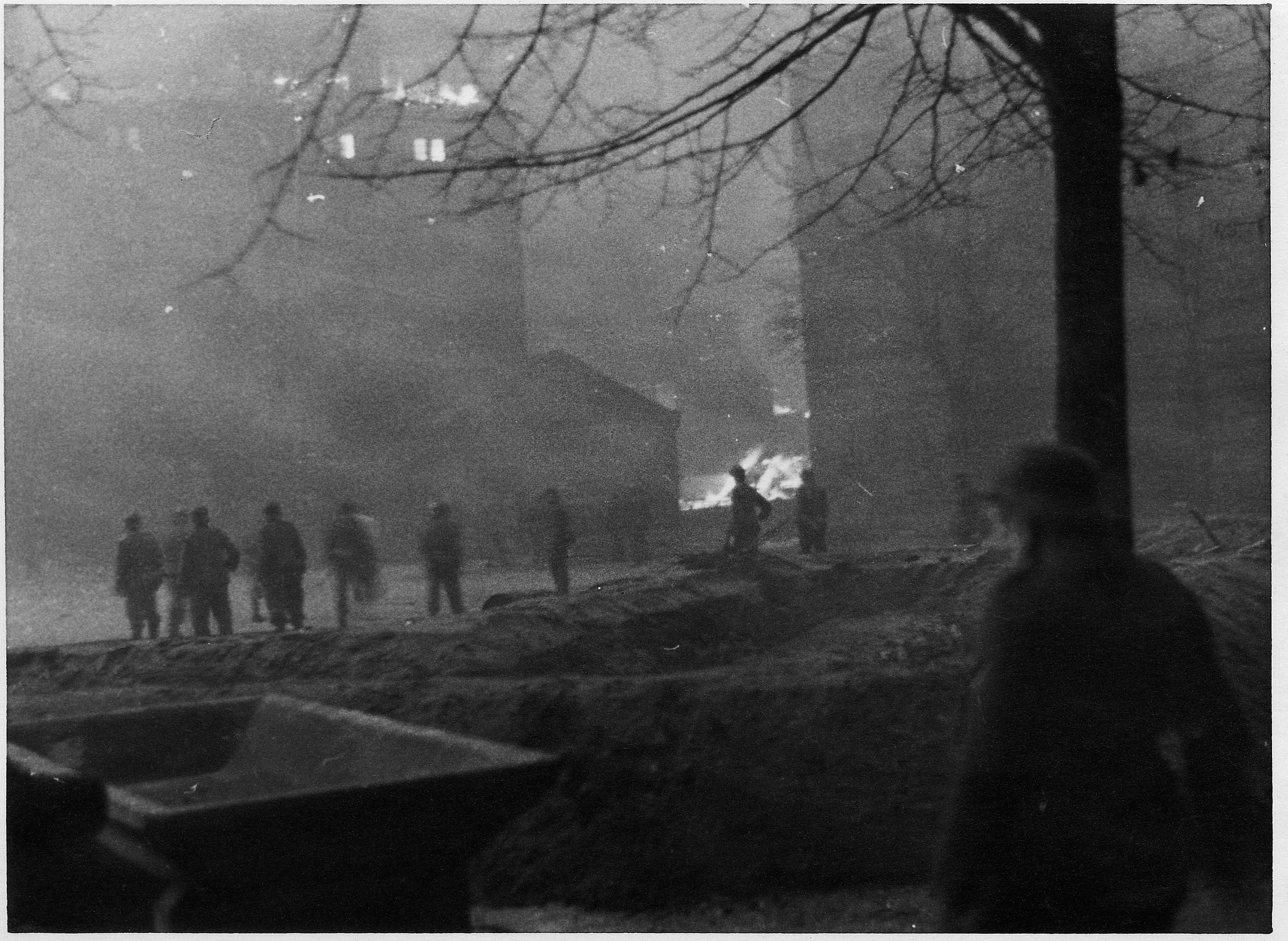
Fires were still burning fiercely in large parts of the city as our car made its way towards the Swedish Legation by unfamiliar detours. Rescue workers in long leather coats hurried about, clearing passages to reach those trapped in cellars and air-raid shelters beneath the debris of collapsed buildings. Along the fire-ravaged streets, whirlwinds swept through the ruins, stirring up clouds of dust so thick that one could scarcely see one's hand before one's face.
It was impossible to reach Rauchstrasse by the usual bridge. The Volkssturm had dragged a tramcar filled with stones across it as a barricade.
By the afternoon, the fires had been brought under control, and life began to resume something approaching its normal rhythm, while the city awaited the next great attack.
Page 2
Poor beer mixed with cheap champagne was the luxury drink in the cellar restaurant of the Eden Hotel, reserved for guests who could pay with cigarettes of foreign manufacture. Immaculate uniforms from the Axis countries mingled with the most extraordinary garments worn by the city's own emaciated inhabitants. Very little was said about the war, and then usually in the form of some anecdote. “Have you heard that they can no longer use the Panzerfaust on the Eastern Front? The backblast would strike the Western Front in the back!”
My room at the Westpension on Kurfürstendamm cost the equivalent of seven Swedish öre. It measured approximately ten by six metres, had unbroken windows and clean linen. The kindly landlady gave me sound advice on how to behave during air-raid warnings. At the preliminary warning, one was to get up, dress, pack one's valuables and extinguish the light. At the air-raid alarm, one was to hurry down to the lower cellar. Under no circumstances should one go out into the street to look about, as one might then be fired upon by the wardens. If already outdoors, one should seek the nearest shelter or cellar. As a rule, one could reckon upon a major air raid in the morning, between ten and eleven, and another in the middle of the night. She did not consider there to be any danger from thieves or robbers. At the petrol station, payment was accepted only in coffee: ten grammes of coffee beans for each litre of petrol. The borrowed and somewhat battered DKW was filled up for two hundred grammes of coffee and set off, wheezing and rattling, on a sightseeing tour. At the siegessenk [sic.] on the Ost–Vest Axis, the continuation of Unter den Linden, it was stopped by the police, as work was under way to convert the broad avenue through the centre of the city into an emergency airfield. Near the Olympic Stadium, the DKW came to a halt with engine trouble. There was no motor workshop to be found in the vicinity. The street was almost deserted, and nobody took the slightest notice of so trifling a matter as a broken-down motorcar. Suddenly, a soldier appeared and offered his services. He explained that he had once owned a similar car himself and knew all its little tricks. After receiving a cigarette, he became talkative. He had been a stationer on Unter den Linden. Then his premises were bombed. He managed to save his stock and opened another shop, only to lose, on the very same day, his business, his home and half his stock. He moved to new premises and lodged with relatives. One evening, when he returned home, he found the house razed to the ground and his relatives dead. He then moved into his makeshift shop and lived there until that, too, was destroyed by bombing, whereupon he volunteered for military service. He was over fifty-five years of age. When the Oder–Neisse line began to collapse, he thought it best to make himself scarce. Above all, he wished to reach the British, whom the Berliners still believed would be the first to enter and capture the city. He intended to await the British at his brother-in-law's home in the western suburbs and was in no particular hurry. He was therefore quite willing to help me with the car. I cautiously asked whether it was not rather dangerous to desert so openly, but he did not think so. Berlin was at that time swarming with deserters in uniform. The police estimated their number at between thirty and fifty thousand, and since they lived among the ruins and kept comparatively quiet, they were difficult to apprehend. There were, moreover, enormous concentrations of troops both within and outside the city, and it was impossible to check every soldier walking alone. My acquaintance intended to say that he was on his way from Colonel So-and-so to General...
Page 3
...so-and-so, carrying the envelope he had in his pocket. Thus far, however, nobody had challenged him. With the aid of his only civilian possession, a large adjustable spanner which he carried in his pocket, he succeeded, after two hours' work, in coaxing the car into life, coughing and spluttering. As we parted, he declared that if only he were still alive when the war ended, he would have won, for he had, in the most literal sense, absolutely nothing left to lose.
The following day, the air traffic controller at Tempelhof informed me that no aircraft for Sweden was contemplated in the immediate future. A packet of cigarettes, however, caused him to consider whether some solution might be found. Perhaps, with a little cognac, the Gestapo chief could be persuaded to allow the lone Swede to depart aboard an aircraft bound for Copenhagen. Half a litre of two-star cognac, together with an additional packet of Chesterfields, had the desired effect. A soldier was ordered to disembark from an Army aircraft bound for Oslo, and the aircraft was instructed to make a brief stop at Kastrup. There, four packets of cigarettes persuaded the Danes to put a small Fokker into service for a special flight to Malmö.
Quisque iaculis facilisis lacinia. Mauris euismod pellentesque tellus sit amet mollis.